
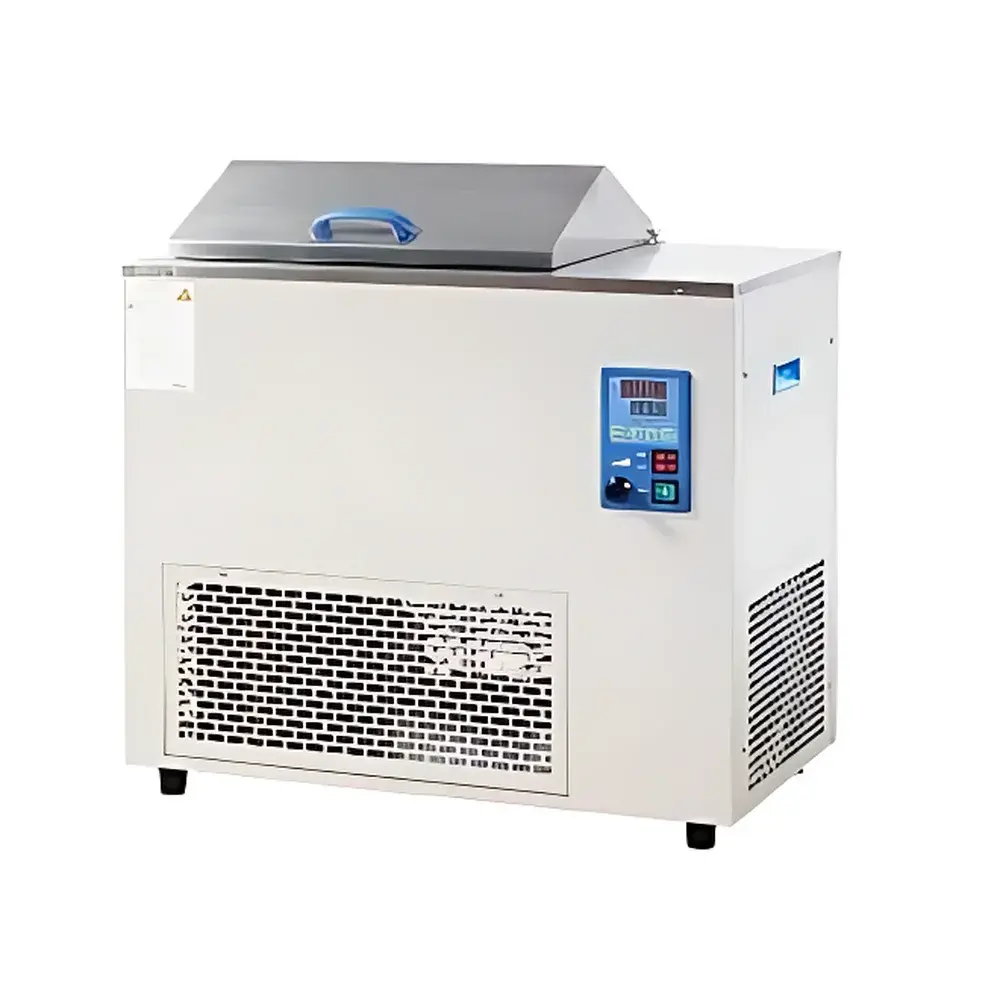
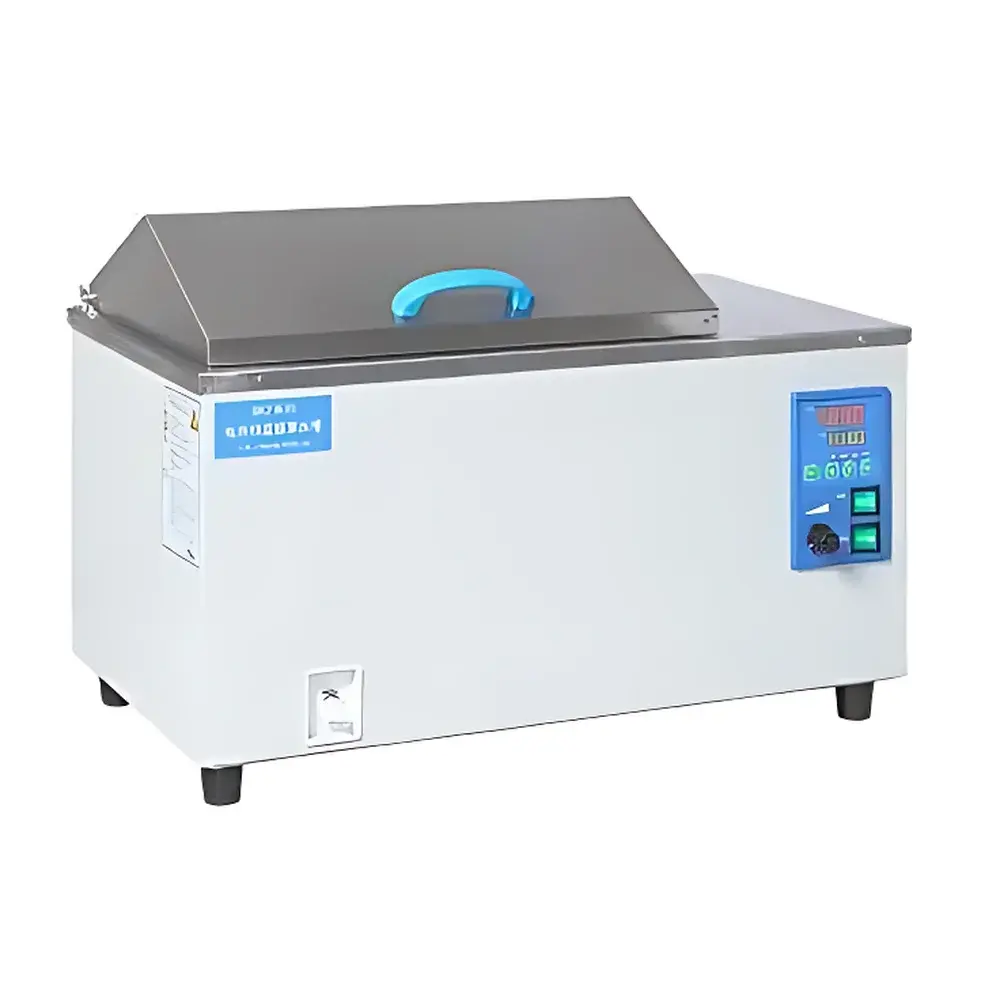
Yi Heng DKZ Series Constant-Temperature Orbital Shaking Water Bath
| Brand | Yi Heng (Shanghai Yi Heng) |
|---|---|
| Origin | Shanghai, China |
| Manufacturer Type | Authorized Distributor |
| Product Category | Domestic |
| Model | DKZ Series |
| Instrument Type | Constant-Temperature Shaking Bath |
| Circulation Mode | Internal & External Circulation |
| Temperature Control | Heating-Only |
| Bath Capacity | Model-Dependent (e.g., DKZ-1: 34 L |
| DKZ-2 | 48 L |
| DKZ-3 | 33 L) |
| Temperature Range | RT+5°C to 99°C (DKZ-1/DKZ-2/DKZ-3) / 10°C to 99°C (DKZ-2B/DKZ-3B) |
| Temperature Stability | ±0.3°C at setpoint (typical, under controlled ambient conditions) |
| Temperature Resolution | 0.1°C |
| Uniformity | ±1.0°C across bath volume (empty, 20°C ambient) |
| Oscillation Frequency | 30–180 rpm (infinitely variable) |
| Amplitude | 30 mm or 40 mm (user-selectable per order) |
| Power Supply | AC 220 V, 50 Hz |
| Input Power | 1250 W (DKZ-1), 1650 W (DKZ-2/DKZ-2B), 1500 W (DKZ-3/DKZ-3B) |
| Interior Dimensions (W×D×H, mm) | 438×310×250 (DKZ-1), 618×310×250 (DKZ-2), 440×300×250 (DKZ-3) |
| Exterior Dimensions (W×D×H, mm) | 643×350×353 (DKZ-1), 823×350×355 (DKZ-2), 710×410×710 (DKZ-3) |
| Construction | Stainless steel inner tank (SUS304 standard) |
Overview
The Yi Heng DKZ Series Constant-Temperature Orbital Shaking Water Bath integrates precise temperature regulation with controllable orbital agitation in a single platform engineered for reproducible incubation and reaction kinetics studies. Unlike static water baths or standalone shakers, this system operates on the principle of forced convection heating combined with low-shear orbital motion—ensuring uniform thermal distribution while maintaining gentle, consistent mixing across liquid-phase samples. Designed for applications requiring simultaneous thermal stability and mechanical homogenization—such as microbial culture expansion, enzyme kinetic assays, hybridization protocols, and small-volume biochemical reactions—the DKZ series delivers robust performance within standard laboratory environments. Its PID-controlled heating architecture, coupled with real-time sensor feedback and programmable ramp profiles, enables stable operation across its full working range (RT+5°C to 99°C), with typical temperature stability of ±0.3°C at setpoint under calibrated ambient conditions (20°C, 50% RH, empty bath).
Key Features
- Stainless steel (SUS304) interior tank and lid—resistant to corrosion from aqueous buffers, saline solutions, and mild reagents; facilitates rapid decontamination and long-term durability.
- Microprocessor-based PID temperature controller with 0.1°C resolution, built-in timer, and auto-restart function after power interruption.
- Comprehensive safety system including over-temperature audiovisual alarm, heater open-circuit detection, and sensor fault diagnostics—ensuring sample integrity during unattended operation.
- Brushless AC gearmotor with infinite speed adjustment (30–180 rpm), delivering linear torque response and acoustic noise <55 dB(A) at maximum load.
- Quick-release oscillation platform—tool-free disassembly allows full access to bath interior for cleaning, calibration verification, or accessory replacement.
- Optional multi-segment programmable controller supporting up to 7 programs × 63 steps, with individual step duration (1 min–99 h 59 min) and ramp rate configuration—enabling complex thermal-agitation profiles without external scripting.
- Soft-start oscillation initiation prevents splashing during startup; configurable amplitude (30 mm or 40 mm) accommodates varying vessel heights and viscosity requirements.
Sample Compatibility & Compliance
The DKZ series accommodates standard laboratory vessels—including Erlenmeyer flasks (50–2000 mL), test tubes, microcentrifuge tube racks, and custom trays—within its designated bath volume and height constraints. All models meet CE marking requirements for electrical safety (IEC 61010-1) and electromagnetic compatibility (EN 61326-1). While not certified to ISO/IEC 17025 or GLP-specific validation standards out-of-the-box, the system supports user-defined IQ/OQ documentation through its traceable temperature logging (via optional RS485 interface) and programmable event history. For regulated environments, the instrument’s alarm logs, setpoint history, and self-diagnostic records may be integrated into laboratory quality management systems compliant with FDA 21 CFR Part 11 when paired with validated third-party data acquisition software.
Software & Data Management
The base unit operates via front-panel keypad and LCD display, providing real-time monitoring of current temperature, setpoint, elapsed time, and oscillation speed. Optional RS485 serial communication enables connection to PC-based control platforms for remote parameter setting, continuous data logging (temperature, speed, alarm status), and export to CSV or Excel formats. When equipped with the multi-segment programmer, users can store and recall complete experimental protocols—including temperature ramps, dwell periods, and synchronized agitation changes—reducing manual intervention and operator-induced variability. Audit trail functionality is available through external software that timestamps all parameter modifications and alarm events, aligning with GLP/GMP documentation expectations for method transfer and equipment qualification.
Applications
This shaking water bath serves core functions in academic research laboratories, pharmaceutical QC labs, and biotechnology process development units. Typical use cases include: bacterial and yeast culture maintenance under defined thermal-agitation conditions; optimization of DNA hybridization stringency via controlled ramp-and-hold temperature profiles; enzymatic reaction monitoring where both thermal activation and substrate mixing influence initial velocity; solubility testing of APIs in aqueous media; and accelerated stability studies of liquid formulations. Its ability to sustain tight thermal uniformity (±1.0°C across the bath volume) while applying repeatable orbital motion makes it particularly suitable for comparative studies requiring inter-batch consistency—such as dose-response assays or kinetic modeling across multiple replicates.
FAQ
What is the difference between DKZ-B and standard DKZ models?
The “B” suffix denotes full stainless steel construction (tank + outer casing), enhancing corrosion resistance and cleanroom compatibility—ideal for high-humidity or saline-rich environments.
Can the DKZ bath operate below ambient temperature?
No. The DKZ series is a heating-only system; refrigerated shaking baths require separate compressor-based cooling modules not included in this product line.
Is external circulation compatible with all models?
Yes—integrated pump and dual-port fittings support closed-loop external circulation to auxiliary jackets or secondary reactors, provided flow resistance remains within 0.1 MPa pressure drop limits.
How is temperature uniformity verified during qualification?
Per ISO 17025 guidance, users should perform a 9-point mapping (3×3 grid at mid-depth) using calibrated PT100 probes; deviation ≤ ±1.0°C confirms compliance with published specifications.
Does the system support GLP-compliant electronic records?
The hardware provides timestamped event logs; full 21 CFR Part 11 compliance requires integration with validated third-party software that enforces user authentication, audit trails, and electronic signatures.



