
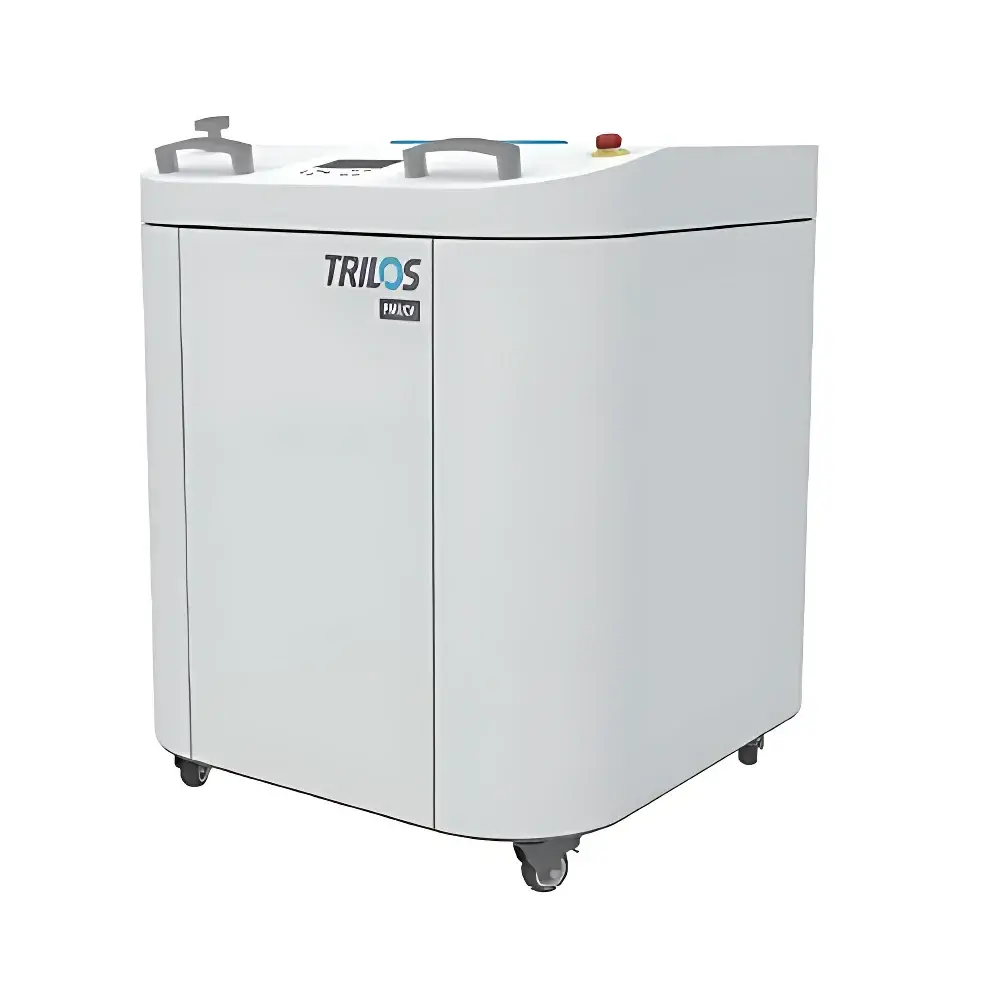
TRILOS PM1kv Planetary Vacuum Mixer & Deaerator
| Brand | TRILOS |
|---|---|
| Model | PM1kv |
| Type | Planetary Vacuum Mixer & Deaerator |
| Origin | USA |
| Max Capacity | 2 × 1100 mL (dual-cup) |
| Max Orbital Speed | 750 rpm |
| Max Rotational Speed | 750 rpm |
| Power Supply | 220 V, 3 kW |
| Dimensions | 760 × 950 × 760 mm |
| Weight | 250 kg |
Overview
The TRILOS PM1kv is a benchtop-to-pilot-scale planetary vacuum mixer and deaerator engineered for high-precision, reproducible mixing and sub-micron bubble elimination in viscous and ultra-viscous materials. It operates on the principle of dual-axis planetary motion—simultaneous orbital revolution and rotational spin—generating controlled, high-shear centrifugal forces that induce intense internal material turnover without mechanical blades or impellers. This non-contact, shear-controlled kinematics enables homogeneous dispersion, emulsification, and degassing across viscosities ranging from low-viscosity solvents to >1,000,000 mPa·s pastes and gels. Integrated vacuum capability (typically down to ≤10 mbar, depending on system configuration and pump selection) facilitates rapid removal of entrapped air and sub-micron voids—critical for applications demanding optical clarity, electrical continuity, mechanical integrity, or accelerated curing kinetics. Designed for sustained operation in QC labs, R&D pilot lines, and small-batch manufacturing environments, the PM1kv bridges the gap between laboratory-scale mixers and full production equipment while maintaining traceable process parameters and repeatable outcomes.
Key Features
- True dual-axis planetary motion with independent, digitally controlled orbital (0–750 rpm) and rotational (0–750 rpm) speed regulation—enabling precise shear profile tuning per material rheology.
- Dual-cup configuration (2 × 1100 mL capacity) supports parallel processing or comparative formulation testing under identical mechanical and vacuum conditions.
- Integrated vacuum interface compatible with standard lab-grade vacuum pumps; vacuum level monitoring and interlock logic prevent operation outside safe pressure thresholds.
- Robust cast-iron frame and precision-machined stainless-steel mixing arms ensure long-term dimensional stability and minimal runout—even under continuous high-torque load at maximum speed.
- IP54-rated control panel with intuitive touchscreen HMI, programmable multi-step recipes, real-time torque feedback, and event-logged operational history (start/stop time, speed setpoints, vacuum status).
- CE-compliant safety architecture including emergency stop, lid interlock, over-temperature protection, and motor overload detection—fully documented per EN 61000-6-2/-6-4 and EN ISO 12100.
Sample Compatibility & Compliance
The PM1kv accommodates a broad spectrum of non-corrosive and mildly corrosive materials—including polymer resins, conductive pastes (e.g., Ag, Cu, Ni-filled epoxies), battery electrode slurries (NMC, LFP, Si-anode), pharmaceutical ointments, cosmetic emulsions, solder pastes, thermal interface materials, and structural adhesives. All wetted parts are constructed from electropolished 316L stainless steel or PTFE-coated components to minimize leaching and facilitate cleaning validation. The system supports GLP/GMP-aligned workflows: audit trails, user access levels (admin/operator), electronic signature-capable recipe execution, and optional 21 CFR Part 11 compliance via TRILOS LabSuite™ software integration. Meets ASTM D1875 (viscosity measurement preparation), ISO 2812-3 (bubble content in coatings), and USP particulate matter requirements when used with validated protocols.
Software & Data Management
TRILOS LabSuite™ (v4.2+) provides full remote supervision, data export (CSV, PDF, XML), and automated report generation—including torque vs. time curves, vacuum decay profiles, and cycle completion certificates. All parameter changes, manual interventions, and alarm events are timestamped and stored with user ID attribution. Optional cloud synchronization enables centralized fleet monitoring across multiple instruments. Raw sensor data (motor current, vacuum pressure, temperature) is sampled at ≥10 Hz and retained for ≥90 days unless archived externally. Exported datasets comply with FAIR principles (Findable, Accessible, Interoperable, Reusable) and integrate natively with LIMS platforms via OPC UA or REST API.
Applications
- Battery R&D: Homogeneous slurry mixing and deaeration of cathode/anode slurries prior to slot-die coating—reducing pinholes and improving electrode density uniformity.
- Electronics Manufacturing: Void-free dispensing of underfill, encapsulants, and conductive adhesives for flip-chip and power module assembly.
- Pharmaceutical Development: Preparation of sterile ointments and topical gels with controlled particle distribution and absence of micro-aeration-induced oxidation.
- Nanocomposite Synthesis: Dispersing carbon nanotubes, graphene, or metal oxides into polymer matrices without agglomeration or re-aggregation.
- Advanced Packaging: Formulating low-outgassing thermal pastes and die-attach materials for aerospace and high-reliability semiconductor applications.
FAQ
What vacuum level can the PM1kv achieve during operation?
System-level vacuum performance depends on the connected vacuum pump (not included); typical configurations reach ≤10 mbar absolute pressure within 60–90 seconds using a dry scroll pump rated ≥12 m³/h.
Is the PM1kv suitable for abrasive or highly filled pastes?
Yes—provided filler particles are ≤100 µm and hardness does not exceed Mohs 7. Optional tungsten-carbide coated mixing arms are available for extended service life with abrasive systems.
Can I validate the deaeration efficiency quantitatively?
Yes—via gravimetric density measurement pre/post-processing, ultrasonic time-of-flight analysis, or cross-sectional SEM imaging of cured samples; TRILOS provides application notes and method templates for ISO 1628-1 and ASTM D2765 alignment.
Does the system support IQ/OQ documentation packages?
Yes—factory-issued IQ/OQ protocols compliant with ISO 9001:2015 and GAMP5 are available upon order, including calibration certificates traceable to NIST standards.
What maintenance intervals are recommended?
Lubrication of planetary gearboxes every 1,000 operating hours; vacuum seal inspection every 200 cycles; full mechanical calibration annually or after 5,000 cycles—documented in the included Maintenance Logbook and accessible via LabSuite™.



