
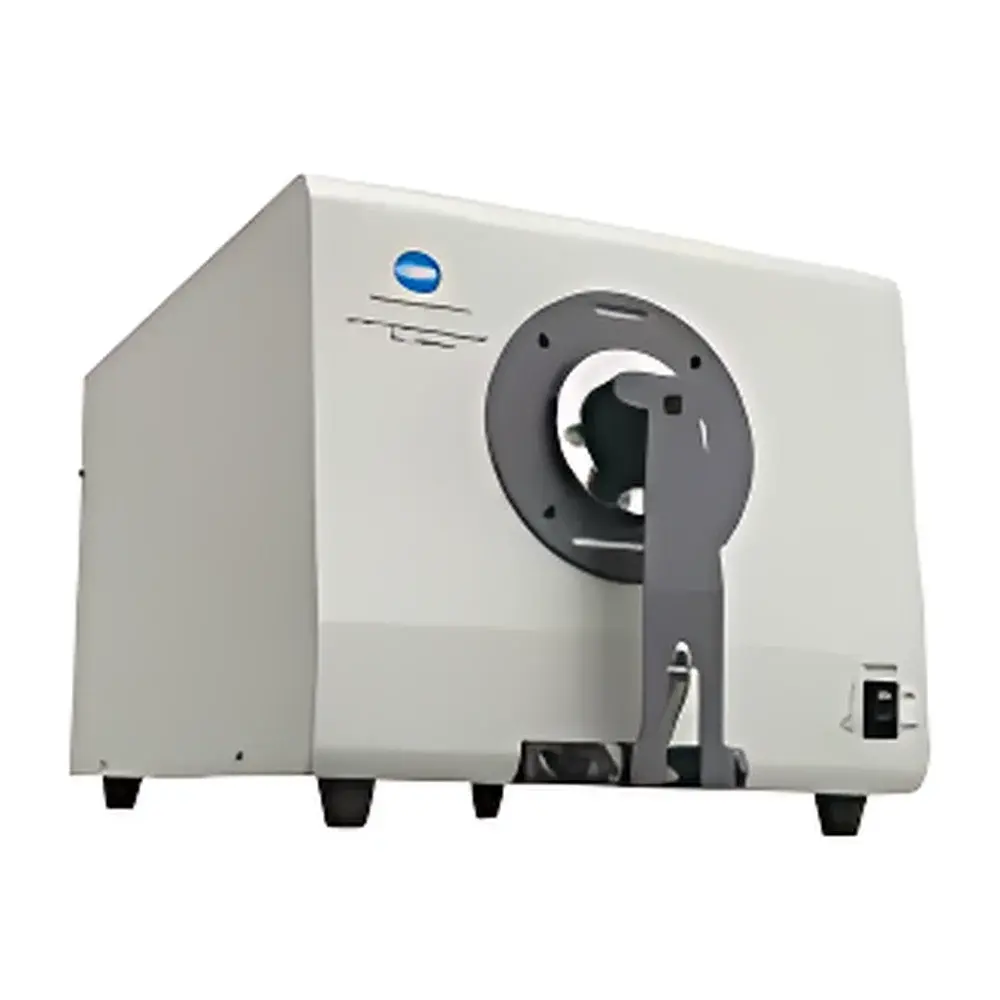
Konica Minolta CM-3600d Spectrophotometer
| Brand | Konica Minolta |
|---|---|
| Origin | Japan |
| Model | CM-3600d |
| Illumination/Viewing Geometry | d/8° (diffuse illumination, 8° viewing) for reflectance |
| Compliance | CIE No. 15, ISO 7724-1, ASTM E1164, DIN 5033-7, JIS Z8722 Condition C |
| Spectral Range | 360–740 nm |
| Spectral Interval | 10 nm |
| FWHM | ~10 nm |
| Detector | Dual 40-element silicon photodiode arrays |
| Grating Type | Planar diffraction grating |
| Integrating Sphere Diameter | Φ152 mm |
| Light Source | Four pulsed xenon lamps |
| Measurement Time | ~1.5 s (to data output) |
| Apertures | LAV (Φ25.4 mm), MAV (Φ8 mm), SAV (Φ4 mm) for reflectance |
| Repeatability | ΔE*ab ≤ 0.02 (standard deviation), spectral reflectance SD ≤ 0.1% |
| Instrumental Error | ΔE*ab ≤ 0.15 (LAV/SCI, BCRA Series II tile average) |
| UV Control | Digital UV adjustment with selectable 400 nm / 420 nm cutoff filters |
| Transmittance Chamber | 133 mm (W) × ~50 mm (D), ~17 mm aperture |
| Interface | RS-232C (D-sub 9-pin female) |
| Power | AC 120 V / 230 V, 50 / 60 Hz (via included adapter) |
| Operating Environment | 13–33 °C, ≤80% RH (non-condensing) |
| Dimensions (W×H×D) | 244 × 208 × 378 mm |
| Weight | 12 kg |
| Standard Accessories | White calibration tile, aperture masks (Φ4/Φ8/Φ25.4 mm), zero calibration box, AC adapter, dust cover, accessory case, driver software, RS-232C cable (2 m) |
Overview
The Konica Minolta CM-3600d is a high-precision benchtop spectrophotometer engineered for rigorous color measurement in R&D, quality control, and production environments. It employs a dual-beam optical architecture with a large-diameter (Φ152 mm) integrating sphere and a planar diffraction grating to achieve stable, repeatable spectral acquisition across the full visible and near-UV range (360–740 nm at 10 nm intervals). Unlike conventional instruments relying on mechanical filter wheels or moving apertures, the CM-3600d implements patented digital UV control and simultaneous SCI (Specular Component Included) and SCE (Specular Component Excluded) measurement—both achieved without any moving optical components. This solid-state design enhances long-term stability, reduces calibration drift, and supports compliance with international colorimetric standards including CIE Publication No. 15, ISO 7724-1, ASTM E1164, DIN 5033-7, and JIS Z8722 Condition C. Its ability to deliver ΔE*ab instrumental error ≤ 0.15 (LAV/SCI, BCRA Series II average) and repeatability of ΔE*ab ≤ 0.02 positions it as a metrologically robust platform for applications demanding traceable, inter-laboratory comparable results.
Key Features
- Digital UV control with selectable 400 nm and 420 nm cutoff filters—enabling real-time correction for fluorescent whitening agents (FWAs) without mechanical filter switching.
- Simultaneous SCI and SCE measurement capability via fixed optical path—eliminating mechanical toggling and ensuring identical geometric conditions for both modes.
- Triple aperture system (SAV: Φ4 mm, MAV: Φ8 mm, LAV: Φ25.4 mm) optimized for diverse sample geometries—from small printed patches to large painted panels—without compromising signal-to-noise ratio.
- High-speed pulsed xenon lamp illumination (four lamps) delivering stable, flash-based excitation—minimizing thermal load on samples and enabling consistent measurement of heat-sensitive materials.
- Compact industrial enclosure housing a 6-inch integrating sphere—achieving high optical efficiency while maintaining footprint suitability for constrained lab benches.
- Robust dual 40-element silicon photodiode array detector—ensuring high linearity (0–200% reflectance/transmittance), low noise, and excellent wavelength registration stability over time.
Sample Compatibility & Compliance
The CM-3600d accommodates both reflective and transmissive measurements under standardized geometries. For reflectance, it supports d/8° geometry compliant with ISO 7724-1 and ASTM E1164, with selectable aperture sizes enabling precise targeting of textured, patterned, or heterogeneous surfaces. Transmittance measurements follow d/0° geometry per CIE No. 15 and ASTM E1164, using a dedicated chamber (133 mm × ~50 mm × ~17 mm aperture) compatible with plate and liquid samples via optional holders. The instrument meets GLP-relevant operational requirements: its firmware logs calibration history, operator ID (when integrated with SpectraMagic™ NX), and environmental metadata (temperature/humidity if externally monitored). While not inherently 21 CFR Part 11-compliant, its audit-trail-ready data export architecture—combined with SpectraMagic™ NX’s optional electronic signature and role-based access modules—supports validation in regulated industries including pharmaceutical packaging, automotive coatings, and food packaging QA.
Software & Data Management
The CM-3600d operates natively with Konica Minolta’s SpectraMagic™ NX software—a Windows-based application designed for traceable color data management. It enables full spectral data export (CSV, TXT), CIE-compliant color space conversion (CIELAB, CIELCH, XYZ, Yxy), tolerance setting (ΔE*ab, ΔE00, ΔEcmc), and batch reporting aligned with ISO 11664 and ASTM D2244. The software supports multi-instrument synchronization, statistical process control (SPC) charting, and custom report generation compliant with internal QA documentation protocols. All measurement records include embedded metadata: date/time stamp, operator ID, aperture used, measurement mode (SCI/SCE), UV setting, and calibration verification status. Raw spectral files retain full 360–740 nm resolution at 10 nm intervals—ensuring backward compatibility with future algorithm updates or third-party spectral analysis tools.
Applications
The CM-3600d serves as a reference-grade instrument across sectors requiring absolute color fidelity and inter-instrument agreement. In automotive manufacturing, it validates paint and plastic trim consistency against OEM master standards under both SCI (appearance) and SCE (colorant concentration) modes. In printing and packaging, its SAV aperture enables precise spot measurement of halftone dots and fine text, while digital UV correction ensures accurate assessment of FWA-containing substrates. Within textile QA, its repeatability (ΔE*ab ≤ 0.02) supports pass/fail decisions on dyed fabric lots per AATCC Evaluation Procedure 1. In plastics compounding, transmittance mode quantifies yellowness index (YI) and haze per ASTM D1003, with spectral data supporting predictive modeling of thermal degradation effects. Its compact size and low maintenance profile also make it suitable for satellite QC labs in global supply chains where metrological continuity across sites is critical.
FAQ
Does the CM-3600d support GLP or GMP compliance?
The hardware itself does not include built-in electronic signatures or biometric authentication. However, when paired with SpectraMagic™ NX (with optional validation package), it supports audit trails, user access controls, and calibrated data export—enabling alignment with GLP principles and supporting GMP validation in color-critical manufacturing.
Can the CM-3600d measure metallic or pearlescent coatings?
It measures total color appearance under d/8° geometry but does not provide gonio-spectrophotometric data. For effect pigments requiring multi-angle evaluation, Konica Minolta’s CM-5 series or MA-5 series is recommended.
Is regular recalibration required?
Yes—daily zero and white calibration is recommended per ISO 9001-aligned procedures. Annual factory recalibration is advised to maintain traceability to NIST-traceable standards.
What is the maximum sample thickness supported in transmittance mode?
The standard transmittance chamber accommodates samples up to ~50 mm deep. Thicker specimens require custom fixtures; optical path length must remain within the instrument’s dynamic range (0–200% transmittance).
How is temperature variation compensated during measurement?
The CM-3600d incorporates internal thermal stabilization and reports temperature dependence: spectral reflectance drift ≤ ±0.10%/°C and ΔE*ab drift ≤ 0.05/°C—values that inform environmental control requirements during qualification studies.



