
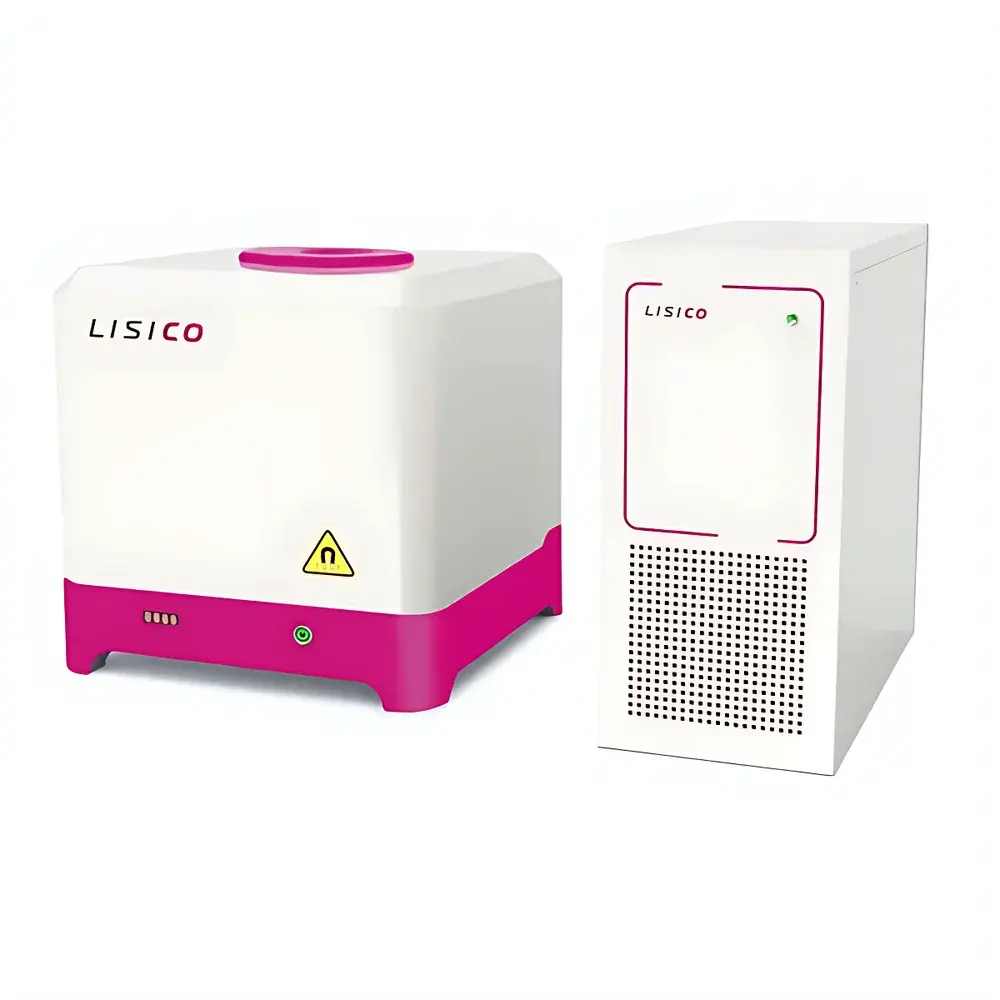
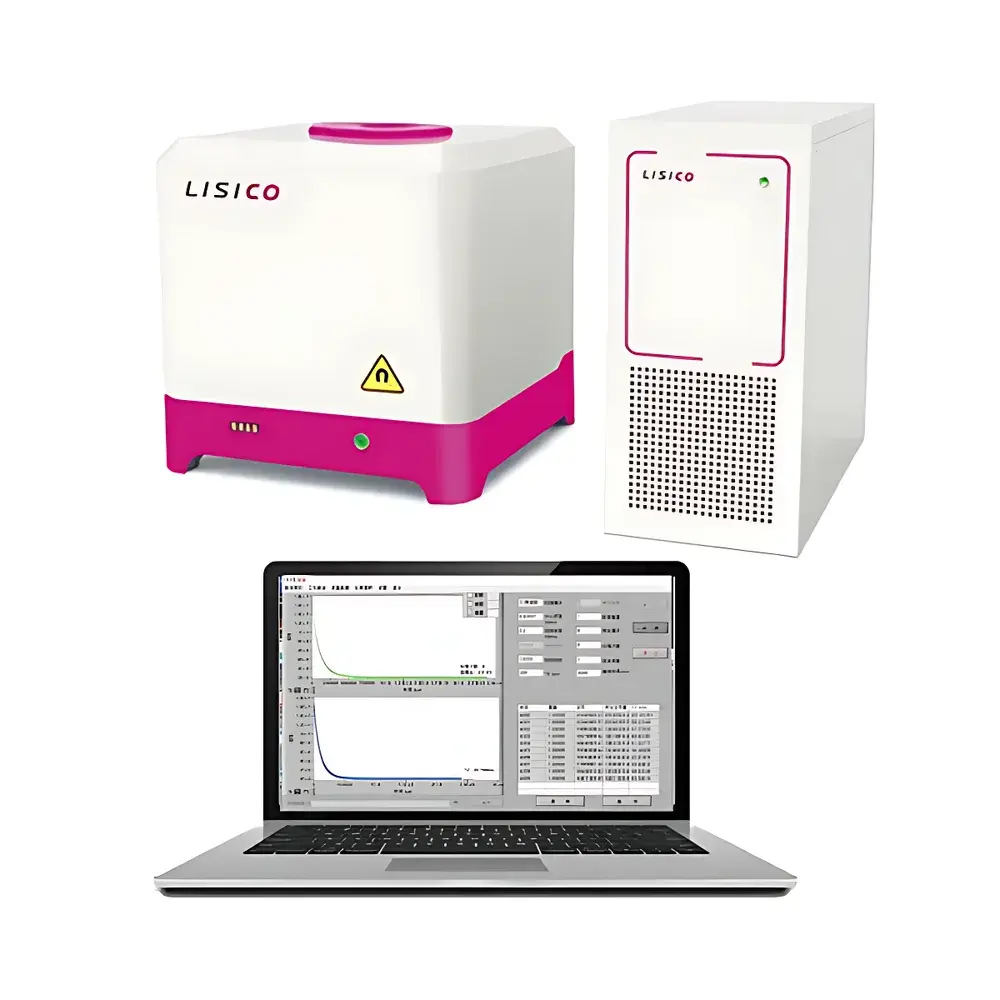
LISICO LS-1 Low-Field Time-Domain Nuclear Magnetic Resonance Analyzer
| Brand | LISICO |
|---|---|
| Origin | Shanghai, China |
| Manufacturer Type | Authorized Distributor |
| Product Category | Domestic |
| Model | LS-1 |
| Price Range | USD 14,000 – 70,000 |
| Instrument Type | Low-Field TD-NMR Analyzer |
| Sample Type | Solid–Liquid Suspensions |
| Magnet Type | Samarium–Cobalt Permanent Magnet |
| Static Field Strength | 0.165 ± 0.01 T |
| Larmor Frequency | 7.0 ± 0.3 MHz |
| Frequency Tuning Range | 1–75 MHz |
| Pulse Sequences Supported | FID, Spin Echo (SE), CPMG, Saturation Recovery T₁ (Sat_T1) |
| Relaxation Time Range | 0.1 ms – 10 s |
| Probe Inner Diameter | 20 mm |
| Sample Volume | 1–5 mL |
| Measurement Repeatability | ±2% |
| Frequency Resolution | 0.28 Hz |
| Phase Accuracy | 0.09° |
| Timing Resolution | 13.3 ns |
| Sampling Rate | 75 MS/s |
| Maximum Acquisition Bandwidth | 10 MHz |
| Minimum Echo Spacing | 150 µs |
| Maximum Echo Train Length | 60,000 |
Overview
The LISICO LS-1 is a benchtop low-field time-domain nuclear magnetic resonance (TD-NMR) analyzer engineered for quantitative characterization of particle–liquid interfacial phenomena in heterogeneous suspensions. Unlike high-field NMR spectrometers designed for molecular structure elucidation, the LS-1 operates at a fixed static magnetic field of 0.165 T (7.0 MHz 1H Larmor frequency), enabling robust, non-invasive, and solvent-agnostic measurement of transverse (T₂) and longitudinal (T₁) relaxation dynamics in solid–liquid dispersions. Its core application lies in correlating measured relaxation decay profiles with physical parameters governing colloidal stability—specifically, the fraction of immobilized (“bound”) solvent molecules adsorbed on particle surfaces versus bulk-like (“free”) solvent. This physical distinction underpins quantitative estimation of wet specific surface area (SSA), dispersion homogeneity, sedimentation resistance, and interfacial wettability—parameters critical to battery slurry formulation, pharmaceutical suspension development, ceramic processing, and mineral flotation optimization.
Key Features
- Compact permanent-magnet architecture using SmCo material, delivering stable, drift-free B₀ fields without cryogens or active shimming.
- Integrated RF probe with 20 mm inner diameter, optimized for 1–5 mL suspension volumes and compatible with standard NMR tubes or custom disposable vials.
- High-fidelity pulse control system supporting industry-standard sequences: Free Induction Decay (FID), Spin Echo (SE), Carr–Purcell–Meiboom–Gill (CPMG), and Saturation Recovery T₁—enabling both T₁ and T₂ mapping under identical experimental conditions.
- Sub-microsecond timing resolution (13.3 ns) and ultra-low phase error (0.09°) ensure high-fidelity echo train acquisition, essential for resolving multi-exponential relaxation components in polydisperse systems.
- Real-time signal digitization at 75 MS/s with 10 MHz effective bandwidth minimizes spectral distortion and preserves fine features in short-T₂ decays.
- USB-based host interface with deterministic latency for synchronized instrument control, data streaming, and post-acquisition processing via embedded MATLAB-compatible analysis environment.
Sample Compatibility & Compliance
The LS-1 accepts opaque, turbid, or highly viscous solid–liquid suspensions—including aqueous and organic-based slurries—without optical transparency requirements. It accommodates particulates ranging from nanoscale clays (<100 nm) to micron-scale pigments (1–50 µm), provided sample geometry fits within the 20 mm probe bore. No sample derivatization, drying, or vacuum treatment is required. The system complies with IEC 61000-6-3 (EMC emission standards) and meets CE marking requirements for laboratory instrumentation. Data integrity protocols align with GLP principles; audit trails, user access logs, and electronic signature support are available through optional firmware modules compliant with FDA 21 CFR Part 11 Annex 11 guidelines.
Software & Data Management
The LS-1 is operated via LISICO’s proprietary NMRView Suite—a Windows-based application providing full sequence programming, real-time spectrum visualization, and automated relaxation inversion using non-negative least-squares (NNLS) algorithms. Raw FID/echo train data are stored in HDF5 format with embedded metadata (pulse sequence, temperature, operator ID, timestamp). Quantitative outputs include mono- and multi-component T₂ distributions, T₁–T₂ correlation maps, wet SSA (m²/g), bound–free water ratio, and dispersion stability index (DSI). Export options include CSV, MATLAB .mat, and ASTM E2929-compliant XML for integration into LIMS or statistical process control platforms.
Applications
- Battery electrode slurry R&D: Monitoring binder–conductive additive–active material interactions during mixing and aging; quantifying solvent binding capacity as a predictor of coating uniformity.
- Pharmaceutical suspension formulation: Assessing surfactant efficacy in preventing particle aggregation; correlating T₂ shortening with zeta potential trends.
- Ceramic green body processing: Evaluating dispersant dosage effects on particle packing density and rheological yield stress via wet SSA evolution.
- Mineral processing: Characterizing clay swelling behavior in flotation pulps; distinguishing hydrophilic vs. hydrophobic surface coverage through T₁/T₂ ratio analysis.
- Food colloid science: Studying protein–polysaccharide coacervation kinetics in emulsion-based delivery systems using time-resolved T₂ mapping.
FAQ
Is the LS-1 suitable for measuring absolute particle size distribution?
No. The LS-1 does not resolve size directly; it infers wet surface area and dispersion state from relaxation dynamics. For size distribution, coupling with dynamic light scattering (DLS) or laser diffraction is recommended.
Can the instrument operate unattended for long-term stability monitoring?
Yes. Scheduled auto-acquisition mode supports sequential sampling over 72+ hours with temperature-stabilized probe housing (optional Peltier module).
Does the system require liquid nitrogen or helium cooling?
No. The SmCo permanent magnet operates at ambient temperature; no cryogens or external chillers are needed.
How is calibration performed for wet specific surface area?
Calibration uses reference materials with certified SSA (e.g., NIST SRM 1980 silica) dispersed in the same solvent matrix; K-factor derivation follows ISO 18757 Annex B methodology.
Is remote operation supported?
Yes. Secure RDP or VNC access is enabled via Ethernet port; full instrument control and data review are possible from off-site locations.
Related Products





