
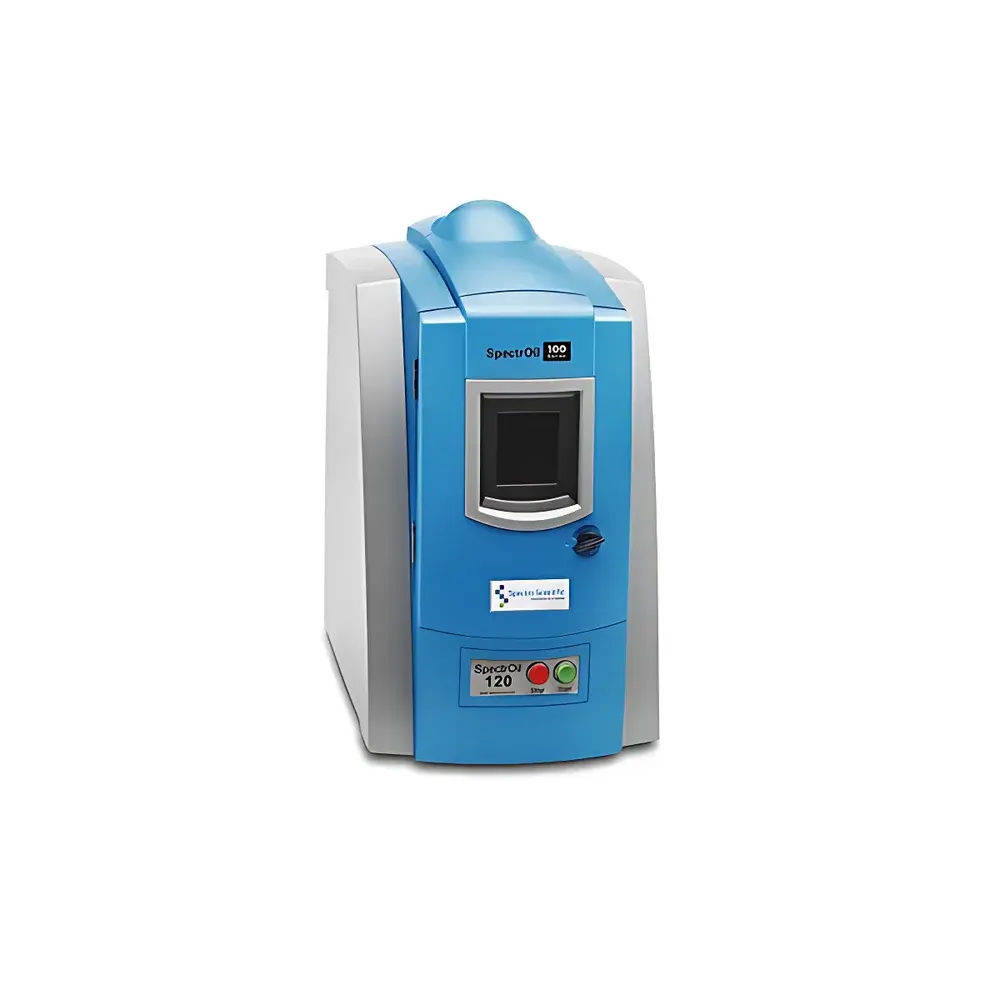
Spectro Scientific SpectrOil 100 Series Oil Emission Spectrometer
| Brand | Spectro Scientific |
|---|---|
| Origin | USA |
| Manufacturer Type | Authorized Distributor |
| Product Origin | Imported |
| Model | SpectrOil 100 Series |
| Pricing | Upon Request |
Overview
The Spectro Scientific SpectrOil 100 Series is a benchtop rotating disk electrode (RDE) atomic emission spectrometer engineered for precise, rapid elemental analysis of in-service lubricants, hydraulic fluids, fuels, and coolants. Based on ASTM D6595 (equivalent to NB/SH/T 0865) and ASTM D6728 methodologies, the instrument employs arc-spark excitation of oil samples deposited on a rotating graphite electrode, followed by high-resolution optical detection across a broad spectral range (200–800 nm). Unlike flame or ICP-based systems, RDE spectroscopy requires no sample digestion, dilution, or carrier gas—enabling direct liquid analysis with minimal operator intervention. The SpectrOil 100’s core architecture centers on a dual-layer charge-coupled device (CCD) optical system mounted along a Rowland circle geometry, replacing traditional photomultiplier tube (PMT) detectors. This design delivers superior detection limits, multi-element parallel acquisition, and robust long-term calibration stability—critical for predictive maintenance labs operating under ISO/IEC 17025, MIL-STD-3007, or SAE AS5672 frameworks.
Key Features
- CCD-based optical system with 15 discrete sensors positioned on a Rowland circle for simultaneous wavelength coverage from 200 nm to 800 nm
- Rotating disk electrode (RDE) excitation source enabling direct, solvent-free analysis of neat oil, fuel, and coolant samples
- Analysis time ≤30 seconds per sample, including auto-calibration and background correction
- Standard quantification of 24 elements: wear metals (Al, Cd, Cr, Cu, Fe, Pb, Mg, Mn, Mo, Ni, Ag, Sn, Ti, V, Zn, Sb), contaminants (B, Ca, K, Si, Na), and additives (Ba, P, Li, plus repeat-listed elements reflecting formulation overlap)
- Expandable element library: 10 optional elements (Sr, Bi, As, In, Co, Zr, W, Ce, Nb, Rh) configurable via software—no hardware modification required
- Integrated standby mode with instant wake-up; power management compliant with IEC 62304 Class B medical-grade safety standards
- Self-contained operation: only 100–240 V AC, 50/60 Hz input required—no external argon, nitrogen, or vacuum pumps
- Compact benchtop footprint (66 × 40 × 74 cm); net weight 75 kg; designed for deployment in mobile field labs or fixed QC environments
Sample Compatibility & Compliance
The SpectrOil 100 Series supports undiluted mineral-, synthetic-, and bio-based lubricants (engine oils, gear oils, turbine oils, greases), aviation fuels (Jet A, JP-8), diesel, gasoline, and ethylene glycol-based coolants. All measurement protocols adhere strictly to ASTM D6595 for wear metal quantification and ASTM D6728 for fuel analysis—both referenced in OEM oil analysis specifications (e.g., Caterpillar SOS, Komatsu MMS, Rolls-Royce RRES 90011). Instrument validation includes linearity verification per ASTM E1313, precision assessment per ASTM D7252, and bias evaluation against NIST SRM 2721a (used engine oil). Data integrity complies with FDA 21 CFR Part 11 requirements through audit-trail-enabled software, electronic signatures, and role-based access control—supporting GLP/GMP-regulated laboratories.
Software & Data Management
Spectro’s proprietary OilView™ software (v6.2+) provides full method configuration, spectral deconvolution, interference correction (including 16-channel cross-talk compensation), and trend analysis aligned with ISO 4406 and SAE J183 reporting formats. Raw spectra are stored in vendor-neutral .spc format; results export to CSV, PDF, or LIMS-compatible XML. Built-in statistical process control (SPC) tools generate Shewhart charts, alarm thresholds based on historical baselines, and automated exception reporting. Software updates are delivered via secure HTTPS channel with SHA-256 signature verification. Calibration files include traceable metadata (date, operator ID, reference standard lot number), satisfying internal audit and third-party accreditation requirements.
Applications
- Early-stage wear detection in rotating machinery (gearboxes, turbines, compressors) through trending of Fe, Cr, Cu, and Al concentrations
- Contaminant ingress monitoring (Si for dirt, Na/K for coolant leakage, B for borated additives or contamination)
- Additive depletion analysis (Ca, Mg, Zn, P, Ba) to assess remaining useful life of anti-wear and detergent packages
- Fuel quality assurance: detection of wear metals in aviation fuel systems, sulfur content estimation, and biodiesel blend verification
- Condition-based maintenance program support for defense logistics (MIL-PRF-2104G, MIL-PRF-6081F) and rail transport (AAR S-660)
- Third-party oil analysis laboratories performing API-certified testing (API RP 545)
FAQ
Does the SpectrOil 100 require daily recalibration?
No—calibration stability exceeds 72 hours under typical lab conditions. A single daily verification using a certified reference oil (e.g., Spectro CRM-100) satisfies ASTM D6595 requirements.
Can it analyze grease samples?
Yes, when diluted with solvent (e.g., kerosene) per ASTM D5185 procedure; undiluted grease analysis is not supported.
Is the CCD detector susceptible to spectral drift over time?
No—the Rowland-circle-fixed sensor array and real-time wavelength reference channel (4128-pixel reference CCD) ensure sub-pixel spectral registration stability over 5+ years without mechanical adjustment.
What data security protocols are implemented?
Role-based user authentication, encrypted local database (AES-256), immutable audit trails, and electronic signature workflows compliant with 21 CFR Part 11 Subpart B.
How is interference from overlapping emission lines corrected?
Through embedded multivariate regression models trained on >12,000 reference spectra, applying 16-bit interference correction matrices per element—including simultaneous correction for 256 interference combinations.






