
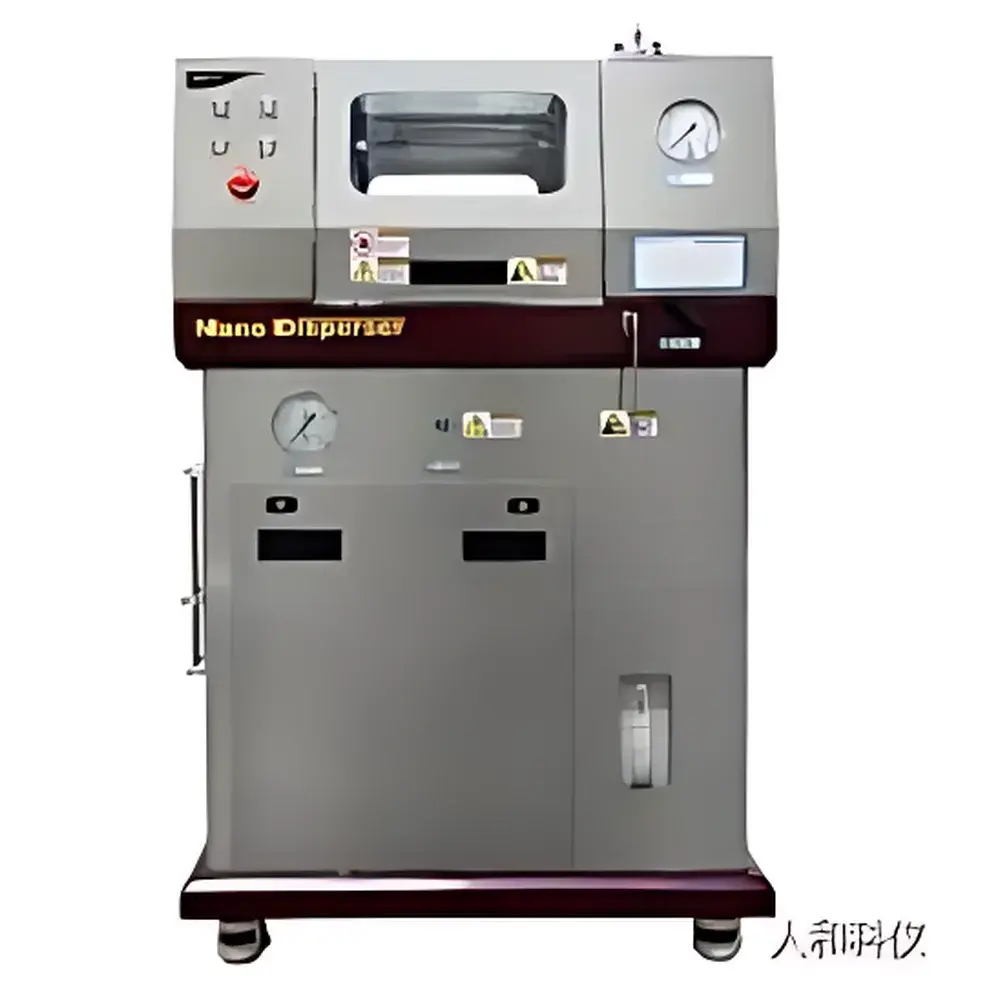
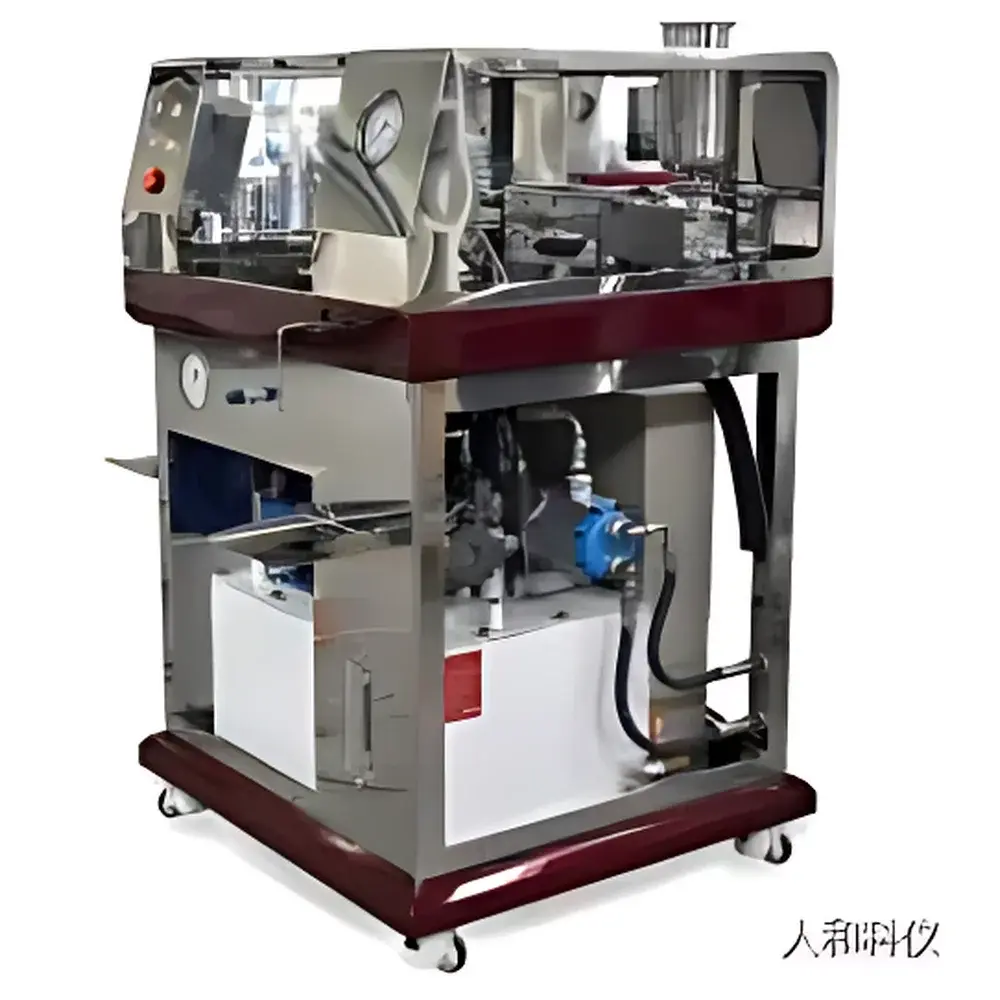
ILSHIN Nano Disperser NH500 Microfluidic Homogenizer
| Brand | ILSHIN Autoclave |
|---|---|
| Origin | South Korea |
| Model | NH500 |
| Instrument Type | Microfluidic (Microjet) Homogenizer |
| Operating Pressure | 1,500 bar (Max. 2,000 bar) |
| Flow Rate | 500 mL/min |
| Interaction Chamber Sizes | 75 µm, 100 µm, 200 µm, 400 µm |
| Interaction Chamber Types | Z-type and Y-type |
| Dimensions (W×D×H) | 850 × 800 × 1500 mm |
| Weight | ~350 kg |
| Power Supply | 220/380/440 VAC, 50/60 Hz, 5 HP |
| Cooling System | Integrated standard cooling unit |
| Continuous Operation Capability | Yes |
| Processing Capacity Range | 75–30,000 mL/h |
Overview
The ILSHIN Nano Disperser NH500 is a high-pressure microfluidic homogenizer engineered for reproducible nano-scale dispersion, emulsification, and particle size reduction across demanding R&D and pilot-scale production environments. Utilizing the principle of microjet fluid dynamics—where pressurized sample streams are accelerated through precisely engineered interaction chambers (Z- or Y-type)—the NH500 subjects materials to intense shear, cavitation, and impact forces under controlled hydraulic conditions. Unlike rotor-stator or ultrasonic systems, this microfluidic architecture ensures consistent energy input per unit volume, enabling narrow polydispersity indices (PDI < 0.1) in lipid nanoparticles, polymer micelles, nanoemulsions, and inorganic colloids. Designed for uninterrupted operation, the NH500 integrates a robust hydraulic power unit and factory-calibrated cooling system to maintain thermal stability during extended processing cycles—critical for heat-sensitive biologics, active pharmaceutical ingredients (APIs), and thermolabile cosmetic actives.
Key Features
- High-pressure microfluidic platform with dual interaction chamber configurations (Z-type for maximum shear; Y-type for balanced shear/cavitation)
- Adjustable operating pressure up to 2,000 bar, with recommended continuous duty at 1,500 bar for optimal longevity and process repeatability
- Interchangeable interaction chambers (75 µm, 100 µm, 200 µm, 400 µm) enabling systematic optimization of particle size distribution across diverse formulations
- Integrated closed-loop cooling system maintaining jacket temperature within ±1.5 °C during 8-hour continuous runs
- Hydraulic drive unit rated at 5 HP (3.7 kW), compatible with global voltage standards (220/380/440 VAC, 50/60 Hz) and compliant with IEC 60204-1 safety directives
- Stainless steel 316L wetted parts and ASME BPVC Section VIII-compliant pressure housing for chemical resistance and long-term reliability
- Front-access service panel and modular chamber assembly enabling tool-free interaction chamber replacement in under 90 seconds
Sample Compatibility & Compliance
The NH500 accommodates aqueous, organic, and mixed-phase suspensions with viscosities up to 5,000 mPa·s (at 25 °C) and solid loadings up to 40 wt%. It supports sterile processing when paired with validated single-use tubing sets and autoclavable chamber kits. The system meets ISO 22000 and ISO 9001 requirements for food-grade manufacturing and complies with cGMP Annex 11 principles for electronic record integrity. For pharmaceutical applications, the NH500’s pressure control loop and flow monitoring interface support integration into FDA 21 CFR Part 11–compliant data acquisition systems, including audit trail generation, user-level access control, and electronic signature capability when deployed with validated SCADA software.
Software & Data Management
While the NH500 operates via intuitive local HMI with real-time pressure, flow, and temperature readouts, it features RS-485 Modbus RTU and optional Ethernet/IP connectivity for integration into centralized lab informatics platforms (e.g., LabVantage, STARLIMS). Process parameters—including total run time, cumulative energy input (kJ/L), chamber temperature history, and pressure deviation logs—are timestamped and exportable in CSV or PDF formats. Optional firmware upgrades enable automated batch reporting aligned with ASTM E2500-22 (Guide for Specification, Design, and Verification of Pharmaceutical and Biopharmaceutical Manufacturing Systems) and USP on characterization of nanomaterials.
Applications
- Pharmaceutical: Production of liposomal doxorubicin, mRNA-LNPs, and nanostructured lipid carriers (NLCs) with mean particle size control from 50 nm to 250 nm
- Cosmetics: Stabilization of water-in-oil nanoemulsions for UV filters and encapsulated retinoids with improved skin permeation and photostability
- Food Science: Fabrication of whey protein–curcumin nanocomplexes and casein-based delivery systems for enhanced bioavailability of nutraceuticals
- Advanced Materials: Exfoliation of 2D materials (e.g., graphene oxide, MXenes) and dispersion of quantum dots in polymer matrices for optoelectronic films
- Chemical Industry: Synthesis of stable pigment dispersions for inkjet inks and high-solids coatings with reduced rheological hysteresis
FAQ
What is the minimum and maximum processing volume per batch?
The NH500 is optimized for continuous flow operation. Its nominal throughput range is 75–30,000 mL/h, supporting both small-volume R&D (e.g., 50 mL test batches via recirculation mode) and scalable pilot production.
Can the NH500 be used for sterile nanoparticle synthesis?
Yes—when equipped with sterilizable interaction chambers, PTFE-lined tubing, and integrated SIP (steam-in-place) compatibility, the system meets ISO 13408-1 requirements for aseptic processing of parenteral nanomedicines.
How does chamber geometry affect final particle size distribution?
Z-type chambers generate higher localized shear rates and are preferred for hard-to-disperse crystalline APIs; Y-type chambers promote more uniform energy dissipation and are ideal for fragile biologics requiring lower peak stress exposure.
Is validation documentation available for GMP environments?
ILSHIN provides IQ/OQ protocols, traceable calibration certificates for pressure transducers and flow meters, and material compliance declarations (EN 10204 3.1) upon request—fully aligned with EU Annex 15 and ASTM E2500-22 guidance.
What maintenance intervals are recommended for sustained performance?
Daily visual inspection of seals and cooling lines; quarterly verification of pressure sensor linearity and chamber wear (using supplied optical bore scope); annual full hydraulic fluid replacement and accumulator precharge validation per OEM service manual.



