
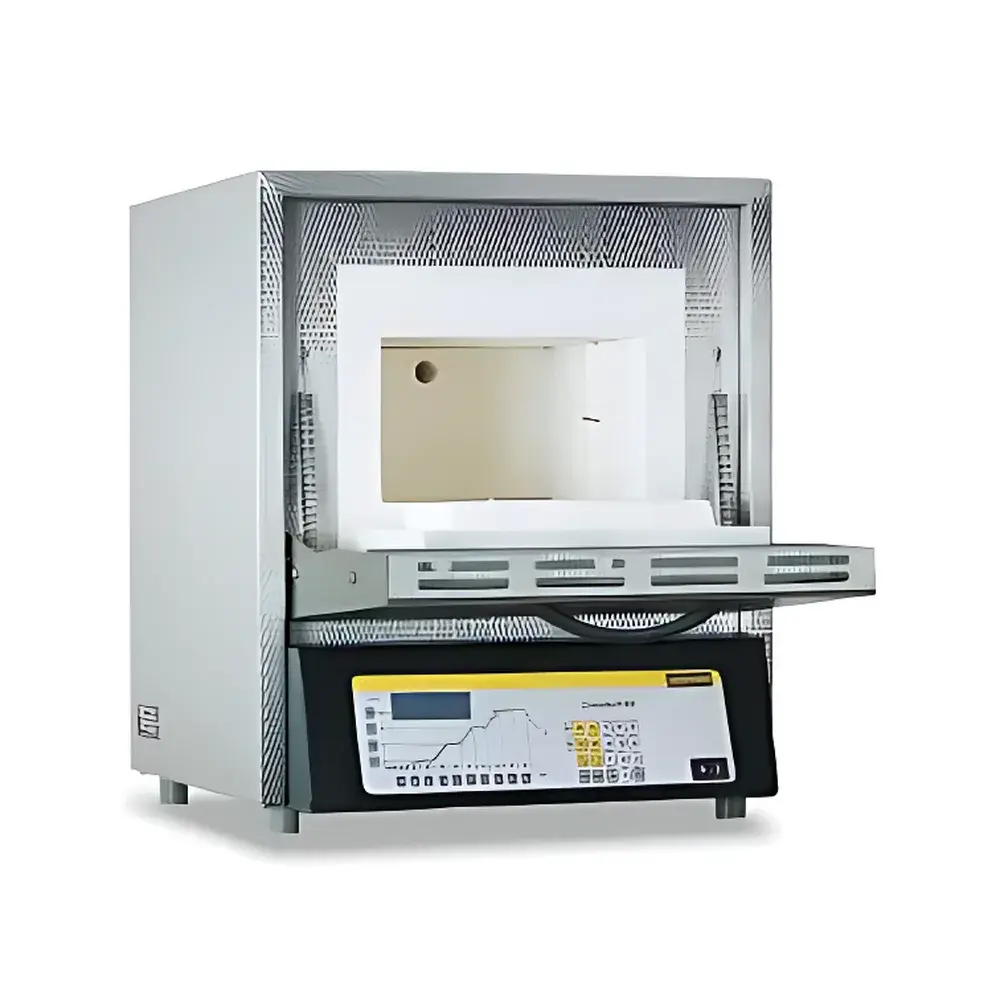
Nabertherm LT5/12/B180 Lift-Door Laboratory Muffle Furnace
| Brand | Nabertherm |
|---|---|
| Origin | Germany |
| Model | LT5/12/B180 |
| Max Operating Temperature | 1200 °C |
| Internal Dimensions (W×D×H) | 200 × 170 × 130 mm |
| Chamber Volume | 5 L |
| External Dimensions (W×D×H) | 440 × 470 × 520 + 220 mm |
| Power Supply | 2.4 kW, Single-Phase |
| Weight | 35 kg |
| Heating Time to Max Temp | ~75 min |
| Controller Type | B180 Programmable Touchscreen Interface |
| Programmable Steps | 2 |
| Programs Stored | 1 |
| Display | Graphical Color LCD with Text Status Feedback |
| Optional Features | Gas Inlet (rear wall), Exhaust Port (rear wall), Adjustable Air Intake (door), Overtemperature Protection (EN 60519-2 Class 2), Catalytic Exhaust System Compatibility, kWh Meter, Real-Time Clock, Skip Function, Manual MV Control, Self-Optimizing PID Algorithm |
Overview
The Nabertherm LT5/12/B180 is a precision-engineered lift-door laboratory muffle furnace designed for routine thermal processing in research, quality control, and materials development laboratories. Based on the proven LT 5/12 platform, it operates via resistive heating using embedded high-purity ceramic heating elements — delivering uniform temperature distribution and long-term stability across its 1200 °C maximum operating range. Unlike conventional box furnaces with front-hinged doors, the lift-door configuration eliminates direct contact between the operator and hot surfaces during loading/unloading, significantly improving operational safety and ergonomics — particularly critical during repetitive high-temperature procedures such as ashing, calcination, sintering, or heat treatment of small-volume samples. The furnace chamber is insulated with vacuum-formed high-purity alumina-silica fiber modules, ensuring low thermal mass, rapid heat-up/cool-down cycles, and minimal external surface temperatures (<60 °C at ambient conditions). Its double-walled stainless steel housing (brushed finish) provides structural rigidity and mechanical durability while meeting stringent laboratory space and safety requirements.
Key Features
- Lift-door mechanism: Enables vertical opening without forward swing — ideal for benchtop integration and safe handling of hot crucibles or sample boats.
- Ceramic heating system: Dual-sided (standard) or triple-sided (optional) ceramic plates with embedded resistance wire; fully protected from chemical volatiles and splashes.
- B180 programmable controller: Full-color graphical touchscreen interface with intuitive navigation, real-time status feedback, and multilingual text display.
- Advanced thermal management: Self-optimizing PID algorithm with adaptive tuning, manual MV override, and segment-based ramp/soak programming (2-step max per program, 1 stored program).
- Integrated safety architecture: EN 60519-2 compliant overtemperature protection (Class 2 thermal cut-off), silent solid-state relays, and optional catalytic exhaust or forced-air ventilation kits.
- Gas compatibility: Rear-mounted gas inlet port supports inert (N₂, Ar) or reducing (H₂/N₂) atmospheres; optional manual or automated gas mixing modules available.
- Environmental integration: kWh consumption meter, real-time clock with delayed start scheduling (e.g., off-peak electricity utilization), and runtime counter for maintenance tracking.
Sample Compatibility & Compliance
The LT5/12/B180 accommodates standard laboratory crucibles (alumina, quartz, platinum), ceramic boats, and small metal components up to 200 mm wide × 170 mm deep × 130 mm high. Its muffle design ensures complete thermal isolation between heating elements and sample chamber — eliminating contamination risks from heater degradation or oxidation byproducts. The furnace complies with IEC/EN 61000-6-3 (EMC emissions), EN 61000-6-2 (immunity), and EN 60519-2 (safety requirements for industrial electroheating equipment). For regulated environments, optional audit-trail-capable firmware upgrades support GLP/GMP-aligned operation, including user access logs, parameter change history, and electronic signature readiness — compatible with 21 CFR Part 11–compliant data archiving systems when interfaced via RS485 or Ethernet (with add-on module).
Software & Data Management
While the B180 controller operates autonomously, its serial interface (RS232/RS485) enables bidirectional communication with external PCs running Nabertherm’s optional THERMOCOM software suite. This allows remote monitoring, real-time temperature logging, program upload/download, and export of time-stamped CSV datasets for traceability. All controller events — including program starts/stops, alarm triggers, setpoint changes, and overtemperature interventions — are timestamped and retained in non-volatile memory. The system supports scheduled start times, runtime accounting, and energy consumption reporting — facilitating ISO 17025-compliant calibration interval planning and laboratory energy audits.
Applications
This furnace is routinely deployed in analytical chemistry (AOAC 923.03 ashing, ASTM E1868 loss-on-ignition), metallurgy (pre-sintering of powder compacts), ceramics R&D (glaze firing trials), environmental testing (TGA pre-conditioning), and pharmaceutical QC (residue on ignition per USP ). Its precise thermal reproducibility (±2 °C at 1200 °C, typical), low thermal inertia, and programmable dwell capabilities make it suitable for method validation, inter-laboratory comparison studies, and ISO/IEC 17025-accredited test procedures requiring documented thermal profiles.
FAQ
What is the difference between the lift-door (LT) and flip-door (L) configurations?
The lift-door version raises vertically, minimizing footprint intrusion and eliminating risk of operator contact with hot surfaces; the flip-door opens outward on hinges and is preferred when horizontal sample placement is required.
Can the B180 controller store multiple temperature programs?
No — the base B180 supports one stored program with two segments; multi-program capability requires upgrade to the B190 or T300 series controllers.
Is nitrogen purging supported out-of-the-box?
Yes — a rear-mounted gas inlet port is standard; flow regulation and pressure monitoring require optional manual or automated gas control modules.
Does the furnace include overtemperature protection?
Yes — an independent bimetallic overtemperature limiter (EN 60519-2 Class 2) disconnects power if the main controller fails or exceeds preset limits.
What maintenance is recommended for long-term reliability?
Annual inspection of fiber insulation integrity, verification of door seal compression, cleaning of air intake grilles, and calibration of thermocouple input using a traceable reference source.



