
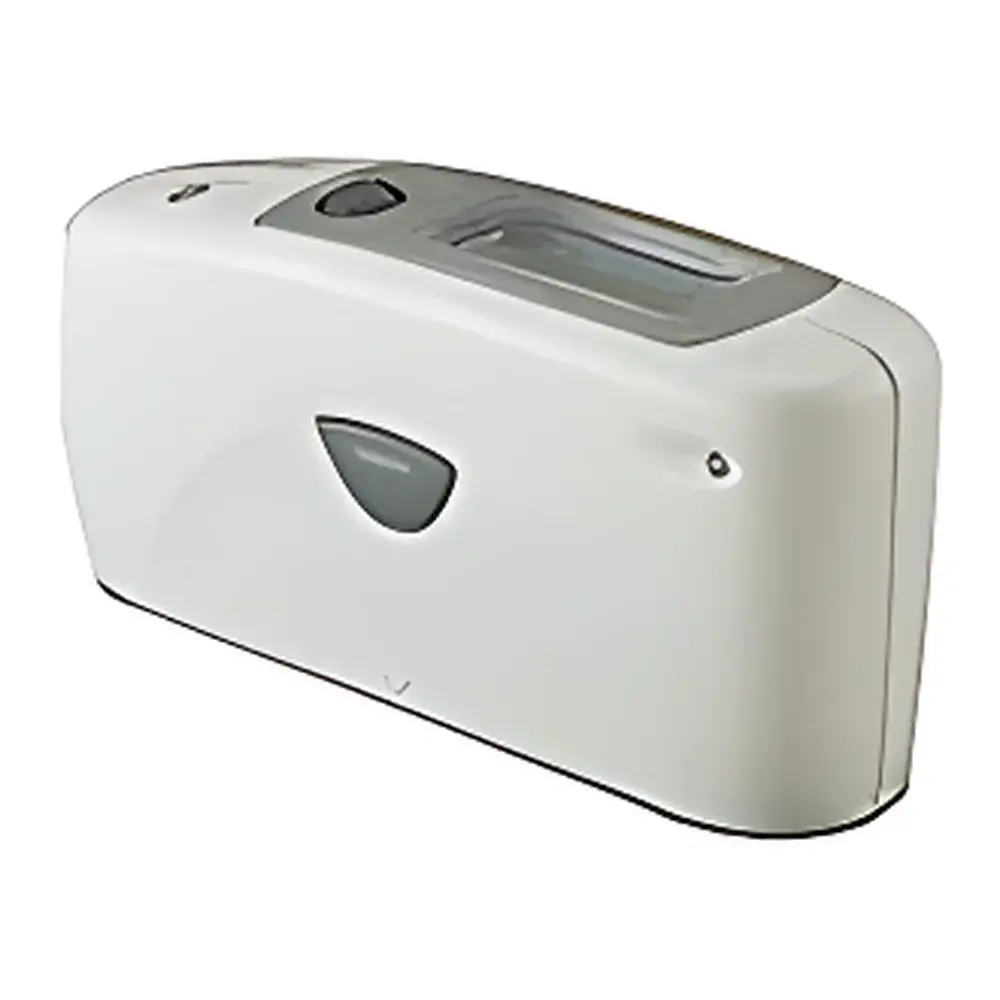
Konica Minolta Uni-Gloss 60 Portable Gloss Meter
| Brand | Konica Minolta |
|---|---|
| Origin | Japan |
| Model | Uni-Gloss 60 |
| Measurement Angle | 60° |
| Measurement Spot Size | 9 × 15 mm |
| Standards Compliance | ISO 2813, ISO 7668, ASTM D523, ASTM D2457, DIN 67530, JIS Z 8741, BS 3900, BS 6161-12 |
| Measurement Range (60°) | 0.0–1000 GU |
| Resolution | 0.1 GU (0.0–99.9 GU), 1 GU (100–1000 GU) |
| Repeatability | ±0.2 GU (0.0–99.9 GU), ±0.2% of reading (100–1000 GU) |
| Instrument Error | ±0.5 GU (0.0–99.9 GU), ±0.5% of reading (100–1000 GU) |
| Memory Capacity | 999 measurements with timestamp |
| Reference Standards Storage | 50 user-defined standards |
| Battery Life | ~10,000 measurements (with 1.5 V AA alkaline cells) |
| Measurement Interval | 0.5 s |
| Auto Power-Off | Adjustable 10–99 s |
| Operating Language | English, Spanish, German, French, Italian, Japanese |
| Operating Environment | 15–40 °C, ≤85% RH (non-condensing at ≤35 °C) |
| Storage Conditions | −10–60 °C, ≤85% RH (non-condensing at ≤35 °C) |
| Power Supply | 1.5 V AA (R6) alkaline batteries (4 pcs) |
| Dimensions | 155 × 73 × 48 mm (W × H × D) |
| Weight | 400 g |
| Interface | RS-232C |
| Included Accessories | 60° calibration tile (high-gloss ceramic), RS-232C cable, carrying case, GlossLink data exchange software, 4 × AA batteries |
Overview
The Konica Minolta Uni-Gloss 60 is a compact, single-angle portable gloss meter engineered for rapid, repeatable surface gloss evaluation at the standard 60° geometry. It operates on the principle of specular reflectance measurement: a collimated beam of visible light (typically centered at 550–560 nm) is directed onto the sample surface at a fixed 60° incidence angle, and the intensity of reflected light measured within the specular direction (also at 60° relative to the surface normal) is quantified in Gloss Units (GU). This geometry is universally adopted for medium-gloss surfaces—such as automotive clear coats, molded thermoplastics, coated paper, and glazed ceramics—where it delivers optimal sensitivity and dynamic range. The instrument adheres strictly to ISO 2813 and ASTM D523, ensuring metrological traceability and cross-laboratory comparability. Its solid-state optical design, temperature-compensated photodetector, and factory-calibrated reference tile minimize drift and support stable operation across variable ambient conditions typical of production floors and R&D labs.
Key Features
- Compact form factor (155 × 73 × 48 mm) and lightweight construction (400 g) enable handheld use during inline QC checks or field inspections without operator fatigue.
- Dual-range resolution: 0.1 GU resolution below 100 GU ensures high fidelity for low-to-mid gloss finishes; 1 GU resolution above 100 GU maintains accuracy across high-gloss applications such as polished metal or lacquered wood.
- High-speed measurement cycle (0.5 s per reading) supports real-time process feedback and statistical sampling protocols (e.g., X̄/R charts) in manufacturing environments.
- Onboard memory stores up to 999 timestamped readings with automatic date/time stamping—essential for GLP-compliant documentation and audit readiness.
- Support for 50 user-defined reference standards enables multi-product line management without recalibration—ideal for facilities handling diverse substrates (e.g., PP injection-molded parts, PU-coated leather, and powder-coated steel).
- Multi-language UI (English, Spanish, German, French, Italian, Japanese) facilitates global deployment and multilingual operator training.
- RS-232C interface enables direct integration with LIMS or MES systems via standard serial protocols; compatible with Konica Minolta’s GlossLink software for automated report generation, trend analysis, and SPC chart export (CSV/PDF).
Sample Compatibility & Compliance
The Uni-Gloss 60 accommodates flat, curved, or textured surfaces with a defined 9 × 15 mm measurement aperture—sufficient to average micro-roughness while avoiding edge effects on samples ≥25 mm in minimum dimension. It is validated for non-metallic, non-transparent materials including thermoset resins, painted metals, anodized aluminum, ceramic glazes, laminated composites, and printed films. All performance specifications—including repeatability (±0.2 GU or ±0.2%), instrument error (±0.5 GU or ±0.5%), and angular alignment tolerance—are verified per ISO 2813 Annex B and ASTM D523 Section 7. The device carries CE marking and conforms to IEC 61000-4 electromagnetic compatibility requirements. While not FDA 21 CFR Part 11–certified out-of-the-box, its audit trail–capable firmware (via GlossLink-generated logs) supports validation under GMP/GLP frameworks when deployed with documented SOPs and periodic verification using NIST-traceable calibration tiles.
Software & Data Management
GlossLink software provides bidirectional communication for configuration, data retrieval, and reporting. Users can define pass/fail thresholds, generate batch reports with statistical summaries (mean, SD, min/max), and export raw datasets for third-party SPC analysis (e.g., Minitab, JMP). Each exported record includes measurement value, timestamp, reference ID, operator code (if entered), and environmental metadata (if logged externally). Firmware updates are distributed via Konica Minolta’s secure support portal, with version history and release notes aligned to ISO/IEC 17025 change control requirements. No cloud connectivity or proprietary cloud accounts are required—data remains fully under user control on local workstations.
Applications
- Automotive: In-line gloss verification of basecoat/clearcoat systems per OEM specifications (e.g., Ford WSS-M2P195-A2, GM 6091M); monitoring batch-to-batch consistency of spray booth output.
- Plastics & Packaging: Quantifying gloss retention after thermal aging (ASTM D2565), UV exposure (ISO 4892-3), or solvent resistance testing (ASTM D5402).
- Ceramics & Building Materials: Evaluating glaze uniformity on sanitaryware, tiles, and architectural façade panels per EN 1004-1 and ISO 10287.
- Printing & Coatings: Validating varnish gloss levels on folding cartons (TAPPI T 480), magazine covers, and industrial labels per ISO 8254-1.
- Academic Research: Correlating surface topography (AFM/RMS roughness) with specular reflectance in polymer film development and nanocomposite characterization studies.
FAQ
Is the Uni-Gloss 60 suitable for measuring metallic or pearlescent coatings?
Yes—provided the surface is non-translucent and exhibits a dominant specular lobe. However, for multi-angle effects (e.g., flip-flop in effect pigments), a multi-angle gloss meter (e.g., Konica Minolta Multi-Gloss 268) is recommended.
Does the instrument require annual recalibration?
While no mandatory annual recalibration is stipulated by ISO 2813, Konica Minolta recommends verification against certified reference tiles every 6 months or after 5,000 measurements, whichever occurs first, to maintain stated accuracy.
Can measurements be exported directly to Excel?
Yes—GlossLink exports tab-delimited (.txt) or CSV files fully compatible with Microsoft Excel, Google Sheets, and statistical analysis platforms.
What is the warranty coverage?
The Uni-Gloss 60 carries a 24-month limited warranty from date of purchase, covering defects in materials and workmanship under normal use conditions.
Is USB connectivity supported natively?
No—the device features RS-232C only; optional USB-to-RS232 adapters (sold separately) are required for modern laptops lacking legacy serial ports.





