
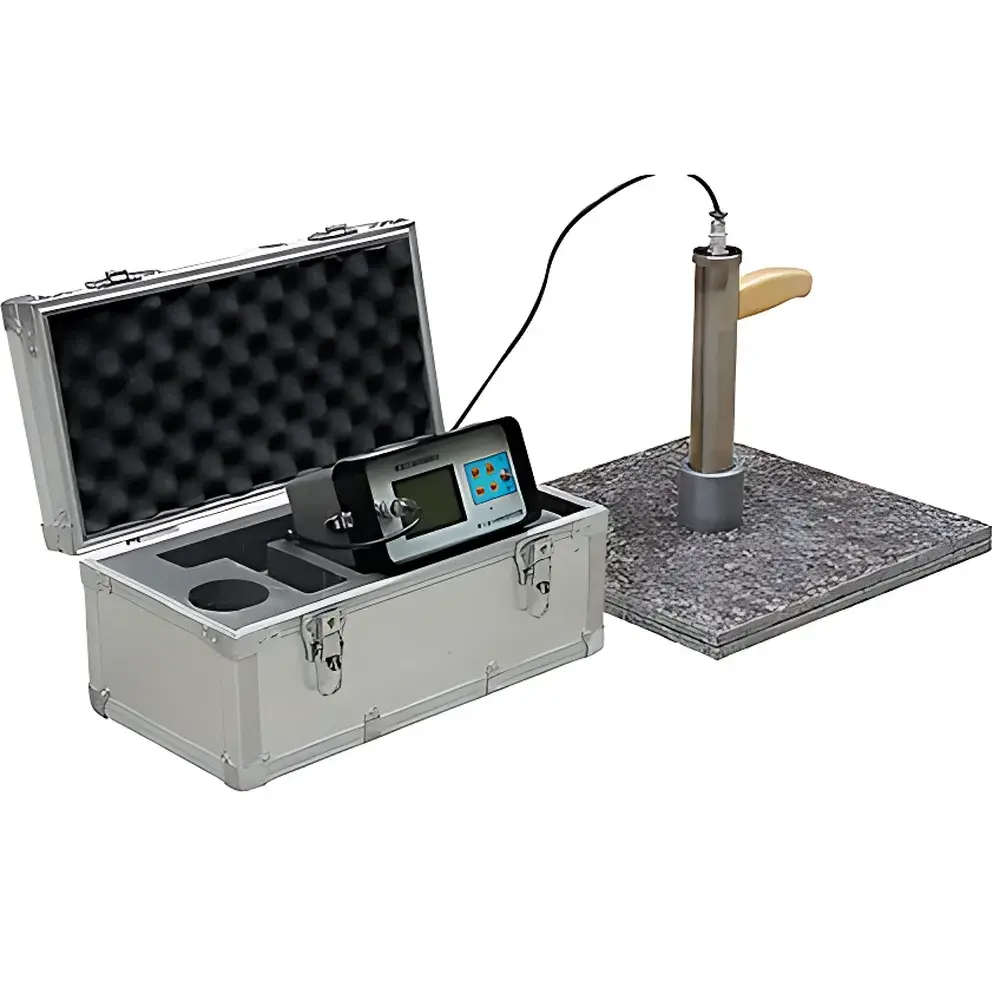
HD-2000 Intelligent Gamma Radiation Survey Meter
| Origin | Beijing |
|---|---|
| Manufacturer Type | Authorized Distributor |
| Origin Category | Domestic (China) |
| Model | HD-2000 |
| Price Range | USD 700–1,400 |
| Instrument Class | Dose Rate Meter |
| Form Factor | Portable |
| Measured Quantity | Ambient Gamma Photon Dose Rate |
| Detector Type | Scintillation-based Environmental Radiation Sensor |
| Measurement Range | (0.01–100) µGy/h |
| Sensitivity | ≥350 s⁻¹ at 1 µGy/h (equivalent to 10³ nGy/h) |
Overview
The HD-2000 Intelligent Gamma Radiation Survey Meter is a field-deployable, scintillation-based dose rate meter engineered for reliable environmental gamma radiation monitoring in regulatory compliance, construction material screening, and routine radiological safety assessments. It operates on the principle of gamma photon interaction with a thallium-doped sodium iodide [NaI(Tl)] scintillation crystal, converting incident ionizing radiation into measurable light pulses. These pulses are amplified and processed by a low-noise photomultiplier tube (PMT) and digital pulse-height analysis circuitry to deliver real-time ambient dose equivalent rate (H*(10)) in microgray per hour (µGy/h). Designed specifically for non-laboratory users—including radiation safety officers, building inspectors, and environmental health technicians—the HD-2000 integrates embedded classification logic compliant with China’s GB 6566–2010 “Limits of Radioactivity in Building Materials”, automatically categorizing stone or ceramic samples as Class A, B, or C based on measured dose rates. Its operational design prioritizes robustness under variable field conditions, with passive temperature compensation and low-power analog front-end architecture ensuring stable performance across its full measurement range.
Key Features
- High-sensitivity NaI(Tl) scintillation detector with energy threshold of 40 keV—optimized for terrestrial gamma emitters including 40K, 226Ra, and 232Th decay chains
- Dual-mode operation: continuous real-time monitoring (3-second averaging interval) and user-selectable timed integration (10 s, 30 s, 60 s, 300 s, or 600 s)
- On-device classification engine compliant with GB 6566–2010 for rapid assessment of natural radionuclide content in construction materials
- Low-power consumption design (≤100 mW), enabling >100 hours of continuous operation on three standard D-cell alkaline batteries
- Integrated LCD with Chinese-language interface—displaying dose rate (µGy/h), count rate (CPS), and material classification status simultaneously
- Long-term stability ≤6% over 8-hour continuous operation; linearity coefficient R² ≥0.999 between gamma source activity and measured CPS
- Calibration traceable to the National Institute of Metrology (NIM), China; supplied with official NIM verification certificate (Certificate No. as issued)
Sample Compatibility & Compliance
The HD-2000 is optimized for ambient gamma field measurements in open-air environments, indoor surfaces (e.g., flooring, wall tiles, countertops), and bulk construction material specimens. It does not require sample preparation or shielding. While not intended for alpha/beta discrimination or spectroscopic identification, its energy response curve (40 keV–1.5 MeV) ensures representative H*(10) estimation for common environmental gamma emitters. The instrument conforms to national metrological verification regulation JJG 393–2018 (Dose Rate Meters for Environmental Gamma Radiation) and supports documentation requirements for GLP-aligned field surveys. Though not certified to IEC 60846-1:2014 or ANSI N42.17B, its performance envelope aligns with typical expectations for Class II portable survey meters used in national building code enforcement and public health screening programs.
Software & Data Management
The HD-2000 operates as a standalone instrument with no external software dependency. All measurement data—including timestamped dose rate values, integration duration, and classification outcomes—are retained in non-volatile memory for up to 500 records. Data export is not supported via USB or Bluetooth; however, manual transcription is facilitated by clear on-screen formatting and dual-unit display (CPS + µGy/h). Audit-ready reporting is enabled through printed NIM verification documentation and internal consistency checks (e.g., real-time stability monitoring and automatic zero-drift compensation). For organizations operating under ISO/IEC 17025 or CNAS-accredited quality systems, the device serves as a primary screening tool—follow-up quantitative analysis of suspect materials should be performed using high-resolution gamma spectrometry (e.g., HPGe systems) in accredited laboratories.
Applications
- Routine radiological screening of granite, marble, ceramic tiles, and concrete aggregates prior to installation in residential or public buildings
- Post-construction verification of compliance with national limits on natural radioactivity in interior spaces
- Environmental baseline surveys near former mining sites, industrial zones, or waste disposal facilities
- Educational demonstrations of gamma radiation detection principles and dose-rate concepts in university physics or health physics labs
- Emergency response triage—rapid identification of elevated ambient fields during transport incidents involving radioactive materials
FAQ
Is the HD-2000 suitable for measuring radon progeny or airborne particulate radioactivity?
No. It measures only penetrating gamma photons from external sources and cannot detect alpha/beta emissions or discriminate short-lived decay products such as 214Po or 212Bi.
Does the instrument provide energy-compensated dose rate readings across its entire range?
Yes—its NaI(Tl) detector and firmware apply empirically derived correction factors to approximate H*(10) within ±20% accuracy across 40 keV–1.5 MeV, per JJG 393–2018 requirements.
Can the HD-2000 be calibrated for use outside China?
It is calibrated against NIM-traceable 137Cs and 60Co reference sources. Users outside China must validate performance against locally accredited standards (e.g., NPL, PTB, or NIST-traceable sources) prior to regulatory deployment.
What maintenance is required to ensure long-term accuracy?
Annual verification against a known gamma source is recommended. Battery compartment seals should be inspected biannually; optical coupling gel between crystal and PMT window requires replacement only if visible degradation occurs after 5+ years of field use.
Related Products







