
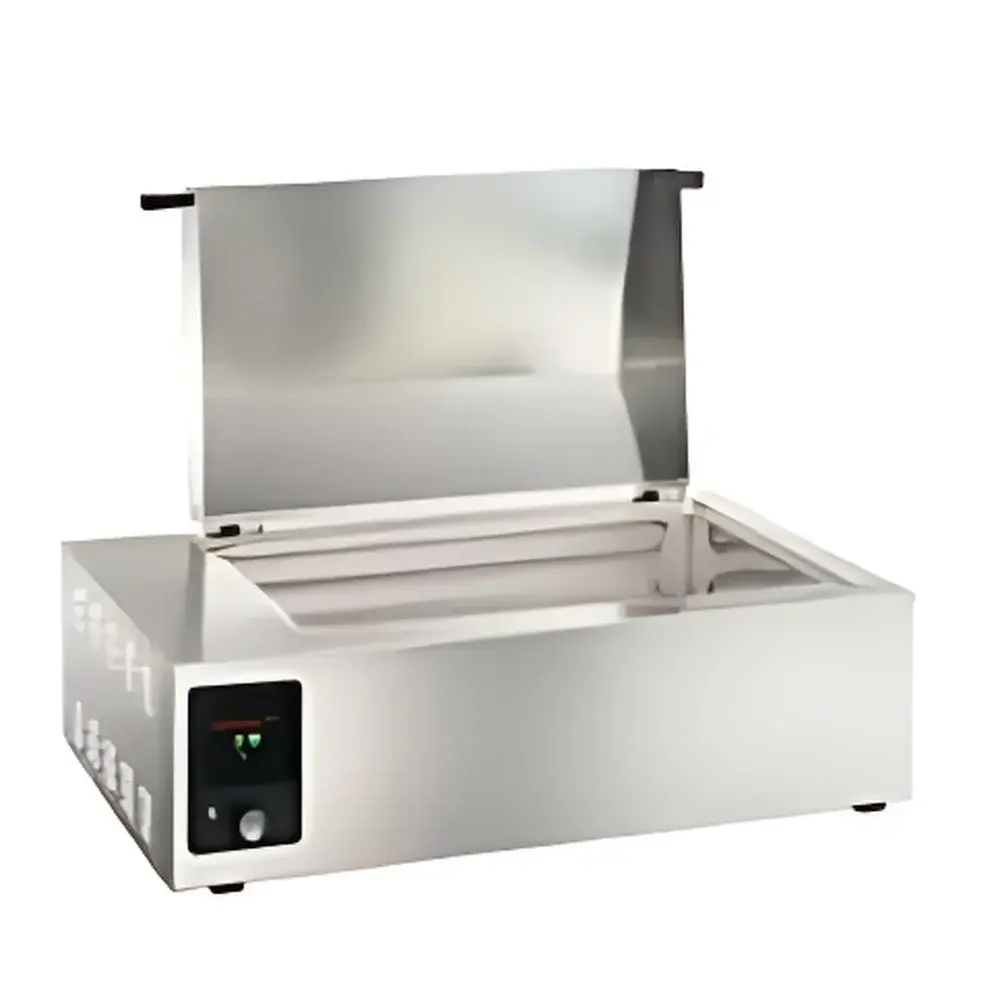
MEMMERT WNB29 Water Bath Circulator
| Brand | MEMMERT |
|---|---|
| Origin | Germany |
| Model | WNB29 |
| Instrument Type | Immersion Circulating Water Bath |
| Circulation | Internal Recirculation |
| Temperature Control | Heating-Only |
| Bath Volume | 29 L |
| Temperature Range | 10 °C to 95 °C (min. setpoint ≥5 °C above ambient) |
| Boiling Mode | 100 °C |
| Temperature Stability | ±0.1 °C (typical, at 37 °C, load-free) |
| Temperature Resolution & Setpoint Accuracy | 0.1 °C |
| Timer Range | B-type: 1 min – 99 h 59 min |
| E-type | 1 min – 999 h |
| Overtemperature Protection | Triple-stage (E-type) / Dual-stage (B-type) |
| Construction | AISI 304 Stainless Steel Inner Bath & Housing |
| Certifications | CE, EN 61010-1, IEC 61000-6-3 |
Overview
The MEMMERT WNB29 is a precision-engineered, internally recirculating water bath designed for stable, uniform thermal conditioning of samples in research, quality control, and production environments. Operating on the principle of forced convection via an integrated circulation pump, the WNB29 ensures homogeneous temperature distribution across the entire 29 L stainless steel bath chamber—critical for applications demanding high reproducibility in enzymatic assays, cell culture incubation, sample thawing, dissolution testing, and controlled chemical reaction kinetics. Unlike passive water baths, its internal recirculation system minimizes thermal gradients (<0.2 °C deviation across bath volume under standard load conditions), enabling reliable operation within tight regulatory frameworks such as ISO/IEC 17025, USP , and GLP-compliant laboratories. The unit complies with EN 61010-1 for laboratory electrical safety and meets electromagnetic compatibility requirements per IEC 61000-6-3.
Key Features
- Pt100 four-wire resistance temperature detector (RTD) probe with traceable calibration—standard on all models; E-type variants include dual independent Pt100 sensors for redundant monitoring and validation-ready temperature logging.
- PID-based digital temperature controller with auto-tuning capability, delivering rapid stabilization (≤15 min from 20 °C to 37 °C, no load) and minimal overshoot (<0.3 °C).
- Triple-level overtemperature protection on E-type units: (1) primary electronic cutoff at +10 °C above setpoint, (2) user-configurable secondary electronic limit (TWW/TWB), and (3) fail-safe mechanical thermostat (TB) activated at +30 °C above maximum rated bath temperature.
- Programmable timer with multiple operational modes: immediate start, delayed start, hold mode, and time-dependent hold (E-type only), supporting unattended overnight or multi-day protocols.
- AISI 304 stainless steel construction throughout—inner bath, outer housing, and fluid-contact components—ensuring corrosion resistance against aqueous buffers, saline solutions, and mild organic solvents.
- LED display with intuitive menu navigation, alarm indicators for temperature deviation, sensor fault, or dry-run detection, and audible/visual warning outputs compatible with building management systems.
Sample Compatibility & Compliance
The WNB29 accommodates a broad range of sample vessels—including Erlenmeyer flasks (100–500 mL), test tubes (14.5–32 mm diameter), microcentrifuge tubes, and custom jigs—via interchangeable support accessories (e.g., conical flask holders, adjustable-height racks, and optional liquid-level controllers). Its open-bath geometry allows direct immersion of probes, sensors, or reactor vessels without spatial constraints. All configurations meet IEC 60529 IP20 ingress protection and are validated for use in GMP-regulated pharmaceutical stability studies (ICH Q1A–Q5C), clinical diagnostic workflows (CLIA, CAP), and academic life science labs adhering to ANSI Z358.1 standards for emergency eyewash proximity. Documentation packages include Factory Acceptance Test (FAT) reports, 3Q (IQ/OQ/PQ) templates, and traceable calibration certificates per ISO/IEC 17025.
Software & Data Management
While the WNB29 operates as a standalone instrument, its E-type controller supports analog output (0–10 V or 4–20 mA) for integration into centralized SCADA or LIMS platforms. Optional RS485 Modbus RTU interface enables remote parameter readout (current temperature, setpoint, timer status, alarm flags) and limited control (start/stop, setpoint adjustment) via LabVIEW, Python, or custom MES software. Audit trail functionality—including timestamped event logging of all operator actions and system alarms—is available when paired with MEMMERT’s optional data logger module (compliant with FDA 21 CFR Part 11 requirements for electronic records and signatures).
Applications
- Thermostatic activation of restriction enzymes and ligases in molecular biology workflows.
- Dissolution testing of solid oral dosage forms per USP and Ph. Eur. 2.9.3.
- Controlled-rate thawing of cryopreserved cell lines and biologics (e.g., CAR-T products) per ASTM F2659 guidelines.
- Pre-heating reagents and solvents prior to HPLC, GC, or spectrophotometric analysis.
- Temperature-dependent viscosity assessment of polymer solutions and hydrogels (in conjunction with rotational viscometers).
- Incubation of microbiological cultures during sterility testing and environmental monitoring programs.
FAQ
Is the WNB29 suitable for oil bath applications?
No—the WNB29 is specifically engineered for aqueous media. For oil-based heating, MEMMERT offers the OB29 series, which features enhanced thermal insulation, higher maximum temperature rating (up to 250 °C), and oil-compatible sealing materials.
Can the WNB29 be used for shaking or agitation?
Yes—when equipped with the optional摇床 (shaking) accessory kit (Order No. L4), the WNB29 supports orbital agitation at fixed speeds (40–200 rpm), ideal for suspension cultures or accelerated extraction protocols.
What is the recommended maintenance interval for the circulation pump?
Under normal usage (8 hrs/day, distilled water), the pump requires inspection every 12 months; cleaning of the impeller and inlet filter is advised quarterly to prevent biofilm accumulation and flow restriction.
Does the WNB29 support external temperature probe input?
Not natively—the controller relies exclusively on its internal Pt100 sensor(s). However, external temperature data can be acquired in parallel using third-party calibrated probes interfaced via the analog output channel.
How is temperature uniformity verified during qualification?
Per ISO 17025 and EURACHEM CG4, uniformity is assessed using a 9-point grid (3×3) with NIST-traceable thermistors or RTDs; maximum deviation from mean must remain ≤±0.3 °C at 37 °C and ≤±0.5 °C at 90 °C.



