
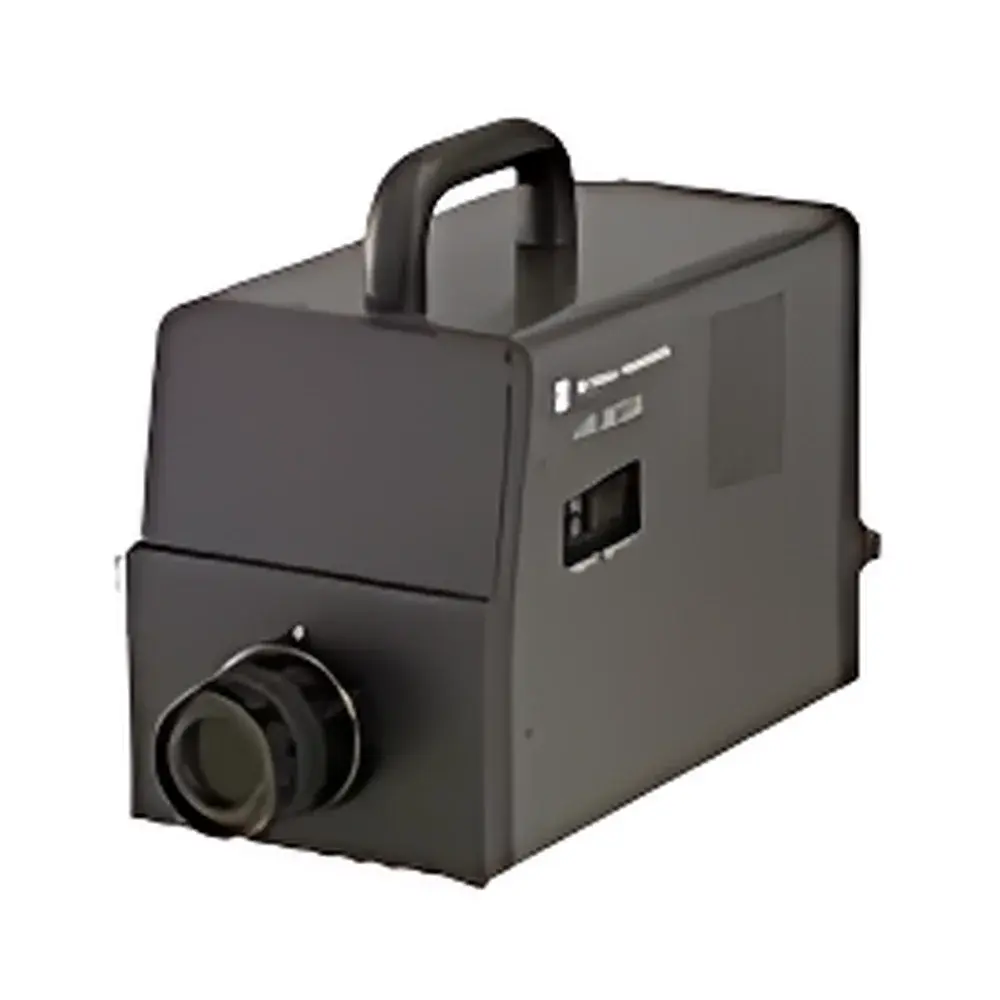
Konica Minolta CS-2000 Spectroradiometer
| Brand | Konica Minolta |
|---|---|
| Origin | Japan |
| Model | CS-2000 |
| Measurement Wavelength Range | 380–780 nm |
| Wavelength Resolution | 0.9 nm/pixel |
| Spectral Bandwidth (FWHM) | <5 nm |
| Measurement Angles | 1°, 0.2°, 0.1° (interchangeable) |
| Luminance Range (A-source) | 0.003–5,000 cd/m² (1°), 0.075–125,000 cd/m² (0.2°), 0.3–500,000 cd/m² (0.1°) |
| Minimum Displayed Luminance | 0.00002 cd/m² |
| Luminance Accuracy | ±2% (A-source, ≥0.003 cd/m²) |
| Chromaticity Accuracy | x,y ±0.003 to ±0.001 (dependent on luminance level) |
| Repeatability (2σ) | Luminance 0.15–0.4%, Chromaticity 0.0004–0.002 |
| Polarization Error | ≤2% (1°), ≤3% (0.1°/0.2°) |
| Integration Time | Fast mode 0.005–16 s, Normal mode 0.005–120 s |
| Measurement Time | 2–243 s |
| Operating Environment | 5–35°C, RH ≤80% (non-condensing) |
| Dimensions | 158 × 200 × 300 mm (main unit), Ø70 × 95 mm (lens) |
| Weight | 6.2 kg |
Overview
The Konica Minolta CS-2000 Spectroradiometer is a high-precision, grating-based spectroradiometric instrument engineered for absolute photometric and colorimetric characterization of ultra-low-luminance light sources—particularly critical in the development and quality assurance of next-generation flat-panel displays (FPDs), OLEDs, microLEDs, and ambient-light-sensitive optical systems. Unlike filter-based photometers or tristimulus colorimeters, the CS-2000 employs a double-monochromator optical architecture with thermoelectrically stabilized CCD detection, enabling true spectral acquisition across 380–780 nm at 0.9 nm/pixel resolution. Its design addresses the fundamental metrological challenge of measuring near-black states—where luminance values fall below 0.01 cd/m²—while maintaining traceable accuracy against NIST-traceable calibration standards. The instrument achieves a dynamic contrast ratio exceeding 100,000:1, making it uniquely suited for evaluating black-level fidelity, panel uniformity, and temporal stability under low-signal conditions where conventional instruments exhibit noise-dominated uncertainty.
Key Features
- Ultra-low-luminance capability: Measures down to 0.003 cd/m² (at 1° field of view), with minimum displayed value of 0.00002 cd/m²—enabling quantification of sub-threshold black emission in OLED and HDR display technologies.
- Triple-angle optical configuration: Interchangeable 1°, 0.2°, and 0.1° measurement angles allow optimization between spatial resolution and signal-to-noise ratio—essential for pixel-level analysis and small-aperture source evaluation.
- High-fidelity spectral acquisition: <5 nm FWHM spectral bandwidth and ±0.3 nm wavelength accuracy (verified at Hg-Cd lamp lines) ensure compliance with CIE S 026/E:2018 and ISO/CIE 19476:2014 spectral irradiance measurement requirements.
- Thermally stabilized detector system: Peltier-cooled CCD array minimizes dark current drift, supporting long integration times (up to 120 s in Normal mode) without thermal noise degradation.
- Robust polarization performance: Polarization error ≤2% (1°) and ≤3% (0.1°/0.2°) across 400–780 nm—critical for accurate measurement of polarized emissive surfaces such as LCDs with retardation films.
- Dual-speed acquisition: Fast mode (as low as 0.005 s integration) enables rapid verification scans; Normal mode supports high-SNR spectral capture for certification-grade reporting.
Sample Compatibility & Compliance
The CS-2000 is optimized for non-contact, point-measurement applications on self-luminous devices including OLED, QD-OLED, AMOLED, and microLED display panels; automotive HUDs; signage LEDs; and laboratory light sources (e.g., calibrated blackbodies, LED chips). It supports measurement of both steady-state and pulsed emissions (with external sync trigger via optional I/O interface). All factory calibrations are traceable to the National Metrology Institute of Japan (NMIJ) and documented per ISO/IEC 17025 requirements. The instrument meets the optical measurement criteria specified in IEC 62341-6-3 (OLED displays), VESA DisplayHDR™ Test Specification, and SMPTE RP 166-2022 for reference monitor validation. While not inherently 21 CFR Part 11 compliant, audit-ready data export (CSV, XML, CIE-15:2018-compliant .cie files) and full metadata logging support GLP/GMP-aligned workflows when integrated into validated laboratory information management systems (LIMS).
Software & Data Management
The CS-2000 operates with Konica Minolta’s proprietary SpectraMagic NX software (v2.9+), providing real-time spectral visualization, CIE 1931 xy, CIE 1976 u’v’, and CIE 2015 TΔuv chromaticity plots, dominant wavelength calculation, and spectral power distribution (SPD) export. Raw spectral data is stored with full instrument metadata—including integration time, angle setting, calibration date, and environmental sensor readings (optional). Software supports batch processing, pass/fail thresholding against user-defined limits (e.g., ΔEu’v’ ≤ 0.002 for black-level consistency), and automated report generation compliant with ISO 13655:2017 spectral measurement documentation. Export formats include CSV (for MATLAB/Python post-processing), XML (for enterprise MES integration), and native .smx project archives with embedded calibration certificates.
Applications
- Display R&D: Quantifying black-level luminance, contrast ratio, and chromaticity shift across grayscale levels in OLED and quantum-dot hybrid displays.
- Manufacturing QA: In-line verification of pixel uniformity, Mura defect detection thresholds, and panel aging studies under accelerated dark-state bias conditions.
- Automotive Electronics: Measuring HUD symbology luminance and chromaticity at driver-eye positions under simulated daylight and night conditions.
- Lighting Engineering: Characterizing low-output architectural lighting elements, emergency signage, and human-centric lighting systems operating in circadian-sensitive dimming ranges.
- Academic Research: Supporting studies in visual perception thresholds, scotopic photometry, and spectral radiance modeling of novel emissive materials.
FAQ
What is the lowest measurable luminance with the CS-2000, and under what conditions?
The CS-2000 achieves a minimum measurable luminance of 0.003 cd/m² using the 1° measurement angle. At this level, chromaticity accuracy is specified as x,y ±0.003 (2σ), and luminance repeatability is 0.4% (2σ). For extended low-light sensitivity, the 0.2° and 0.1° optics provide higher irradiance collection but require corresponding spatial averaging.
Is the CS-2000 suitable for measuring pulsed or PWM-driven displays?
Yes—when synchronized via external trigger input (optional accessory), the CS-2000 can lock integration timing to display frame or PWM cycle, enabling accurate time-resolved spectral acquisition. Manual mode allows user-defined gate timing for custom pulse profiles.
How is calibration maintained over time and temperature?
The instrument includes an internal reference LED for daily verification. Full recalibration is recommended annually or after mechanical shock, performed by Konica Minolta certified service centers using NMIJ-traceable standards. Operating temperature must remain within 5–35°C to maintain stated accuracy specifications.
Can spectral data be exported for third-party analysis?
Yes—raw spectra (301-point, 1 nm intervals) are exportable in CSV format with wavelength and intensity columns, fully compatible with Python (NumPy/Pandas), MATLAB, and commercial optical simulation tools such as LightTools and ASAP.
Does the CS-2000 support automated measurement sequences?
SpectraMagic NX supports macro scripting (VBScript) for unattended grid scanning, multi-angle sweeps, and conditional logic—enabling integration into automated test benches for production line deployment.



