
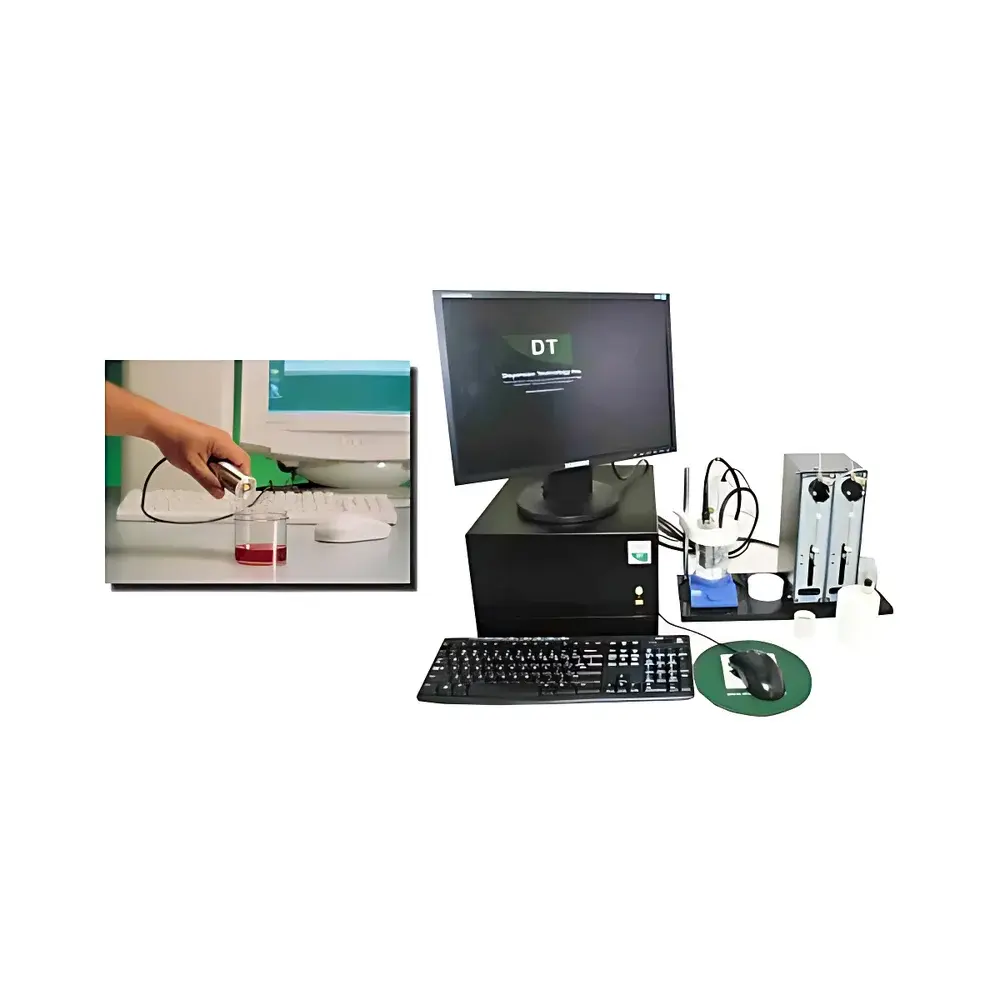
DT Instruments DT-300 / DT-310 Electroacoustic Zeta Potential Analyzer
| Brand | DT Instruments |
|---|---|
| Origin | USA |
| Model | DT-300 / DT-310 |
| Measurement Principle | Electroacoustic (Colloid Vibration Current, CVI) |
| Zeta Potential Range | Unlimited (down to ±0.1 mV) |
| Sample Concentration | 0.1–50% v/v (no dilution required) |
| Minimum Sample Volume | 2 mL |
| Measurable Parameters | Zeta potential, dynamic electrophoretic mobility, Debye length, particle size distribution (via optional ultrasound attenuation spectroscopy), rheological properties (viscoelastic moduli), solid content, porosity |
| Software Platform | Microsoft Access-based database with audit trail capability |
| Optional Module | Automated titration system (DT-310 only) |
| Compliance Context | Designed for GLP/GMP-aligned laboratories |
Overview
The DT Instruments DT-300 and DT-310 Electroacoustic Zeta Potential Analyzers are engineered for direct, non-invasive characterization of concentrated colloidal dispersions and heterogeneous systems without sample dilution or electrode contact. Unlike conventional electrophoretic light scattering (ELS) instruments that require optical transparency and low solids content, the DT series employs the electroacoustic principle—specifically colloid vibration current (CVI) detection—to quantify zeta potential in opaque, high-viscosity, or highly concentrated suspensions. This physical method relies on the generation of an alternating electric current when particles undergo acoustic-driven oscillation in an applied electric field. The resulting CVI signal is directly proportional to the surface charge density and enables robust calculation of zeta potential across a broad range of dispersion media—including aqueous, polar organic, and non-polar solvents. The platform is widely deployed in R&D and QC environments where real-time assessment of formulation stability, surface modification efficacy, and interfacial behavior is critical: e.g., CMP slurries, lithium-ion battery cathode/anode slurries, ceramic green bodies, pharmaceutical emulsions, cementitious pastes, and porous electrodes.
Key Features
- Electroacoustic zeta potential measurement via patented Zeta Probe™ transducer—enabling direct immersion into undiluted samples
- No optical path requirement: fully operational with turbid, opaque, or strongly absorbing dispersions
- Extended dynamic range: capable of resolving zeta potentials as low as ±0.1 mV, essential for weakly charged systems such as polymer-stabilized nanoparticles or near-isoelectric biocolloids
- Simultaneous acquisition of multiple parameters: zeta potential, dynamic electrophoretic mobility, Debye length (κ⁻¹), and—when coupled with ultrasound attenuation spectroscopy—particle size distribution
- Integrated rheological profiling: quantifies storage and loss moduli (G′, G″) in situ, supporting structure–property correlation in viscoelastic dispersions
- DT-310 variant includes motorized, programmable titration module for automated pH, ionic strength, or surfactant titrations with synchronized zeta potential tracking
Sample Compatibility & Compliance
The DT-300/DT-310 accommodates a wide spectrum of industrial and academic sample types: aqueous suspensions (e.g., silica, alumina), non-aqueous formulations (e.g., xylene-based pigment dispersions), high-solid-content battery slurries (>40% w/w), thermosensitive biopharmaceutical emulsions, and rigid porous matrices (e.g., sintered ceramics, fuel cell gas diffusion layers). Its probe-based architecture eliminates membrane fouling, electrode polarization, and bubble interference common in capillary-cell ELS systems. From a regulatory standpoint, the instrument’s Microsoft Access-based software provides structured data storage with user-level access control, timestamped records, and modifiable audit trails—serving as a foundational layer for laboratories implementing FDA 21 CFR Part 11, ISO/IEC 17025, or ICH Q5C-aligned documentation practices. While the base software does not ship with pre-validated electronic signatures, its relational schema supports integration with validated LIMS or ELN platforms under controlled change management protocols.
Software & Data Management
Data acquisition and analysis are managed through DT Instruments’ proprietary software suite, built upon Microsoft Access relational database architecture. Each measurement session logs raw CVI waveforms, calibration metadata, environmental conditions (temperature, conductivity), and derived parameters—including statistical confidence intervals for zeta potential distributions. Reports are exportable in CSV, PDF, and XML formats for traceability and third-party statistical analysis. The DT-310’s titration module adds protocol-driven sequence logging: stepwise reagent addition, real-time response monitoring, endpoint detection algorithms (e.g., inflection point analysis), and overlayable zeta–pH or zeta–ionic strength curves. All database objects support ODBC connectivity, enabling seamless ingestion into enterprise analytics tools or custom Python/R-based modeling pipelines.
Applications
- Stability optimization of chemical-mechanical polishing (CMP) slurries through zeta–pH mapping and double-layer compression analysis
- Electrode slurry development for Li-ion and solid-state batteries: correlating zeta potential with slurry rheology, particle network formation, and coating uniformity
- Quality control of ceramic injection molding feedstocks: assessing binder–particle interaction and green body integrity via combined zeta/rheology metrics
- Formulation screening of oil-in-water and water-in-oil pharmaceutical emulsions under physiologically relevant ionic conditions
- In-process characterization of cement hydration kinetics via time-resolved zeta potential and Debye length evolution
- Pore surface charge profiling in catalyst supports, membranes, and battery separators using back-calculated interfacial potential models
FAQ
Can the DT-300/DT-310 measure zeta potential in non-aqueous media?
Yes—the electroacoustic method is solvent-agnostic and has been validated in alcohols, esters, hydrocarbons, and fluorinated solvents, provided the medium supports sufficient ionic mobility for CVI generation.
Is sample dilution ever required?
No. The system is explicitly designed for native-concentration analysis (0.1–50% v/v); dilution may distort interparticle interactions and yield non-representative surface charge data.
How is Debye length determined?
Debye length is calculated in real time from measured conductivity, temperature, and valence-weighted ion concentration—either input manually or derived from titration profiles in DT-310 mode.
What maintenance does the Zeta Probe require?
The probe contains no consumable electrodes or membranes; routine cleaning with appropriate solvents and periodic calibration verification against NIST-traceable standards constitute standard upkeep.
Does the system comply with 21 CFR Part 11?
The software architecture supports ALCOA+ principles (Attributable, Legible, Contemporaneous, Original, Accurate); full Part 11 compliance requires site-specific validation of electronic signatures, audit trail integrity, and system access controls.



