
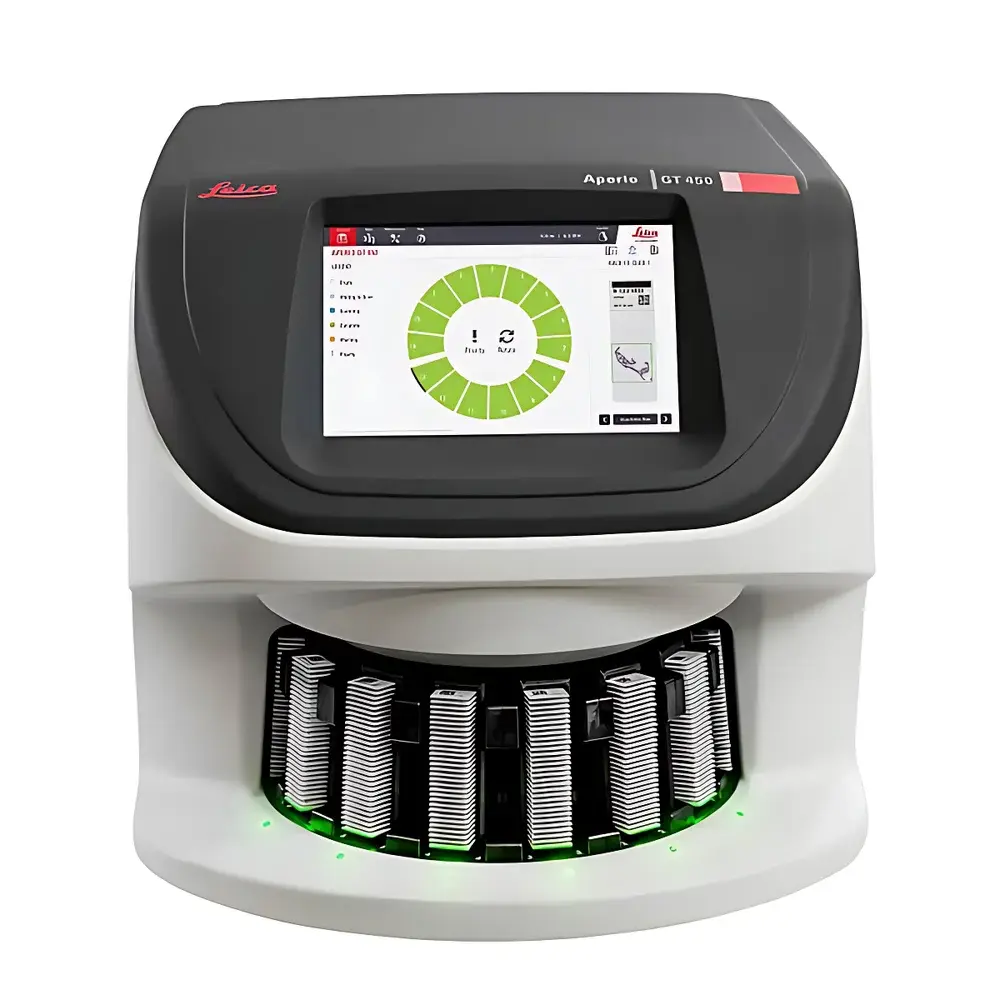
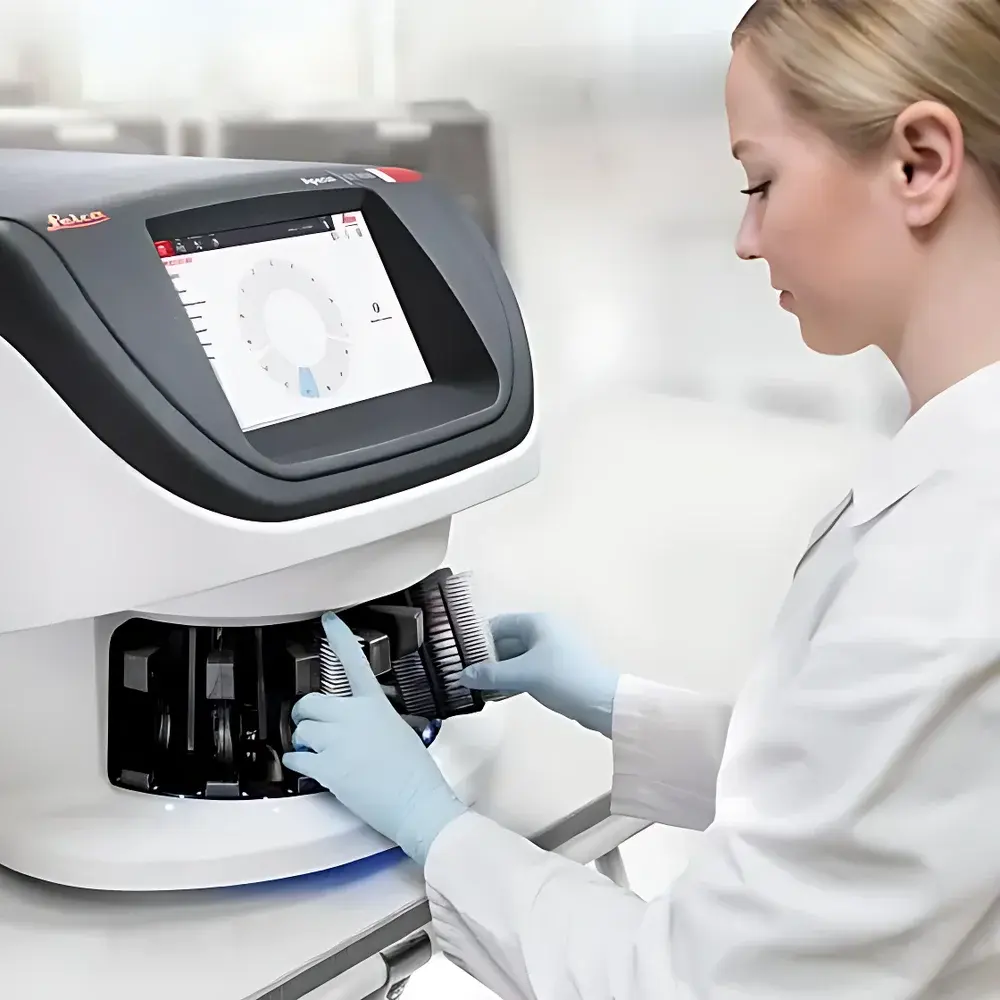
Leica Biosystems Aperio GT 450 Digital Pathology Slide Scanner
| Brand | Leica Biosystems |
|---|---|
| Origin | USA |
| Manufacturer Type | Authorized Distributor |
| Origin Category | Imported |
| Model | Aperio GT 450 |
| Pricing | Available Upon Request |
| Maximum Throughput | 450 slides |
| Slide Rack Capacity | 15 racks × 30 slides or 15 racks × 20 slides |
| Rack Compatibility with Leica HistoCore SPECTRA | Yes |
| Continuous Loading During Scanning | Yes |
| Priority Rack Scanning | Yes |
| Objective Magnification | 40× |
| Pixel Resolution | 0.26 µm/pixel at 40× |
| Scan Speed (15 mm × 15 mm FOV at 40×) | 32 seconds |
| Sustained Throughput | 81 slides/hour |
| Automated Image Quality Control | Yes |
| Slide Dimensions | 1" × 3" (25.4 mm × 76.2 mm) |
| Field of View (FOV) | 1 mm diameter |
| Barcode Recognition | Supports 1D (Code 128, Code 39) and 2D (DataMatrix, QR) symbologies |
| Dimensions (W × L × H) | 20.8" × 23" × 19.5" (52.83 cm × 58.43 cm × 49.53 cm) |
| Weight | 140 lbs (63.5 kg) |
Overview
The Leica Biosystems Aperio GT 450 is a high-throughput, clinical-grade digital pathology slide scanner engineered for precision, reproducibility, and workflow scalability in diagnostic pathology laboratories, academic medical centers, and translational research environments. Built upon Leica’s proprietary optical architecture and integrated color fidelity engine, the GT 450 employs wide-field, motorized stage-based whole-slide imaging (WSI) with a fixed 40× objective to capture high-fidelity digital representations of hematoxylin and eosin (H&E), immunohistochemistry (IHC), fluorescence, and special stain–prepared tissue sections. Its core measurement principle relies on sequential tile acquisition with sub-pixel stitching, real-time focus mapping, and dynamic Z-stack optimization per field—ensuring consistent depth-of-field across heterogeneous tissue topographies. Designed for GLP- and CAP-compliant environments, the system supports audit-ready operation under ISO 13485–certified manufacturing and adheres to DICOM-SR and HL7 FHIR interoperability frameworks for seamless integration into enterprise PACS and LIS infrastructures.
Key Features
- High-throughput scanning capacity up to 450 slides per unattended run, configurable via dual rack formats (15 × 30 or 15 × 20 slides)
- Continuous loading capability enables uninterrupted scanning while new racks are inserted—eliminating idle time between batches
- Prioritized rack scanning allows urgent cases (e.g., intraoperative consultations) to be processed ahead of routine batches without interrupting ongoing acquisitions
- Leica-optimized 40× apochromatic objective with chromatic aberration correction and flat-field illumination ensures uniform resolution (0.26 µm/pixel) and color fidelity across the full 1 mm FOV
- Automated image quality control (IQC) evaluates focus stability, signal-to-noise ratio, stain intensity homogeneity, and barcode readability in real time—flagging suboptimal scans for review or reacquisition
- Integrated 1D/2D barcode reader compliant with CLSI GP26-A3 standards supports bidirectional specimen tracking and chain-of-custody documentation
- Compact footprint (52.83 cm × 58.43 cm × 49.53 cm) and 63.5 kg mass enable deployment in space-constrained lab environments without structural reinforcement
Sample Compatibility & Compliance
The Aperio GT 450 accommodates standard glass microscope slides (25.4 mm × 76.2 mm) with coverslip thicknesses ranging from 0.13 mm to 0.17 mm. It supports conventional paraffin-embedded tissue sections (3–5 µm), frozen sections, cytology preparations (e.g., Pap smears), and bone marrow aspirates mounted on charged or adhesive slides. All scanning protocols comply with CAP Checklist ANP.40500 (Digital Pathology Validation), FDA guidance on Clinical Decision Support Software (CDS), and ISO/IEC 20000-1:2018 for service management. The system is validated for use in IVD workflows under EU IVDR Annex II Class C requirements and supports 21 CFR Part 11–compliant electronic signatures when paired with Leica eSlide Manager v13+.
Software & Data Management
Operation is managed through Leica eSlide Manager—a DICOM-conformant, web-deployable platform supporting role-based access control (RBAC), automated metadata tagging (including case ID, staining protocol, scanner ID, timestamp, and QC flags), and AES-256 encrypted storage. Raw TIFF and compressed JPEG2000 outputs adhere to DICOM Supplement 145 (Whole Slide Microscopy Images). Audit trails record all user actions, parameter changes, and QC events with immutable timestamps—enabling full traceability during regulatory inspections. Integration with third-party AI inference engines (e.g., PathPresenter, Paige, or in-house TensorFlow/PyTorch models) is supported via RESTful API endpoints and OpenSlide-compatible tile access.
Applications
- Clinical pathology departments implementing primary digital diagnosis and remote sign-out under CAP/CLIA guidelines
- Tumor boards requiring synchronized multi-institutional slide review with annotation sharing and version-controlled markup
- Translational research cohorts where longitudinal WSI data must be linked to genomic, proteomic, and clinical outcome databases
- Pharma-sponsored biomarker validation studies requiring batch-scanned archival tissue microarrays (TMAs) with pixel-level quantitation
- Quality assurance programs monitoring inter-observer variability among pathologists using standardized digital reference sets
- Educational repositories for telepathology training, competency assessment, and board exam preparation
FAQ
Is the Aperio GT 450 compatible with Leica’s HistoCore SPECTRA tissue processor?
Yes—the GT 450 accepts SPECTRA-compatible slide racks and shares common barcode symbology and LIMS interface protocols for end-to-end pre-analytical traceability.
Does the system support fluorescence slide scanning?
Yes—when equipped with optional LED-based fluorescence excitation modules and bandpass filter wheels, the GT 450 captures multiplexed IF/IHC co-localization data with spectral unmixing support in eSlide Manager.
Can image quality metrics be exported for QA reporting?
Yes—structured IQC reports (CSV/JSON) include per-scan focus variance, SNR, color delta-E deviation from reference standards, and barcode decode confidence scores.
What network infrastructure is required for enterprise deployment?
A 10 GbE backbone is recommended for concurrent streaming to ≥5 review workstations; minimum requirements include TLS 1.2 encryption, Active Directory integration, and NFS/SMB3 file server compatibility.
Is FDA clearance available for primary diagnostic use?
The Aperio GT 450 holds FDA 510(k) clearance (K201294) for primary diagnosis of H&E- and IHC-stained slides in conjunction with authorized review software and trained pathologists.




