
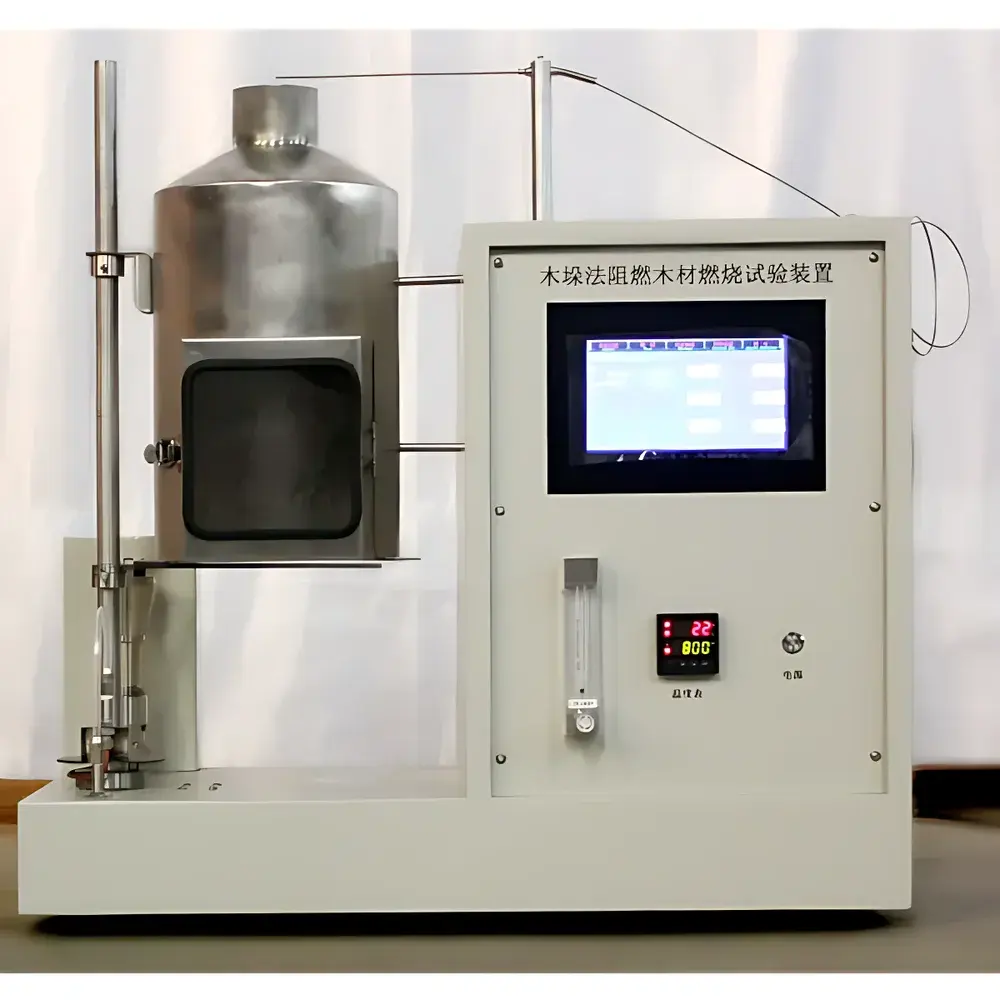
Aerospace WCF-1 Flame Retardancy Tester for Wood – Pile-Burning Method
| Brand | Aerospace |
|---|---|
| Origin | Beijing, China |
| Model | WCF-1 |
| Dimensions (L×W×H) | 700 × 400 × 720 mm |
| Weight | ~30 kg |
| Power Supply | AC 220 V ±10%, 50 Hz, 100 W |
| Gas Source | Natural gas or LPG |
| Ignition Temperature Control | 310 °C ±10 °C |
| Timing Accuracy | ±0.1 s (within 3 min) |
| Repeatability Error | ±0.1% (mass loss) |
| Sample Form | Solid wood specimens |
| Specimen Dimensions | 76 × 13 × 13 mm (±1 mm) |
| Conditioning | 23 ±2 °C, 50 ±5% RH until mass change <1% over 24 h |
| Compliance | GA/T 42.1–2003 “Test Method for Combustion Performance of Flame-Retardant Wood — Pile-Burning Method” |
Overview
The Aerospace WCF-1 Flame Retardancy Tester for Wood – Pile-Burning Method is a purpose-built physical property testing instrument engineered to evaluate the combustion behavior of flame-retardant treated timber under standardized thermal exposure conditions. It implements the pile-burning principle defined in GA/T 42.1–2003, a Chinese public security industry standard aligned with fundamental fire science principles including pyrolysis kinetics, radiant heat transfer, and char layer formation dynamics. The apparatus constructs a controlled, vertically stacked wood specimen array (12 layers × 2 pieces per layer) to simulate real-world thermal feedback geometry during early-stage fire development. Combustion performance is quantified via two primary objective metrics: post-test mass loss ratio (%) and duration of flaming combustion (s), both measured under strictly regulated ignition temperature (310 °C ±10 °C at hood outlet), gas flow, and environmental conditioning (23 ±2 °C / 50 ±5% RH). This method provides reproducible, comparative data essential for quality control in wood treatment facilities, building material certification labs, and fire safety R&D departments.
Key Features
- Engineered compliance with GA/T 42.1–2003: Fully implements all procedural, dimensional, and thermal requirements of the official Chinese standard for wood pile-burning tests.
- Precise thermal regulation: Integrated thermocouple feedback loop maintains hood outlet temperature at 310 °C ±10 °C during flame stabilization phase, verified per calibration protocol.
- High-repeatability mechanical staging: Fixed-height circular specimen support with 25 mm inter-layer spacing ensures consistent convective and radiative coupling between wood elements across replicate tests.
- Dual-phase timing system: Independent countdown (3 min ignition period) and real-time flaming combustion stopwatch with ±0.1 s resolution, manually triggered upon flame extinction.
- Integrated Bunsen burner positioning: Motorized horizontal translation ensures repeatable burner alignment relative to specimen base, minimizing operator-induced variability.
- Robust stainless steel construction: Corrosion-resistant frame and flame shield designed for long-term operation in laboratory environments with periodic soot accumulation.
Sample Compatibility & Compliance
The WCF-1 accepts solid wood specimens meeting strict dimensional tolerances: 76 mm (length) × 13 mm (width) × 13 mm (thickness), cut ±1 mm from nominal values. Specimens must be sourced from timber ≥20 mm thick and conditioned to moisture equilibrium (23 ±2 °C, 50 ±5% RH) prior to testing. Mass stability is confirmed when successive 24-hour weighings yield ≤1% variation. While GA/T 42.1 specifies application to impregnated structural timber, the device’s mechanical and thermal architecture supports comparative evaluation of other dense, low-moisture-content cellulosic solids—provided specimen geometry and placement adhere to the standard’s stacking matrix. The test method itself is referenced in broader fire safety frameworks, including GB 8624 (Chinese building material classification) and informs technical evaluations under ISO 5660 (cone calorimetry correlation studies) and ASTM E84 (surface burning characteristics context).
Software & Data Management
The WCF-1 operates as a hardware-controlled analog-digital hybrid system with no embedded firmware or proprietary software interface. All operational sequences—including burner positioning, ignition timing, and thermal stabilization—are executed via front-panel push-button controls with LED status indicators. Data acquisition remains manual: users record initial/final specimen masses (to 0.1 g), flaming duration (to 0.1 s), and ambient conditions in laboratory notebooks or external LIMS-compatible spreadsheets. This design prioritizes auditability and regulatory transparency—eliminating software validation burdens associated with FDA 21 CFR Part 11 or GLP-compliant electronic records. Test reports generated from WCF-1 data may be formatted to align with ISO/IEC 17025 documentation requirements, including traceable calibration records for digital timers and analytical balances used in conjunction with the instrument.
Applications
- Quality assurance of pressure-impregnated flame-retardant timber in manufacturing plants.
- Third-party verification testing for CE-marked or CCC-certified wood-based construction products.
- Comparative screening of novel flame-retardant formulations (e.g., phosphorus-nitrogen synergists, intumescent coatings) applied to softwood/hardwood substrates.
- Academic research into charring rate kinetics and flame spread inhibition mechanisms in lignocellulosic materials.
- Supporting fire risk assessments for timber-framed buildings under national building codes (e.g., GB 50016).
FAQ
What gas fuels are compatible with the WCF-1?
Natural gas and liquefied petroleum gas (LPG) are supported. A dedicated pressure regulator capable of delivering 0.3 MPa output is required.
Is exhaust ventilation mandatory?
Yes. The apparatus generates smoke, particulate matter, and incomplete combustion byproducts. It must be operated inside a certified fume hood or connected to an active flue gas abatement system.
Does the WCF-1 include calibration certificates?
No. Users must supply and calibrate external equipment: Class II analytical balance (0.01 g readability), digital timer (±0.1 s accuracy), and calibrated thermocouple reader (traceable to NIM or equivalent national metrology institute).
Can the WCF-1 be used for non-wood materials?
GA/T 42.1 applies exclusively to wood. Deviations require method validation per ISO/IEC 17025 Clause 7.2.2 and are not covered by the instrument’s design qualification.
What electrical infrastructure is required?
A dedicated 220 V ±10%, 50 Hz, grounded outlet rated for ≥100 W continuous load. No surge protection or UPS is specified, but recommended for lab-wide power stability.



