
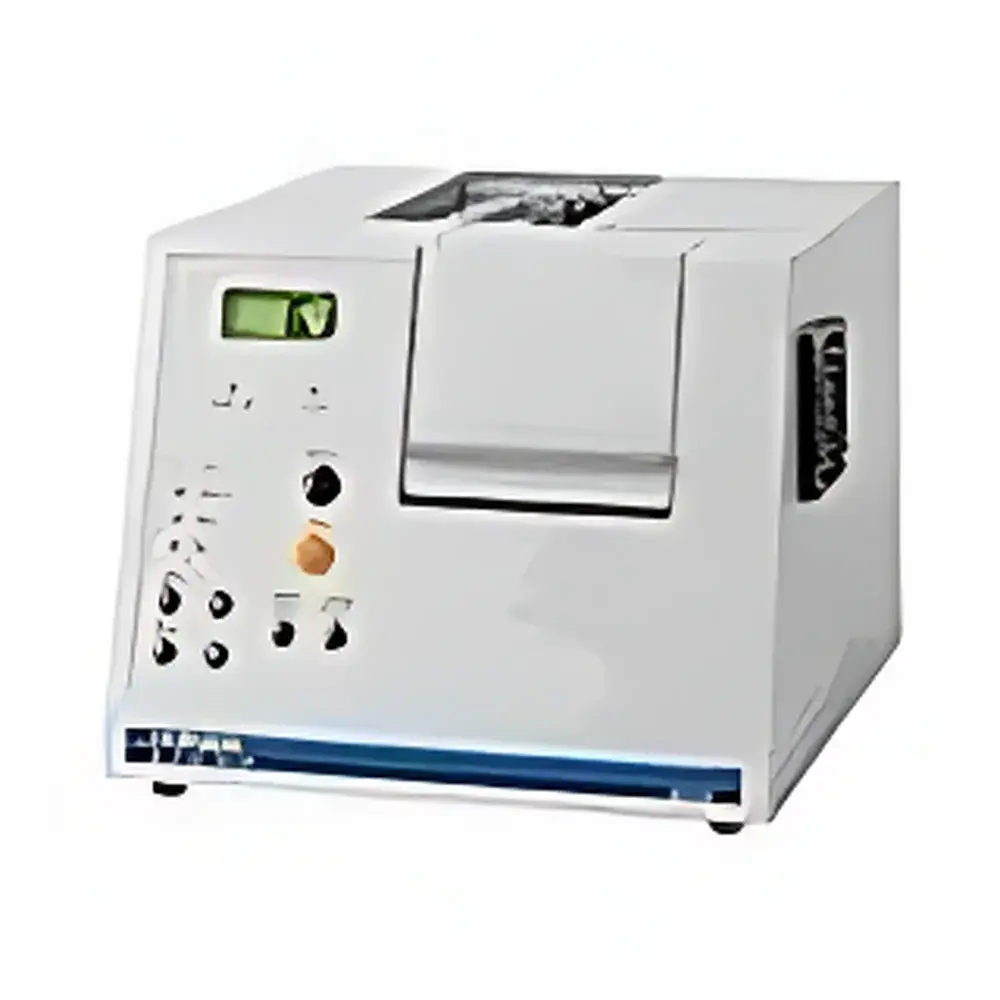
Horiba OCMA-355 Oil Content Analyzer
| Origin | Japan |
|---|---|
| Manufacturer Type | Authorized Distributor |
| Origin Category | Imported |
| Model | OCMA-355 |
| Pricing | Available Upon Request |
Overview
The Horiba OCMA-355 Oil Content Analyzer is a precision laboratory instrument engineered for quantitative determination of hydrocarbon-based oil contaminants in aqueous, solid, and semi-solid matrices using solvent extraction coupled with non-dispersive infrared (NDIR) absorption spectroscopy at the characteristic C–H stretching band near 2960 cm⁻¹ (3.37 µm). Designed to meet stringent regulatory and industrial quality control requirements, the OCMA-355 operates on the H-997 standardized extraction method—aligned with JIS K 0102, ISO 9377-2, and ASTM D7066—ensuring traceable, reproducible results across environmental monitoring, semiconductor manufacturing, precision machining, and wastewater treatment applications. Unlike broad-spectrum UV-Vis analyzers, the OCMA-355 leverages selective IR absorption to minimize interferences from humic substances, surfactants, or suspended solids (SS), delivering high specificity for aliphatic and aromatic hydrocarbons commonly found in cutting fluids, lubricants, and mineral oils.
Key Features
- Non-dispersive infrared (NDIR) detection optimized at 3.37 µm for selective quantification of total petroleum hydrocarbons (TPH) via C–H bond absorption
- Modular, snap-fit sample cell design enabling rapid loading and cleaning—no tools required; compatible with standard halogenated solvents (e.g., CCl₄, C₂Cl₄) per EPA Method 1664A guidelines
- Triple-unit display mode: switch seamlessly between concentration units—mg/L (for aqueous extracts), mg/kg (for soil/sediment extracts), and absorbance (Abs) for method validation and calibration linearity assessment
- Backlit LCD interface with intuitive menu navigation and real-time signal stabilization feedback
- Standard RS-232C serial interface for bidirectional communication with LIMS or PC-based data acquisition software; supports ASCII protocol for automated report generation
- Optical path length fixed at 10 mm for consistent Beer–Lambert law compliance across all measurement ranges
Sample Compatibility & Compliance
The OCMA-355 accommodates pre-extracted samples only—requiring prior liquid–liquid extraction (e.g., using Hach or Horiba-certified extraction kits) per ISO 9377-2 Annex A or JIS K 0102 Clause 8. It is validated for use with water samples containing suspended solids (SS), emulsified oil droplets, and low-turbidity effluents typical of metalworking coolant discharge streams. For soil analysis, homogenized samples must undergo Soxhlet or ultrasonic-assisted extraction using tetrachloroethylene or hexane substitutes compliant with REACH Annex XVII. Instrument performance adheres to GLP principles: each measurement includes embedded audit trail metadata (date/time stamp, operator ID placeholder, cell ID), and optional SR-305 solvent regeneration unit enables closed-loop solvent reuse—reducing hazardous waste volume by >85% versus single-use protocols.
Software & Data Management
While the OCMA-355 operates as a standalone analyzer, its RS-232C port facilitates integration into regulated environments requiring electronic records. When connected to compliant PC software (e.g., Horiba LabSolution or third-party FDA 21 CFR Part 11–enabled platforms), it transmits raw absorbance values, calculated concentrations, unit selection flags, and system diagnostic codes—including lamp intensity decay metrics and detector thermal drift compensation status. All exported data retain native timestamping and checksum integrity verification. The device itself stores no user data internally; measurement history is retained solely in external systems—supporting full traceability during GMP or ISO/IEC 17025 audits.
Applications
- Validation of degreasing efficiency in semiconductor wafer cleaning lines and MEMS fabrication rinse tanks
- Residual oil quantification on machined metal surfaces (e.g., automotive engine blocks, aerospace turbine components) per ISO 4020 and VDA 19.1
- Monitoring of oily wastewater treatment plant influent/effluent compliance with local discharge limits (e.g., Japan’s Water Pollution Control Law Article 13)
- Soil screening at brownfield sites under ASTM D5369 and JIS A 1415 for hydrocarbon contamination prior to remediation
- Quality assurance of recycled coolants in high-precision grinding operations where sub-5 mg/L oil carryover affects surface finish Ra values
FAQ
Does the OCMA-355 perform solvent extraction onboard?
No. It measures only pre-extracted samples. Extraction must be conducted externally using standardized methods (e.g., JIS K 0102 or ISO 9377-2) and appropriate solvents.
Is the SR-305 solvent regenerator compatible with all extraction solvents?
The SR-305 is optimized for tetrachloroethylene (PERC) and trichloroethylene (TCE); performance with alternative solvents such as hexane or cyclohexane requires validation per Horiba Technical Note TN-OCMA-004.
Can the OCMA-355 be calibrated using certified reference materials?
Yes. NIST-traceable mineral oil standards (e.g., AccuStandard OIL-M-1000) are recommended for initial calibration and periodic verification; calibration curves must be verified quarterly per ISO/IEC 17025 Clause 5.6.
What maintenance intervals are specified for the infrared source and detector?
The tungsten-halogen IR source has a rated lifetime of ≥5,000 hours; detector stability is monitored automatically via internal reference channel—no user-replaceable parts are required within first 36 months of operation under normal lab conditions.







