
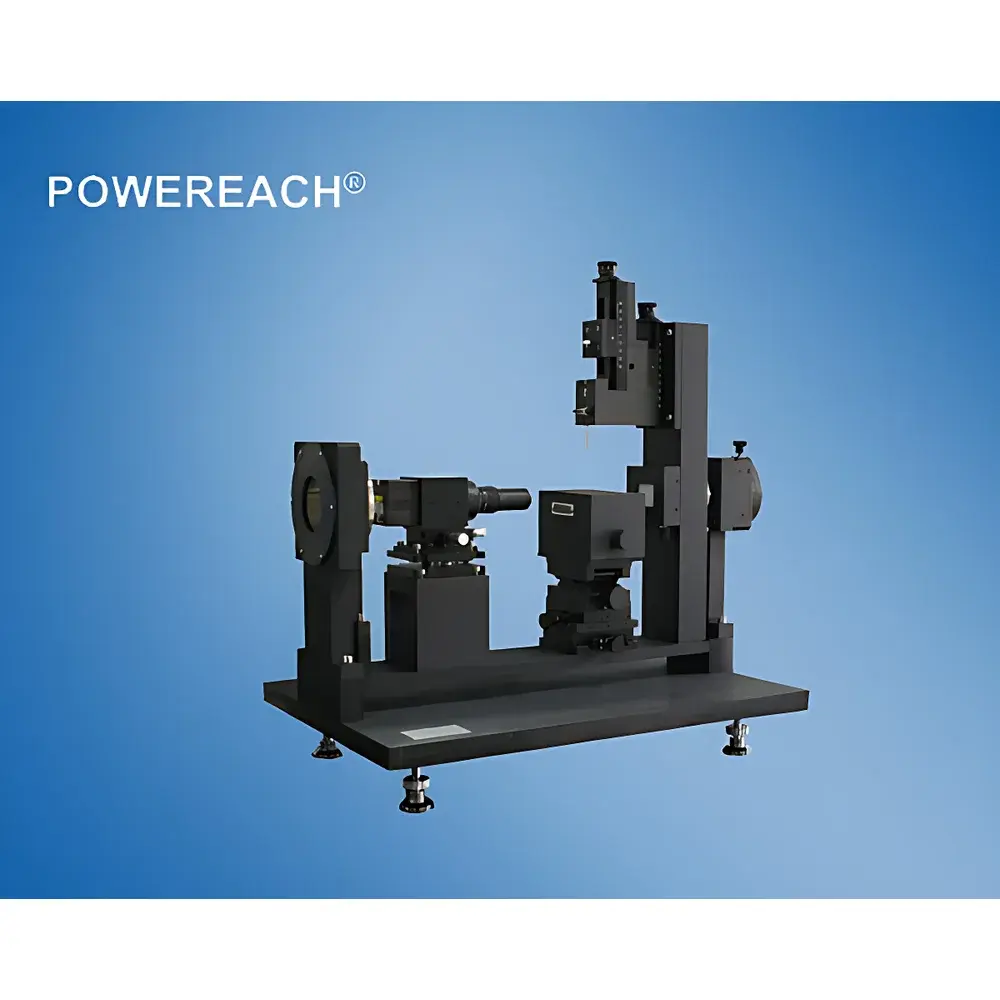
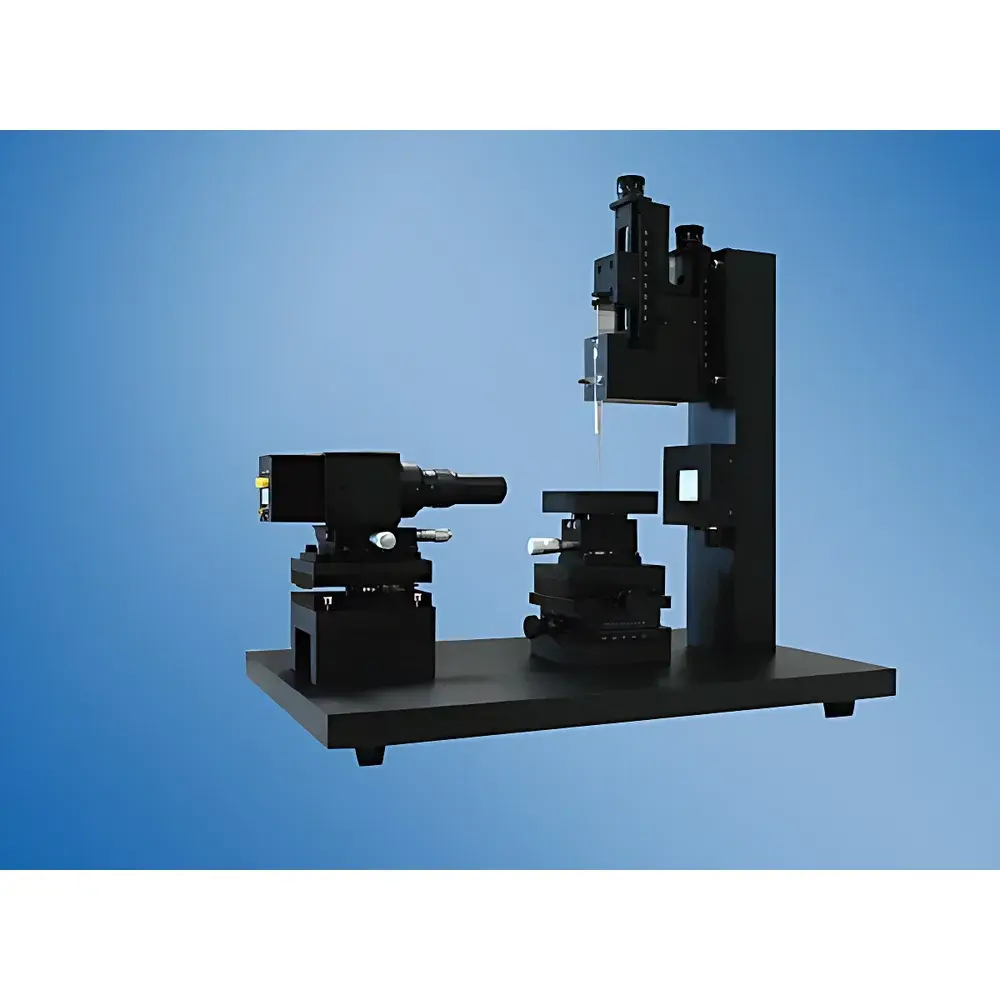
JC2000DM Precision Automated Optical Contact Angle Goniometer
| Origin | Beijing, China |
|---|---|
| Manufacturer Type | Authorized Distributor |
| Origin Category | Domestic (PRC) |
| Model | JC2000DM |
| Price Range | USD 7,000–14,000 |
| Instrument Class | Video-Based Optical Contact Angle Analyzer |
| Form Factor | Benchtop Laboratory System |
| Contact Angle Range | 0–180° |
| Contact Angle Accuracy | ±0.1° |
| Fixed Sample Stage Dimensions | 100 × 80 mm |
| Optical Magnification | 0.7×–4.5× Continuous Zoom |
| Surface/Interfacial Tension Range | 0–2000 mN/m |
| Surface/Interfacial Tension Accuracy | ±0.01 mN/m |
Overview
The JC2000DM Precision Automated Optical Contact Angle Goniometer is an advanced benchtop instrument engineered for quantitative characterization of solid–liquid–gas interfacial behavior using high-resolution video-based optical goniometry. It operates on the principle of sessile drop analysis—capturing high-fidelity side-view images of liquid droplets dispensed onto solid substrates and applying rigorous geometric and curve-fitting algorithms to determine contact angle values at the three-phase boundary. Complementing static measurements, the system supports dynamic contact angle acquisition—including advancing, receding, roll-off, and tilting angle protocols—enabling comprehensive assessment of surface heterogeneity, hysteresis, and wettability kinetics. Designed for materials science, coatings R&D, biomaterials evaluation, and nanomaterial surface functionalization studies, the JC2000DM delivers traceable, reproducible results aligned with ASTM D7334 (Standard Practice for Surface Wettability of Coatings by Contact Angle Measurement) and ISO 19403-2 (Contact Angle Measurement — Part 2: Static Contact Angle). Its modular architecture integrates optomechanical stability, automated fluid handling, and calibrated imaging subsystems to ensure metrological integrity across diverse sample classes.
Key Features
- Automated 360° motorized sample stage with software-controlled rotation for sequential advancing/receding angle measurement and roll-off angle determination
- Dual-channel precision microdispensing system with programmable 0.1 µL resolution, enabling repeatable droplet deposition and multi-point spatial mapping
- Seven-axis mechanical adjustment platform for precise alignment of sample, lens, and illumination axes—critical for minimizing parallax and optical distortion
- Industrial-grade low-light CCD camera operating at 100 fps, supporting high-speed dynamic contact angle tracking and time-resolved droplet evolution studies
- Continuously variable industrial zoom lens (0.7×–4.5×) with integrated telecentric optics, delivering uniform magnification and minimal edge distortion across full field-of-view
- Adjustable cold LED backlight with acrylic diffuser plate ensuring homogeneous illumination—essential for robust edge detection in automated image analysis
- Integrated surface energy calculation module implementing Fowkes (one-liquid), Owens-Wendt (two-liquid), and van Oss–Chaudhury–Good LW-AB (three-liquid) models
Sample Compatibility & Compliance
The JC2000DM accommodates a broad spectrum of solid substrates without requiring vacuum or conductive coating: rigid solids (metals, ceramics, polymers), flexible films (PET, PDMS), textiles (woven/nonwoven fabrics), fibers (single filaments, yarns), and consolidated powder compacts. Optional fixtures—including a fabric tautness frame and fiber holder—ensure mechanical stability during measurement. All hardware components comply with CE safety directives and IEC 61010-1 for laboratory electrical equipment. Data acquisition workflows support audit-trail generation and user-access logging, facilitating alignment with GLP and internal quality assurance requirements. While not pre-certified for FDA 21 CFR Part 11, the software architecture permits configuration of electronic signatures, version-controlled method files, and immutable data export—enabling laboratories to implement compliant documentation practices.
Software & Data Management
The proprietary analytical suite provides six validated contact angle calculation methods: tangent (θt), height (θh), circle-fit, ellipse-fit, Young–Laplace fitting (for pendant/sessile drop), and fully automated edge-detection–driven analysis. Dynamic measurement sequences are configurable from 10 ms to 3600 s per frame, with synchronized timestamped image capture and metadata embedding (e.g., ambient temperature/humidity, operator ID, calibration status). Raw images (BMP), processed data tables (CSV/Excel), and annotated reports (PDF) are stored in a relational database with built-in backup, compression, and cross-session query functions. All contact angle values—including left/right asymmetry quantification and statistical summaries (mean, SD, CV%)—are exportable with embedded curve fits and error indicators. Surface free energy outputs include total energy (mJ/m²) alongside dispersive (γD) and polar (γP) components, traceable to reference liquid databases conforming to IUPAC-recommended surface tension values.
Applications
- Quantitative evaluation of plasma, corona, or chemical surface treatments on polymeric films and packaging materials
- Characterization of hydrophobic/hydrophilic gradients in functionalized membranes and filtration media
- Wettability screening of catalyst supports, battery electrode coatings, and printed electronics substrates
- Surface energy mapping of heterogeneous biomedical scaffolds and tissue-engineered constructs
- CMC determination and surfactant adsorption isotherm modeling via pendant drop interfacial tension analysis
- Quality control of anti-fouling coatings, self-cleaning surfaces, and omniphobic textiles
FAQ
What measurement principles does the JC2000DM employ?
It utilizes optical goniometry based on high-resolution side-view imaging of sessile and pendant drops, combined with mathematical curve fitting (Young–Laplace equation) and geometric tangent methods.
Can it measure contact angles on curved or rough surfaces?
Yes—the software includes dedicated curvature correction modules for convex/concave substrates and optional roughness compensation algorithms based on local slope normalization.
Is the system compatible with non-aqueous or volatile solvents?
Yes—sealed environmental chambers (optional accessory) enable controlled atmosphere operation (N₂, dry air) for low-volatility or oxidation-sensitive liquids.
Does the software support automated batch processing of multiple samples?
Yes—method templates can be assigned to sample groups; the system executes auto-focus, auto-dispense, image capture, and analysis sequentially without manual intervention.
What calibration standards are recommended for routine verification?
Certified glass slide standards with certified contact angles (e.g., 60° ± 0.5° and 110° ± 0.5°) and NIST-traceable surface tension reference fluids (e.g., diiodomethane, ethylene glycol, water) are advised for daily performance checks.



