
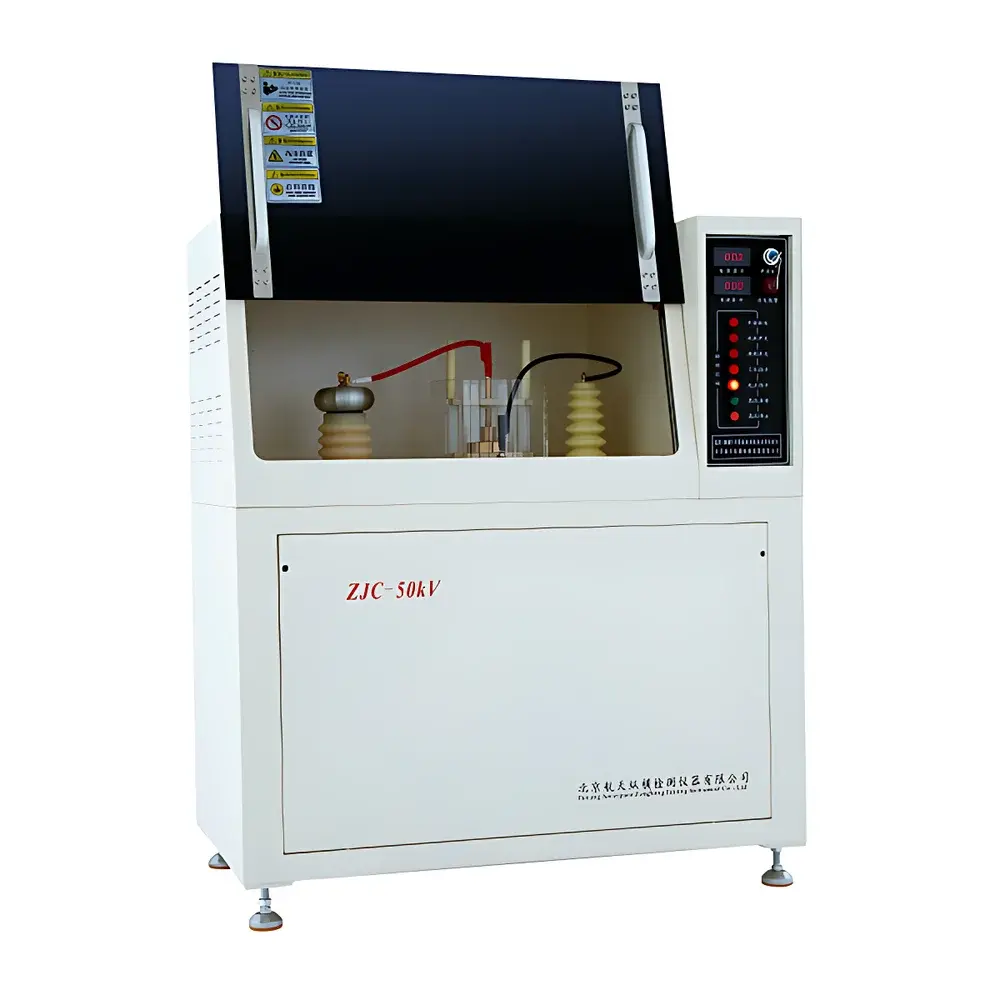
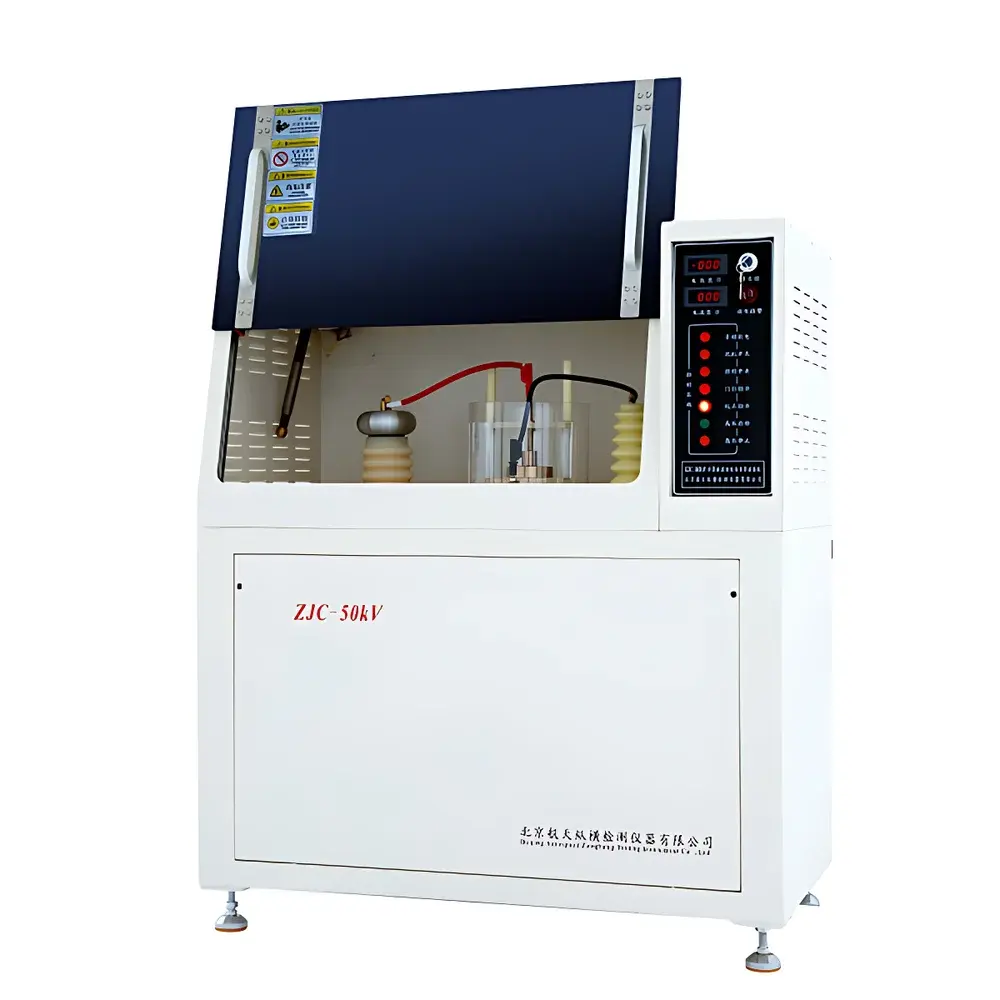
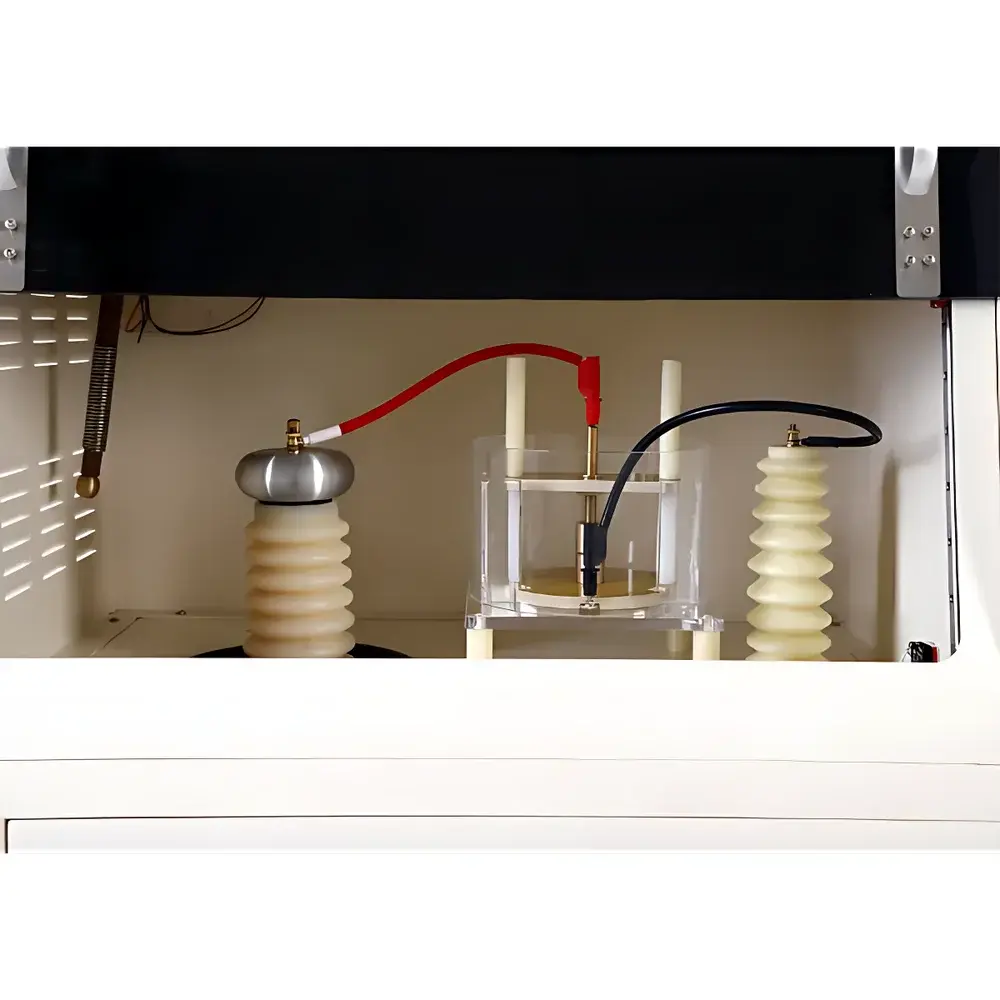
Aerospace ZJC-100KV AC/DC Dielectric Breakdown Tester
| Brand | Aerospace |
|---|---|
| Origin | Beijing, China |
| Manufacturer Type | Authorized Distributor |
| Product Category | Domestic |
| Model | ZJC-100KV |
| Price Range | USD 7,000 – 21,000 (FOB) |
| Maximum Output Voltage | 100 kV |
| Voltage Ramp Rate | 0.5–5 kV/s (continuously adjustable) |
| Voltage Measurement Range | 0–100 kV |
| Voltage Resolution | 1 V (10-bit A/D) |
| Breakdown Current Range | 0.1–100 mA |
| Current Accuracy | ±1% FS |
| Overvoltage Protection Threshold Accuracy | ±5% |
| Overcurrent Response Time | <1 ms |
| Flashover Auto-Restart Delay | 0–60 s (adjustable) |
| Safety Interlock Compliance | IEC 61010-1 |
| Data Sampling Rate | 500 Hz |
| Output Formats | CSV (raw), PDF (standard report) |
| Environmental Operating Conditions | 25±5°C, ≤65% RH |
| Electrode Material | Tungsten-Copper |
| Recommended Electrode Maintenance | Polishing with #800 grit sandpaper after every 50 tests |
| Transformer Oil Service Interval | Filtration required after 500 operating hours |
Overview
The Aerospace ZJC-100KV AC/DC Dielectric Breakdown Tester is an engineered solution for quantitative evaluation of electrical insulation integrity under controlled high-voltage stress. Based on the fundamental principle of dielectric strength measurement—applying a steadily increasing electric field across a test specimen until electrical breakdown occurs—the system complies with core international standards including IEC 60243-1 (Methods of Determining Dielectric Strength of Solid Insulating Materials), ASTM D149 (Dielectric Breakdown Voltage of Solid Electrical Insulating Materials at Commercial Power Frequencies), and GB/T 1408.1. It supports both AC (50/60 Hz sinusoidal) and DC voltage application modes, enabling comparative assessment of material behavior under alternating versus steady-state electric fields—a critical distinction in power cable insulation qualification, capacitor dielectric screening, and high-voltage component validation.
Key Features
- Programmable voltage ramp rate from 0.5 to 5 kV/s, continuously adjustable to match standard-specific requirements (e.g., UL 746C step-stress protocols or IEC 60243 continuous ramp).
- Dual-mode operation: selectable AC (rms voltage measurement) and DC (constant-polarity output) testing circuits, each with independent calibration traceability.
- High-fidelity measurement architecture featuring a 10-bit analog-to-digital converter for voltage sensing, delivering 1 V resolution across the full 0–100 kV range.
- Breakdown current monitoring with 0.1–100 mA range and ±1% full-scale accuracy, supporting post-failure analysis of conduction mechanisms (e.g., thermal runaway vs. avalanche ionization).
- Triple-layer safety architecture: (1) overcurrent cutoff (<1 ms response), (2) flashover detection with user-configurable auto-restart delay (0–60 s), and (3) IEC 61010-compliant mechanical door interlock ensuring zero high-voltage output unless fully latched.
- Real-time data acquisition at 500 Hz, generating time-synchronized voltage–time waveforms for breakdown event localization and transient characterization.
Sample Compatibility & Compliance
The ZJC-100KV accommodates solid, liquid, and composite dielectrics per standardized electrode configurations (e.g., ASTM D149 disk electrodes, IEC 60243 needle-plane, or custom liquid-cell fixtures). For solid specimens (e.g., XLPE sheets, ceramic insulators, epoxy laminates), thickness-dependent voltage initiation settings are programmable—e.g., 15 kV initial voltage for 3–5 mm XLPE samples. Liquid media testing requires optional magnetic stirrer (≥200 rpm) and compatible dielectric fluids (e.g., silicone oil, 30–50 cSt viscosity). All test procedures align with GLP documentation requirements: audit trails record operator ID, timestamp, parameter set, environmental readings (temperature/humidity), and raw waveform metadata. The system supports 21 CFR Part 11–compliant electronic signatures when integrated with validated laboratory information management systems (LIMS).
Software & Data Management
Embedded firmware enables automated report generation compliant with ISO/IEC 17025 technical record requirements. Each test exports two primary artifacts: (1) a timestamped CSV file containing voltage, current, time, and status flags at 500 Hz; and (2) a formatted PDF report listing test standard, specimen ID, electrode geometry, environmental conditions, pass/fail determination, measured breakdown voltage, and statistical summary (n ≥ 5 replicates). Optional industrial PC integration adds synchronized high-speed imaging (1000 fps) triggered at voltage threshold crossing, enabling spatial correlation of breakdown paths with microstructural features. Data integrity is reinforced via SHA-256 hashing and optional blockchain timestamping for regulatory submissions requiring non-repudiation.
Applications
This instrument serves as a primary qualification tool in R&D and QC laboratories across multiple sectors: polymer compounders validating crosslinked polyethylene (XLPE) formulations for underground power cables; ceramic manufacturers certifying insulator performance under wet-flashover conditions; battery material developers assessing separator film dielectric stability under DC bias; and aerospace composites suppliers verifying lightning strike protection layer integrity. Its dual AC/DC capability supports comparative studies on space charge accumulation (DC mode) versus partial discharge inception (AC mode)—a key differentiator for evaluating next-generation high-temperature dielectrics used in electric vehicle traction inverters and wind turbine generators.
FAQ
What standards does the ZJC-100KV comply with?
It meets the electrical safety requirements of IEC 61010-1 and supports test methods defined in IEC 60243-1, ASTM D149, UL 746C, and GB/T 1408.1.
Is third-party calibration support available?
Yes—calibration certificates traceable to national metrology institutes (e.g., NIM China, NIST USA) can be provided upon request, with recommended recalibration intervals every 6 months or after 200 operational hours.
Can the system interface with existing LIMS or MES platforms?
It supports OPC UA and Modbus TCP protocols for bidirectional data exchange, enabling automated test initiation, result ingestion, and electronic batch record linkage.
How is electrode wear managed during high-throughput testing?
Tungsten-copper electrodes require surface polishing with #800 grit abrasive paper after every 50 tests to maintain consistent contact resistance and field uniformity—documented in the maintenance log embedded in the software.
What environmental controls are mandatory for valid results?
Testing must occur in an environment stabilized at 25±5°C and ≤65% RH; for humidity-sensitive materials (e.g., hygroscopic polymers), preconditioning in a climate-controlled chamber (e.g., 50°C/30% RH for 48 h) is required prior to testing.



