
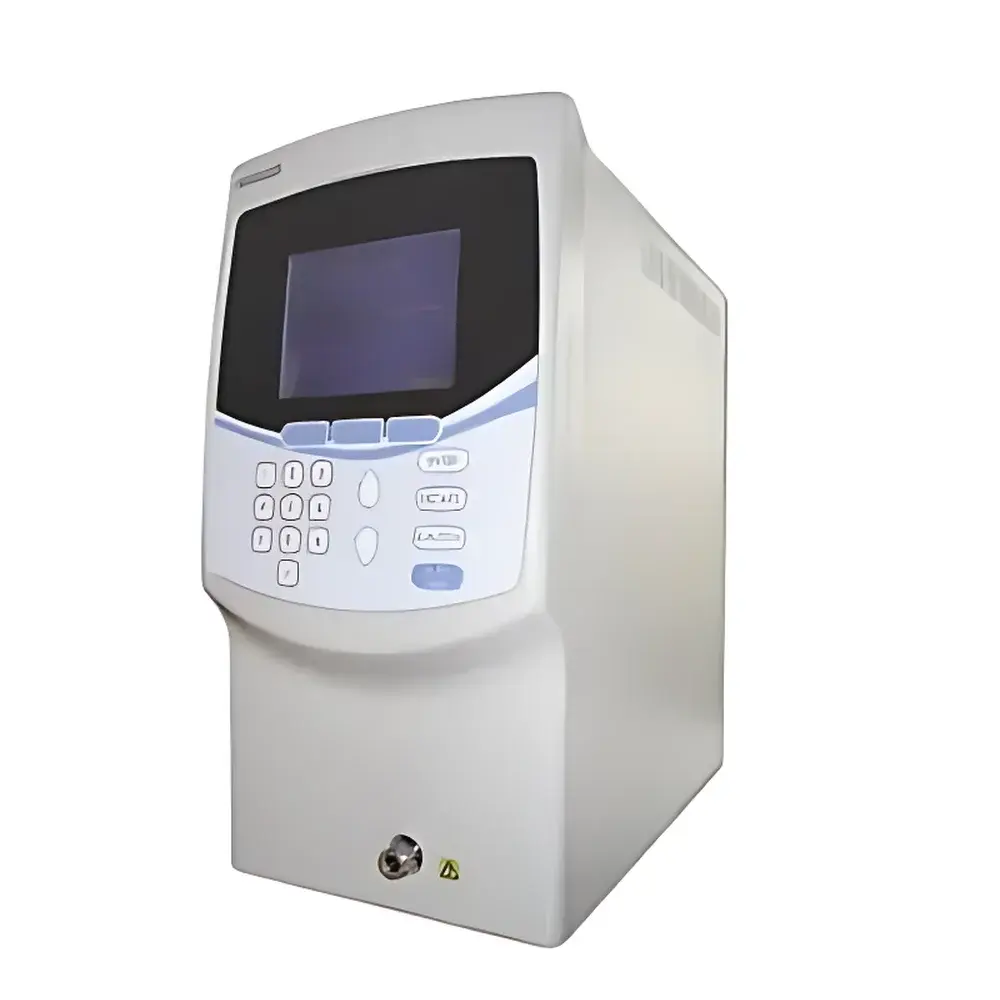
Chromachem DDL301 Evaporative Light Scattering Detector (ELSD)
| Brand | LABA (Tianjin Lanbo) |
|---|---|
| Origin | USA |
| Manufacturer Type | Authorized Distributor |
| Product Category | Imported Instrument |
| Model | DDL301 |
| Instrument Type | Evaporative Light Scattering Detector (ELSD) |
| Wavelength Range | 190–900 nm |
| Detection Method | Photomultiplier Tube (PMT) |
| Light Source | High-Intensity Halogen Lamp |
| Evaporation Principle | Low-Temperature Nebulization & Drift Tube Evaporation |
| Compatibility | HPLC, UHPLC, and LC-MS Coupling |
| Detection Sensitivity | Mass-sensitive, independent of chromophore, fluorophore, or electrochemical activity |
| Gradient Compatibility | Fully compatible with gradient elution |
| Baseline Stability | High resistance to flow rate and temperature fluctuations |
| Physical Footprint | Compact benchtop design (W × D × H: 240 × 450 × 320 mm) |
Overview
The Chromachem DDL301 Evaporative Light Scattering Detector (ELSD) is a mass-sensitive, universal detection system engineered for high-reproducibility quantification of non-volatile and semi-volatile analytes in liquid chromatography. Unlike UV-Vis or fluorescence detectors, the DDL301 operates on the physical principle of light scattering: analyte-containing mobile phase is first nebulized into fine droplets, solvent is evaporated in a precisely controlled heated drift tube, and residual non-volatile particles scatter incident light—detected by a high-gain photomultiplier tube (PMT). This mechanism ensures quantitative response proportional to analyte mass, irrespective of optical or electrochemical properties. As such, the DDL301 delivers consistent detection for compounds lacking chromophores (e.g., carbohydrates, lipids, polymers, surfactants, glycosides), making it indispensable in pharmaceutical QC, natural product analysis, excipient characterization, and method development under ICH Q2(R2) and USP guidelines.
Key Features
- Low-temperature evaporation architecture: Optimized drift tube heating profile minimizes thermal degradation of labile analytes—including phospholipids, triglycerides, oligosaccharides, and thermally unstable natural products.
- Adjustable nebulization chamber temperature: Enables precise control over droplet size distribution, improving reproducibility and reducing baseline noise—especially critical for aqueous-rich mobile phases (e.g., >80% water).
- Patented Venturi-assisted dual-stage gas flow: Primary Venturi geometry ensures uniform aerosol transport; secondary Venturi at the drift tube outlet introduces sheath gas to center particle stream within the detection cell—maximizing scattering efficiency and preventing wall deposition.
- Spiral-heated drift tube design: Enhances residence time and heat transfer uniformity, enabling complete solvent removal at lower setpoint temperatures (typically 35–65 °C), thereby preserving analyte integrity.
- High-stability PMT detection system: Coupled with broadband halogen illumination (190–900 nm), provides broad spectral coverage without wavelength selection constraints—ideal for unknown or multi-component samples.
- Benchtop compactness (240 × 450 × 320 mm): Integrates seamlessly into existing HPLC or UHPLC workstations without requiring dedicated ventilation or external cooling.
Sample Compatibility & Compliance
The DDL301 detects any non-volatile or low-volatility compound resolvable by reversed-phase, HILIC, or normal-phase HPLC—including small-molecule APIs, herbal extracts, polysaccharide fractions, synthetic polymers, and lipidomics standards. It supports gradient elution across wide solvent polarity ranges (e.g., 5–100% acetonitrile/water or methanol/water), with minimal baseline drift. The detector complies with GLP/GMP documentation requirements when paired with validated chromatography data systems (CDS); audit trails, electronic signatures, and instrument qualification protocols (IQ/OQ/PQ) align with FDA 21 CFR Part 11 and EU Annex 11 expectations. Its response linearity (R² ≥ 0.995 over 3 orders of magnitude) meets USP analytical instrument qualification criteria for mass-based detectors.
Software & Data Management
The DDL301 interfaces via standard analog (±1 V) and digital (RS-232/USB) outputs with major CDS platforms—including Empower, Chromeleon, OpenLAB, and LabSolutions. Real-time signal acquisition, baseline correction algorithms, and peak integration are fully configurable. Raw ELSD signal files (ASCII or .csv) retain full timestamping and hardware metadata (nebulizer temp, drift temp, gas flow) for traceability. Optional firmware updates support enhanced noise suppression and auto-zero stabilization routines—critical for long-duration stability testing per ICH Q5C.
Applications
- Pharmaceutical quality control: Quantification of excipients (lactose, mannitol, PEG), degradation products, and active ingredients without chromophores.
- Traditional Chinese medicine (TCM) analysis: Simultaneous detection of saponins, flavonoid glycosides, and polysaccharides in complex herbal matrices per ChP and USP monographs.
- Lipidomics and metabolomics: Robust response to triglycerides, phosphatidylcholines, and ceramides—compatible with LC-MS hyphenation for structural confirmation.
- Polymer characterization: Molecular weight distribution profiling of PVP, PEG, and PLGA using SEC-ELSD—no derivatization required.
- Food and nutraceuticals: Quantitation of prebiotic fibers (inulin, FOS), steviol glycosides, and plant sterols in fortified formulations.
FAQ
How does the DDL301 differ from refractive index (RI) detectors?
Unlike RI detectors, the DDL301 is insensitive to solvent composition changes, enabling full compatibility with gradient elution and delivering superior signal-to-noise ratios for low-concentration analytes.
Can the DDL301 be used with aqueous mobile phases?
Yes—the adjustable nebulizer temperature and optimized Venturi gas dynamics minimize baseline noise even at >90% water content, eliminating the need for post-column solvent makeup.
Is the DDL301 compatible with LC-MS systems?
Yes—it functions as a parallel, orthogonal detector; its effluent can be split pre- or post-detector for simultaneous MS analysis without compromising sensitivity or column backpressure.
What maintenance is required for long-term stability?
Routine cleaning of the nebulizer capillary and drift tube (weekly, with isopropanol/water), annual PMT gain calibration, and quarterly verification of temperature sensor accuracy per manufacturer SOP.
Does the DDL301 support 21 CFR Part 11 compliance?
When integrated with a validated CDS supporting electronic signatures, audit trails, and role-based access control, the DDL301 satisfies core technical requirements for regulated environments.
Related Products






