
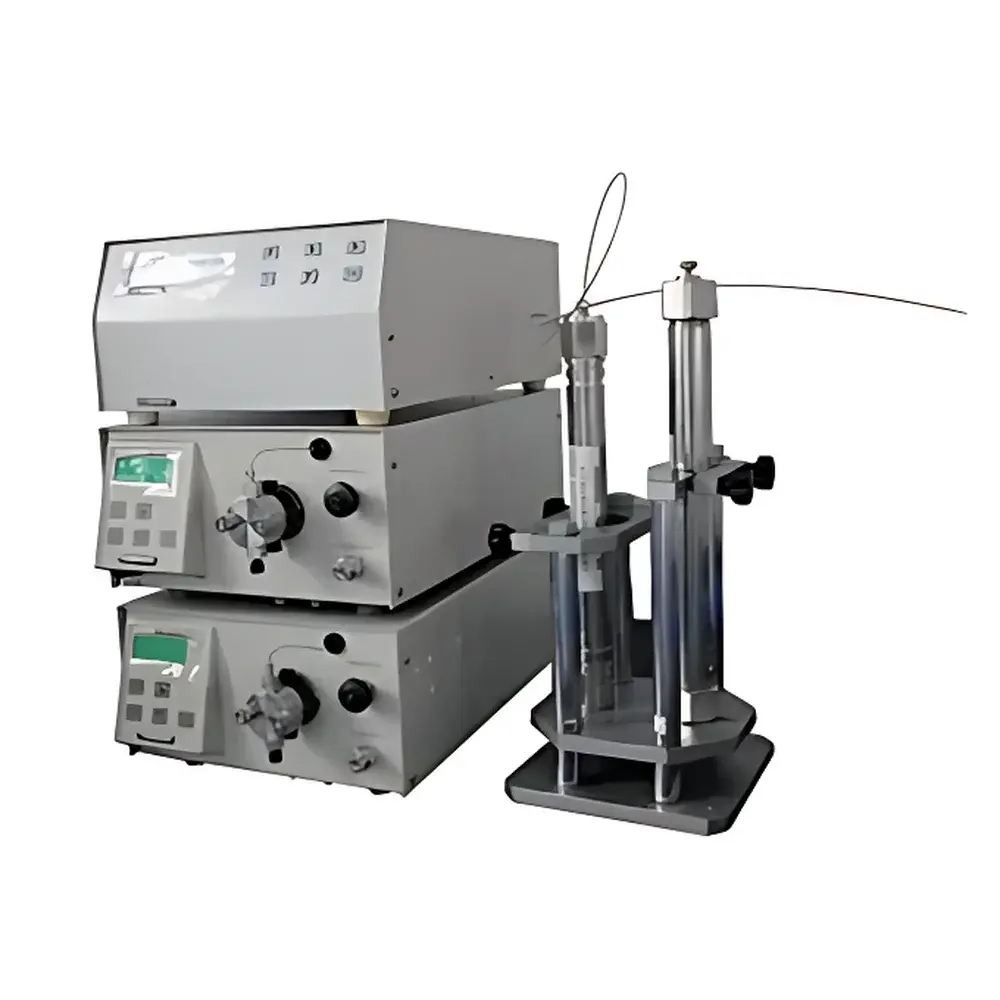
LABA PC2001 Semi-Preparative HPLC System
| Brand | LABA |
|---|---|
| Model | PC2001 |
| Origin | USA |
| Instrument Type | Conventional High-Performance Liquid Chromatograph (HPLC) |
| Flow Rate Range | 0.01–100.00 mL/min |
| Maximum Pressure | 0–6000 psi |
| Autosampler Capacity | 100 positions |
| Injection Volume Range | 1–80 µL |
| Column Oven Temperature Range | Ambient to 60 °C |
| UV-Vis Detector Wavelength Range | 190–900 nm |
| Data Acquisition Rate | 100 Hz |
Overview
The LABA PC2001 Semi-Preparative HPLC System is a dual-purpose, modular high-performance liquid chromatography platform engineered for both high-resolution analytical characterization and milligram-scale compound purification. Built upon a robust binary gradient architecture, it employs positive-displacement piston pumps with active solvent compressibility compensation to deliver precise, pulse-free flow across its full operational range (0.01–100.00 mL/min). The system operates under pressures up to 6000 psi, enabling compatibility with sub-2 µm particle-packed columns for enhanced resolution and peak capacity—critical for resolving complex natural product extracts, synthetic reaction mixtures, or pharmaceutical impurity profiles. Its design adheres to core principles of ISO 17025-compliant laboratory workflows, supporting method transfer between analytical and semi-preparative scales without re-optimization. Unlike dedicated preparative systems, the PC2001 maintains analytical-grade sensitivity and retention time reproducibility (RSD < 0.2% over 24 h), making it suitable for quality control laboratories requiring both identity confirmation and small-batch isolation in a single instrument footprint.
Key Features
- Dual high-precision reciprocating pumps with real-time flow calibration and pressure feedback control, supporting linear, step, and multi-step gradient elution profiles
- 100-position refrigerated autosampler with programmable needle wash, low-dead-volume injection loop (1–80 µL), and variable injection speed to minimize band broadening
- Column compartment with Peltier-based temperature regulation (ambient to 60 °C, ±0.2 °C stability), accommodating standard 4.6 mm × 150 mm analytical columns and 10 mm × 250 mm semi-preparative columns
- UV-Vis photodiode array detector featuring a 190–900 nm spectral range, 1 nm wavelength accuracy, and 100 Hz acquisition rate for high-fidelity peak tracking during fraction collection
- Modular detector interface supporting seamless integration of optional detectors—including differential refractometers (RI), fluorescence detectors (FLD), and mass spectrometer interfaces—without hardware modification
- Self-diagnostics engine with real-time pressure monitoring, leak detection, and pump seal wear estimation; designed for >12 months of continuous operation without scheduled maintenance
Sample Compatibility & Compliance
The PC2001 accommodates a broad spectrum of sample matrices, including aqueous buffers, organic solvents (acetonitrile, methanol, THF), and mildly corrosive mobile phases (e.g., 0.1% TFA, 10 mM ammonium acetate). It complies with key regulatory frameworks governing analytical instrumentation: its firmware supports audit trail logging per FDA 21 CFR Part 11 requirements when paired with compliant LIMS or CDS software; column oven and detector modules meet IEC 61010-1 safety standards; and gradient composition accuracy (±0.2% v/v) satisfies ASTM E2633–21 criteria for HPLC method validation. The system is routinely deployed in GLP-certified environmental testing labs (EPA Method 8330B), pharmaceutical QC environments (USP ), and academic natural products research where trace-level quantitation and scalable isolation must coexist.
Software & Data Management
Control and data processing are managed via LABA ChromoView Pro—a Windows-based chromatography data system (CDS) validated for IQ/OQ/PQ protocols. The software provides method editor with gradient delay volume compensation, automatic peak integration using tangent skim and valley-to-valley algorithms, and customizable report templates aligned with ISO/IEC 17025 reporting clauses. Raw data files (.lcd) are stored in vendor-neutral HDF5 format, ensuring long-term readability independent of software version. Electronic signatures, user role-based access control (admin/operator/auditor), and encrypted database backups support compliance with GxP documentation integrity requirements. Integration with third-party platforms (e.g., Waters Empower, Thermo Chromeleon) is achieved via ASTM E1394-compliant ASCII export or direct OPC UA server connectivity.
Applications
- Purification of synthetic intermediates and APIs at 1–50 mg scale while retaining analytical-grade retention time fidelity
- Impurity profiling of biologics and small molecules per ICH Q5 and Q3B guidelines
- Isolation of bioactive constituents from plant extracts for subsequent NMR or MS structural elucidation
- Environmental analysis of persistent organic pollutants (POPs) in soil/water extracts using EPA-approved HPLC methods
- Routine QC release testing of excipients and finished dosage forms in accordance with pharmacopoeial monographs (USP, EP, JP)
- Method development for chiral separations using polysaccharide-based columns under elevated backpressure conditions
FAQ
Can the PC2001 be used for fully automated fraction collection?
Yes—when equipped with an optional fraction collector module and configured in time- or peak-triggered mode within ChromoView Pro, it supports discrete or pooled collection across up to 120 tubes.
Is the system compatible with UHPLC columns?
It supports columns rated up to 6000 psi; however, optimal performance with sub-2 µm particles requires careful dwell volume management and gradient steepness adjustment to maintain resolution.
Does the autosampler support needle-in-loop injection for viscous samples?
Yes—the syringe-driven injection mechanism allows selectable aspiration/injection speeds and optional solvent flush cycles to prevent carryover in high-viscosity applications.
What validation documentation is provided with the system?
Each unit ships with Factory Acceptance Test (FAT) reports, IQ/OQ protocol templates, and a Certificate of Conformance traceable to NIST standards.
Can the UV-Vis detector perform simultaneous multi-wavelength quantitation?
Yes—the PDA detector acquires full spectra at 100 Hz and enables post-run extraction of chromatograms at any wavelength or averaged bands within the 190–900 nm range.
Related Products




