
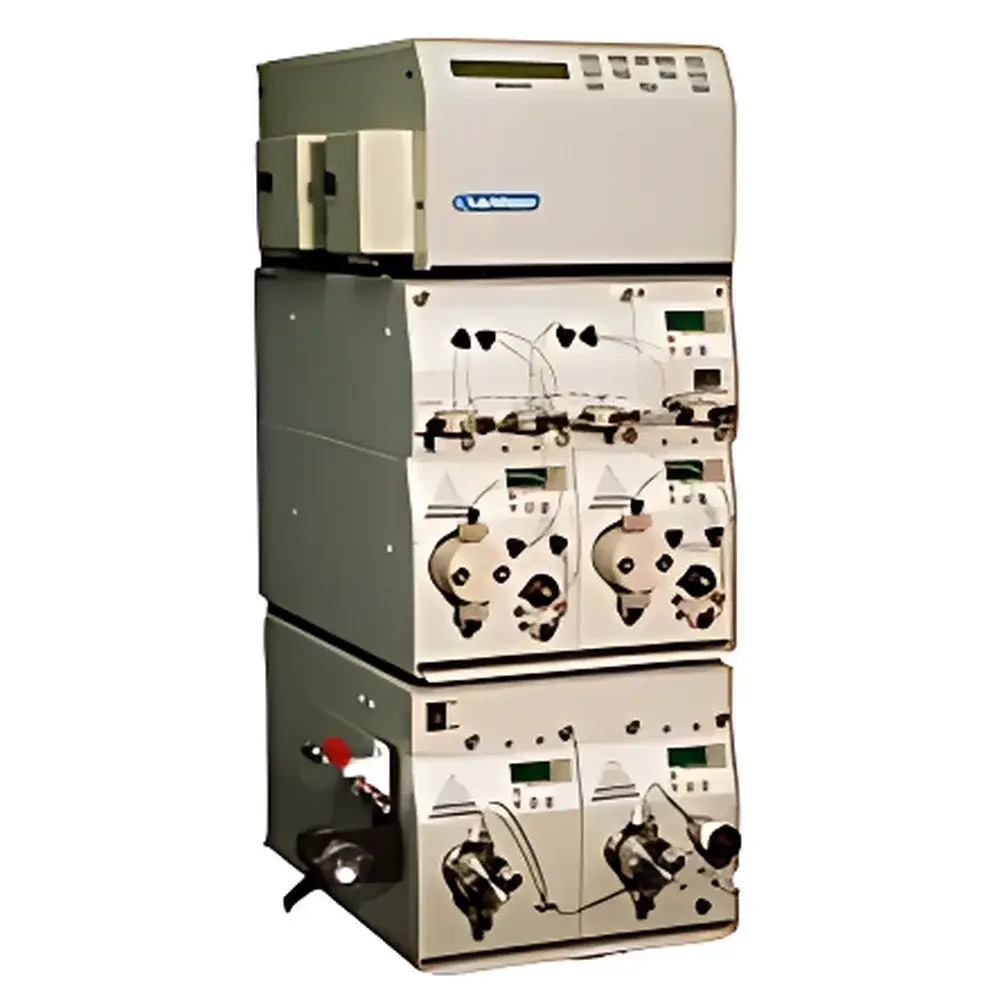
Laballiance WA2002SF High-Performance Liquid Chromatograph (HPLC) System
| Origin | USA |
|---|---|
| Manufacturer Type | Authorized Distributor |
| Import Status | Imported |
| Model | WA2002SF |
| Pricing | Available Upon Request |
Overview
The Laballiance WA2002SF High-Performance Liquid Chromatograph (HPLC) is a fully integrated, modular analytical platform engineered for robust separation, identification, and quantification of trace-level analytes in complex aqueous and biological matrices. Built upon the proven architecture of Laballiance’s Serial III series, this system employs high-pressure gradient liquid chromatography with dual detection modalities—UV-Vis absorbance and fluorescence—to deliver high reproducibility and method flexibility. The core separation mechanism relies on partitioning of solutes between a pressurized mobile phase (typically aqueous/organic solvent gradients) and a chemically bonded stationary phase (e.g., C18, phenyl-hexyl, or HILIC), enabling resolution of structurally diverse compounds including polar pesticides, polycyclic aromatic hydrocarbons (PAHs), mycotoxins, amino acids, and antibiotics. Designed for routine QC/QA laboratories and environmental testing facilities, the WA2002SF meets the operational demands of regulated workflows requiring method transferability, long-term column stability, and compliance-ready data handling.
Key Features
- Laballiance Serial III high-pressure binary or quaternary solvent delivery system with pulse-dampened reciprocating piston pumps, delivering flow rates from 0.001 to 10.0 mL/min with ≤0.1% RSD flow precision at 1 mL/min.
- Dual-detector configuration: Model 201 variable-wavelength UV-Vis detector (190–700 nm, 1 nm wavelength increment, <±0.5 nm wavelength accuracy) and Model 305 fluorescence detector (excitation 200–700 nm, emission 220–800 nm, programmable gain and time constant).
- PCR150 dual-pump post-column derivatization module supporting online chemical reaction (e.g., o-phthalaldehyde or ninhydrin derivatization for amino acids; iodine oxidation for carbamates), with independent temperature-controlled reaction coils and precise reagent mixing.
- Compatible with both manual loop injectors (10–100 µL standard loops) and automated sample introduction via Laballiance-compatible autosamplers with 100+ position capacity, 0.1 µL injection precision, and refrigerated tray option (4–10 °C).
- Rugged stainless-steel fluidic path construction with chemically resistant wetted materials (e.g., PEEK, sapphire, titanium), supporting mobile phases containing up to 100% acetonitrile or methanol and pH 1.5–12.0 operation with appropriate column selection.
Sample Compatibility & Compliance
The WA2002SF is validated for analysis of priority contaminants in environmental and food safety applications, including carbamate (carbaryl, carbofuran), organophosphate, and pyrethroid pesticides (deltamethrin); herbicides (atrazine, glyphosate); PAHs (benzo[a]pyrene); cyanotoxins (microcystin-LR); and natural toxins (aflatoxin B1). It supports derivatized and underivatized analysis of amino acids, taurine, fatty acids, mono- and disaccharides, and β-lactam antibiotics. The system architecture conforms to key regulatory frameworks: methods developed on this platform align with EPA Method 531.1 (pesticides in water), ASTM D7777 (glyphosate in surface water), USP (chromatography), and ISO 17025:2017 requirements for method validation. When operated with audit-trail-enabled software and electronic signatures, it supports GLP and GMP environments compliant with FDA 21 CFR Part 11.
Software & Data Management
Controlled by Laballiance Chromatography Workstation (v5.x), the WA2002SF provides full instrument control, sequence management, real-time chromatogram visualization, peak integration using dynamic baseline algorithms (tangent skim, valley-to-valley, exponential skim), and customizable report generation. The software supports AIA/CDF export, CSV data interchange, and direct integration with LIMS via ODBC. Audit trail functionality logs all user actions—including method edits, sequence changes, and result modifications—with timestamps and operator IDs. Raw data files are stored in proprietary .LCW format with embedded metadata (instrument ID, date/time, method parameters, detector settings), ensuring full traceability for regulatory submissions.
Applications
- Environmental monitoring: Quantification of carbamates, triazines, and neonicotinoids in drinking water, wastewater, and soil extracts per EPA and ISO protocols.
- Food safety: Detection of aflatoxins in cereals, microcystins in algal blooms, and glyphosate residues in fruits and vegetables using LC-FLD or LC-UV workflows.
- Clinical and nutritional analysis: Profiling of free amino acids and taurine in serum or urine; quantification of short-chain fatty acids in fecal supernatants.
- Pharmaceutical QC: Assay of antibiotic potency (e.g., amoxicillin, cephalexin) and related substances per USP monographs.
- Research chromatography: Method development for polar compound separation using HILIC or ion-pairing modes; optimization of post-column reaction kinetics for enhanced sensitivity.
FAQ
Is the WA2002SF compatible with mass spectrometry interfaces?
Yes—the system features standard 1/16″ OD stainless-steel tubing connections and pressure-rated fittings suitable for coupling to ESI or APCI sources of benchtop LC-MS systems.
Does the PCR150 derivatization module support temperature programming?
The PCR150 includes two independently controlled Peltier-heated reaction coils (range: ambient +5 °C to 120 °C), allowing precise thermal optimization of derivatization reactions.
Can the workstation perform automatic calibration curve generation and limit-of-quantitation (LOQ) verification?
Yes—calibration curves (linear, quadratic, or weighted) can be generated automatically from injected standards, with LOQ/LOD calculated per ICH Q2(R2) guidelines using signal-to-noise or standard deviation of response/slope approaches.
What column oven options are available?
Laballiance offers a compact, air-circulating column heater-cooler (ambient to 80 °C, ±0.1 °C stability) with dual-column capability and external sensor port for inline temperature monitoring.
Is remote monitoring supported?
The workstation supports secure remote access via TLS-encrypted VNC or RDP sessions when deployed on a local network with IT-approved firewall configurations.




