
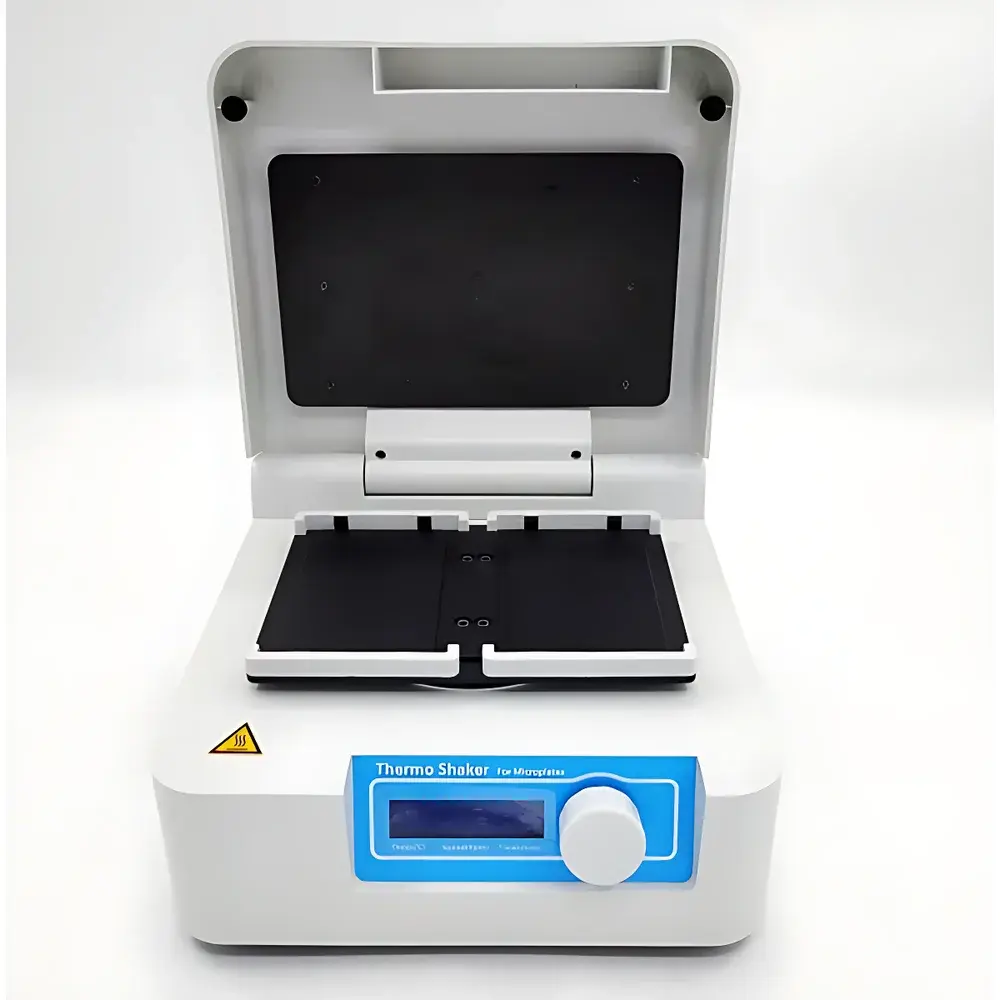
Hanuo HN70-2 Microplate Incubator
| Brand | Hanuo |
|---|---|
| Model | HN70-2 |
| Temperature Range | Ambient +5°C to 70°C |
| Temperature Uniformity | ≤ ±0.5°C |
| Temperature Stability | ≤ ±0.2°C |
| Platform Accuracy | < ±0.3°C (at 37°C) |
| Heating Rate | < 25 min (20°C to 70°C) |
| Timer Range | 0–99 h 59 min |
| Capacity | 2 standard microplates (e.g., 96-well or 384-well ELISA plates) |
| Power Consumption | 150 W |
| Dimensions (W×D×H) | 284 × 264 × 157 mm |
| Origin | Shanghai, China |
Overview
The Hanuo HN70-2 Microplate Incubator is an engineered thermal management system designed for precise, uniform, and reproducible temperature control of microtiter plates during biological and biochemical assays. It operates on a dual-surface heating architecture—simultaneously heating both the top and bottom surfaces of the microplate—to minimize thermal gradients across individual wells. This design is critical for applications where well-to-well consistency directly impacts assay fidelity, such as enzyme-linked immunosorbent assays (ELISA), cell-based kinetic studies, antigen-antibody binding kinetics, and real-time immunoassay development. The unit employs a microprocessor-based PID (Proportional-Integral-Derivative) control algorithm to maintain setpoint stability with minimal overshoot and drift. Its operational range spans from ambient +5°C to 70°C, covering common incubation conditions for mammalian cell culture (37°C), bacterial growth (30–37°C), hybridization (42–65°C), and high-temperature enzymatic reactions.
Key Features
- Dual-zone thermal regulation: Independent top and bottom heating elements ensure uniform heat distribution across all wells of 96-well, 384-well, 24-well, and 48-well plates—eliminating edge effects and cold spots.
- PID-controlled temperature management: Delivers long-term stability of ≤ ±0.2°C and uniformity of ≤ ±0.5°C across the entire plate surface, validated per ISO/IEC 17025 traceable calibration protocols.
- High-resolution LCD interface: Displays real-time setpoint, actual platform temperature, and countdown timer with second-level resolution; supports intuitive touch-based parameter entry and profile recall.
- Programmable timing function: Adjustable timer range from 1 minute to 99 hours 59 minutes, with audible end-of-cycle alert and automatic power-down option for unattended operation.
- Compact benchtop footprint: Ergonomic dimensions (284 × 264 × 157 mm) and smooth, non-porous housing facilitate integration into crowded biosafety cabinets, laminar flow hoods, or shared core facility workspaces.
- Energy-efficient thermal architecture: 150 W rated power consumption optimized for continuous operation without excessive ambient heat generation or electrical load impact.
Sample Compatibility & Compliance
The HN70-2 accommodates two standard-format microplates simultaneously—including ANSI/SBS-compliant 96-well and 384-well ELISA plates, flat-bottom or U/V-bottom cell culture plates, PCR plates (non-heated lid), and custom assay strips. It supports both aqueous and low-viscosity buffered solutions (e.g., PBS, Tris-HCl, HBSS) up to 300 µL per well. The device complies with IEC 61010-1:2010 safety standards for laboratory electrical equipment and meets EMC requirements per EN 61326-1:2013. While not certified for GMP manufacturing environments, its stable thermal performance aligns with GLP documentation practices and supports audit-ready workflows when integrated with external logging systems.
Software & Data Management
The HN70-2 operates as a standalone instrument with no proprietary software dependency. All configuration and monitoring occur via the onboard LCD and capacitive touch interface. For laboratories requiring electronic recordkeeping, optional RS-232 or USB-to-serial adapters (sold separately) enable connection to third-party data acquisition platforms. When paired with compliant software (e.g., LabArchives, Benchling, or custom Python/NI LabVIEW scripts), users may log timestamps, temperature readings, and cycle completion events—supporting 21 CFR Part 11–aligned audit trails when combined with user authentication and electronic signature modules.
Applications
- ELISA incubation: Optimized for primary/secondary antibody binding steps at 37°C with consistent dwell time and minimal evaporation.
- Cell-based assays: Supports short-term viability testing, dye loading (e.g., Calcein-AM), and receptor internalization studies under controlled thermal conditions.
- Molecular diagnostics: Enables temperature-sensitive hybridization steps in rapid immunoassays and lateral flow strip development.
- Quality control in biomanufacturing: Used for in-process verification of reagent stability and kit lot consistency during QC release testing.
- Academic research: Widely deployed in immunology, virology, and pharmacology labs for reproducible multi-plate kinetic experiments requiring inter-plate comparability.
FAQ
Does the HN70-2 support humidity control?
No—this model provides conductive heating only and does not include humidification or vapor containment features. For moisture-sensitive assays, users should pre-equilibrate plates or use sealed adhesive seals.
Can it accommodate deep-well plates or PCR plates?
Yes—mechanical clearance allows standard-height deep-well plates (up to 44 mm height) and full-skirted 96-well PCR plates; however, thermal coupling efficiency may vary slightly compared to shallow ELISA plates.
Is calibration documentation provided with the unit?
A factory calibration certificate (traceable to NIM, China) is included, specifying accuracy at 37°C and 70°C. Users are advised to perform periodic in-house verification using NIST-traceable PT100 probes.
What safety protections are built in?
Over-temperature cutoff (activated at 75°C), short-circuit protection, and auto-shutdown after timer expiration ensure operator and sample safety during extended unattended runs.
Is the heating platform compatible with aluminum or stainless-steel microplate carriers?
Yes—the thermally conductive aluminum alloy platform interfaces reliably with metal carriers, though thermal response time may increase by ~2–3 minutes compared to direct plate contact.



