
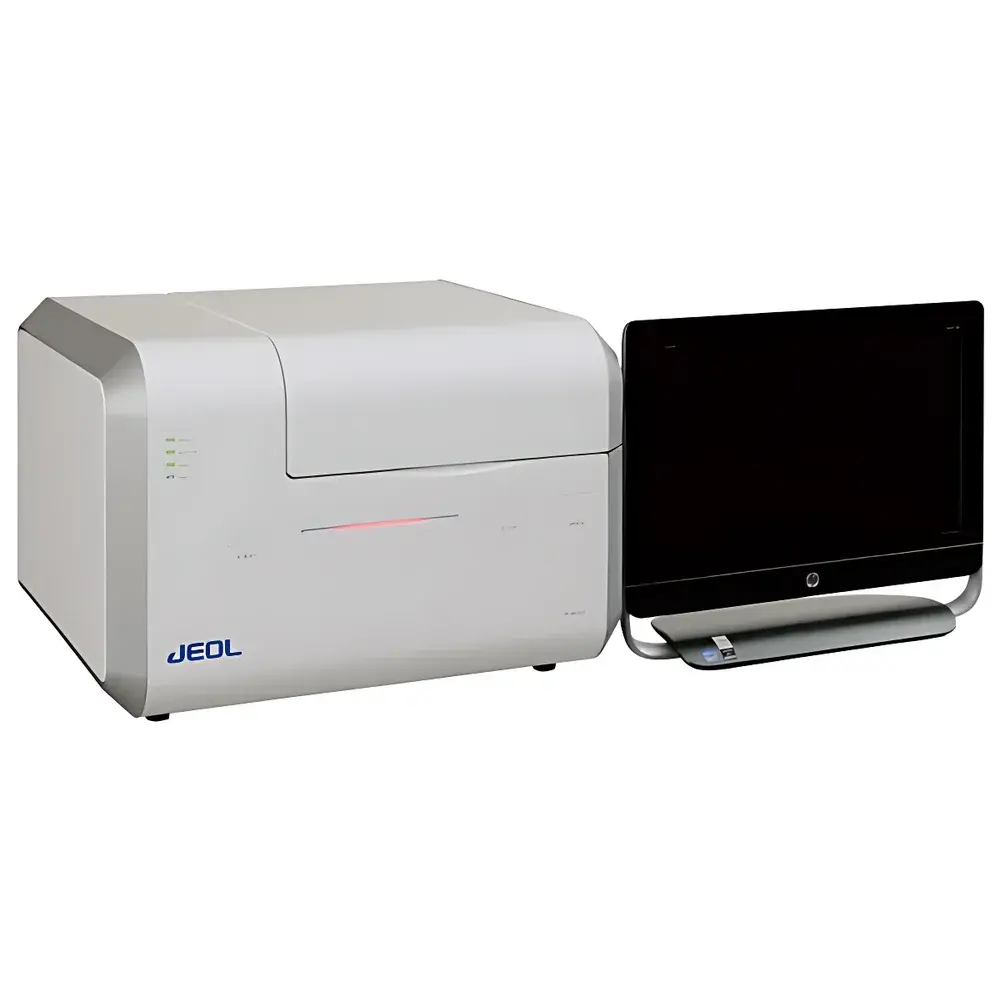
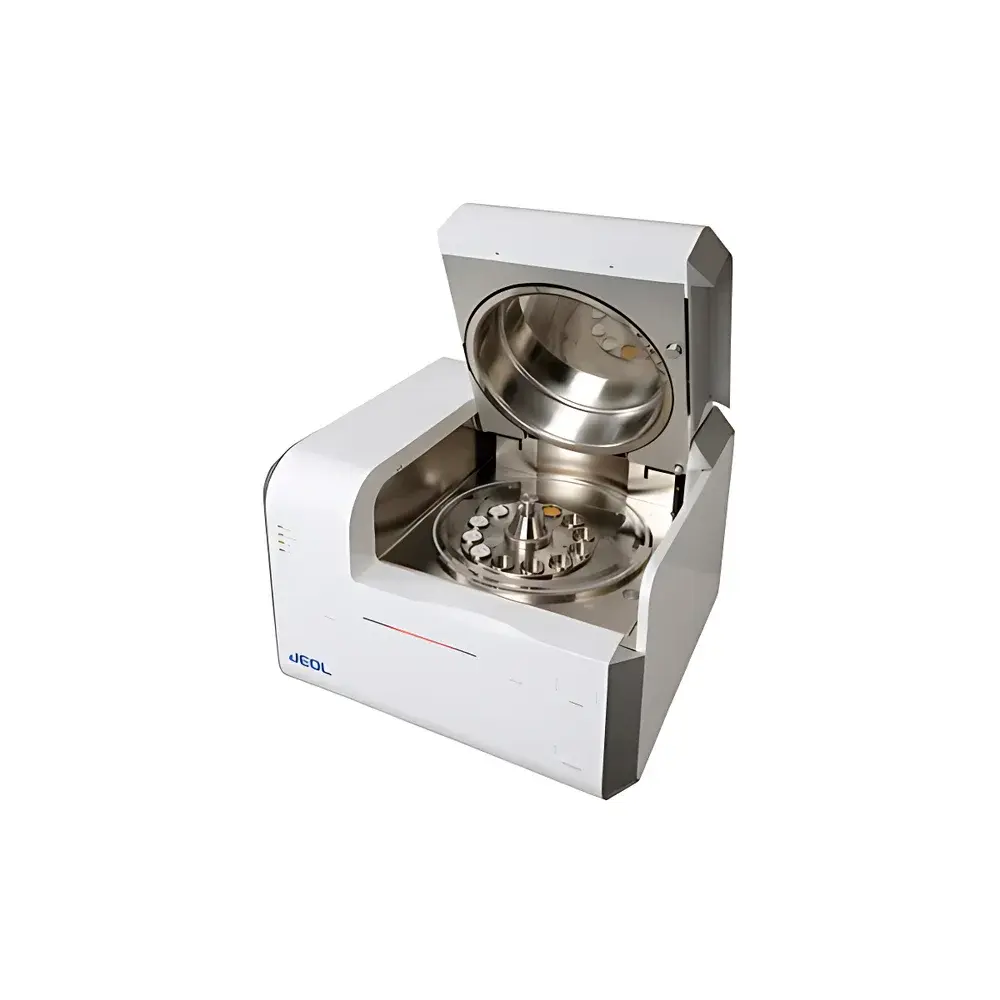
JEOL JSX-1000S Energy Dispersive X-Ray Fluorescence Spectrometer
| Brand | JEOL |
|---|---|
| Origin | Japan |
| Model | JSX-1000S |
| Elemental Analysis Range | Mg–U (Na–U optional) |
| Quantitative Range | 0.1–99.9 wt% |
| Energy Resolution | <170 eV at Mn Kα |
| Repeatability | ±0.1% RSD |
| X-ray Tube | 5–50 kV, 1 mA, Rh anode |
| Filter Options | Standard — OPEN, ND, Cr, Pb, Cd |
| Detector | Silicon Drift Detector (SDD) |
| Sample Chamber | Ø300 mm × 80 mm H |
| Atmosphere Mode | Air (standard) |
| Imaging System | Integrated color camera |
| Software Suite | Qualitative & Quantitative Analysis, RoHS Compliance Module (Cd, Pb, Hg, Br, Cr), Quick-Analysis Mode, Report Generator, Daily Verification Tool |
Overview
The JEOL JSX-1000S is a benchtop energy dispersive X-ray fluorescence (EDXRF) spectrometer engineered for high-precision elemental analysis across diverse industrial and regulatory environments. Based on the fundamental principle of X-ray fluorescence—where primary X-rays excite atoms in a sample, causing emission of characteristic secondary X-rays—the JSX-1000S delivers rapid, non-destructive, multi-element quantification without requiring vacuum operation in standard mode. Its optimized optical path, high-efficiency Rh-target X-ray tube, and silicon drift detector (SDD) collectively ensure excellent peak-to-background ratio and low detection limits—particularly critical for trace-level screening in electronics, polymers, and environmental compliance testing. Designed and manufactured in Japan, the instrument reflects JEOL’s long-standing expertise in electron and X-ray instrumentation, with mechanical stability, thermal management, and electromagnetic shielding integrated at the platform level to support reproducible measurements over extended operational cycles.
Key Features
- High-resolution SDD detector with energy resolution <170 eV at Mn Kα, enabling clear separation of adjacent peaks (e.g., S Kα/Pb Mα, Cr Kα/Fe Kβ) for robust qualitative identification.
- Programmable X-ray tube (5–50 kV, 1 mA) with nine-position automatic filter wheel—supporting both standard (OPEN, ND, Cr, Pb, Cd) and optional (Cl, Cu, Mo, Sb) filters to optimize excitation conditions per element group.
- Large-diameter sample chamber (Ø300 mm × 80 mm height) accommodates irregular, bulky, or multi-part specimens—including PCBs, metal alloys, geological slabs, and packaged consumer goods—without sectioning or mounting.
- Integrated full-color CCD camera with real-time live imaging allows precise positioning of regions-of-interest (ROI), documentation of sample homogeneity, and verification of measurement location prior to analysis.
- Modular software architecture compliant with GLP workflows: all analyses include timestamped metadata, user authentication logs, and audit-trail-enabled report generation meeting FDA 21 CFR Part 11 requirements when deployed with appropriate IT controls.
Sample Compatibility & Compliance
The JSX-1000S accepts solid, powder, liquid, and thin-film samples in ambient air mode—eliminating the need for time-consuming vacuum pumping for most routine applications. Optional vacuum capability extends light-element sensitivity down to sodium (Na), supporting ASTM E1621 and ISO 21047 methodologies for low-Z analysis in catalysts, ceramics, and battery materials. The system meets IEC 62321-5:2013 and RoHS Directive 2011/65/EU requirements for restricted substance screening, with pre-validated methods for Cd, Pb, Hg, Cr(VI), and Br (as PBB/PBDE surrogates). All calibration standards are traceable to NIST SRMs, and instrument performance verification follows JEOL’s internal PQ/QC protocol aligned with ISO/IEC 17025 laboratory accreditation criteria.
Software & Data Management
The native analysis suite includes four core modules: (1) Auto-ID for rapid qualitative survey scanning with library-matched peak assignment; (2) Fundamental Parameters (FP)-based quantitative engine supporting matrix correction for heterogeneous samples; (3) RoHS Wizard—a guided workflow with pass/fail flagging against EU threshold limits (100 ppm Cd/Pb/Hg, 1000 ppm Br/Cr); and (4) Report Studio, generating PDF/Excel outputs with embedded spectra, calibration curves, uncertainty estimates (k=2), and digital signatures. Raw spectral data (.jdx, .csv) and method files are stored in a relational SQLite database with role-based access control. Data export supports LIMS integration via ASTM E1382-compliant XML schema.
Applications
The JSX-1000S serves as a primary screening tool in quality assurance laboratories for incoming material inspection (e.g., plating thickness verification, alloy grade confirmation), recycling stream sorting (WEEE scrap classification), and regulatory due diligence (REACH SVHC screening, toy safety EN71-3). In R&D settings, it enables rapid formulation optimization in pigments, catalysts, and additive manufacturing powders. Its ease of use and minimal training requirement make it suitable for shift-based operators in production environments—while its metrological rigor satisfies ISO 17025-accredited labs performing accredited EDXRF testing under scope.
FAQ
Does the JSX-1000S require liquid nitrogen or Peltier cooling for the detector?
No—the silicon drift detector is thermoelectrically cooled to –20 °C using a multi-stage Peltier module; no cryogens or external chillers are needed.
Can the instrument analyze coated or layered samples?
Yes—depth-resolved analysis is supported via variable voltage/filter combinations and FP modeling; layer thickness accuracy depends on matrix composition and interfacial roughness.
Is vacuum operation mandatory for detecting elements below magnesium?
Vacuum is required for reliable Na and Mg quantification; atmospheric mode begins effective detection at Al.
How often must the instrument be recalibrated?
Daily verification using JEOL-supplied check standards is recommended; full calibration is typically performed quarterly or after major maintenance events.
Does the software support custom method development for proprietary materials?
Yes—users can define custom matrices, add reference standards, configure multi-point calibrations, and embed proprietary algorithms via the Script Editor module.





