
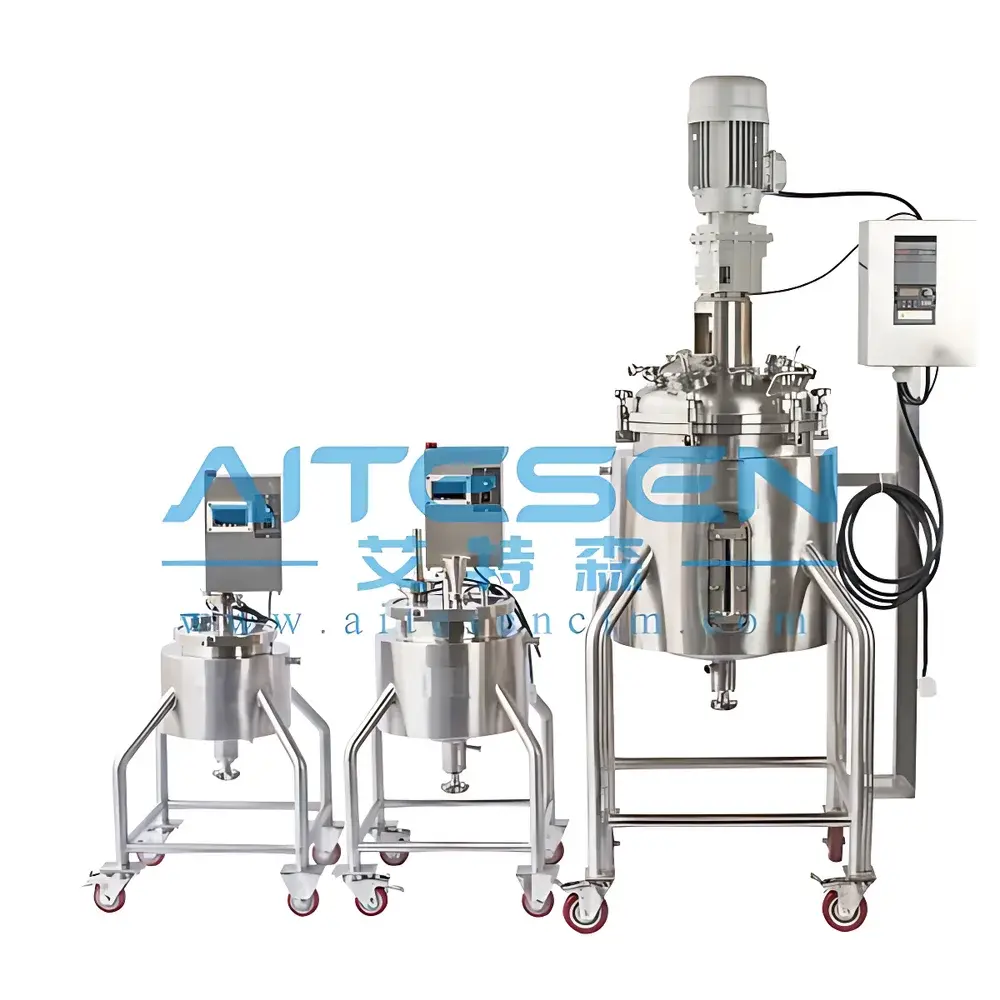
Aitesen Custom-Built Biopharmaceutical Tank Module System
| Brand | Aitesen |
|---|---|
| Origin | Jiangsu, China |
| Manufacturer Type | Authorized Distributor |
| Country of Origin | China |
| Model | Custom-Engineered |
| Pricing | Available Upon Technical Specification Review |
Overview
The Aitesen Custom-Built Biopharmaceutical Tank Module System is an integrated, GMP-compliant process vessel platform engineered for critical unit operations in nanomedicine development and biopharmaceutical manufacturing. Designed around modular architecture principles, the system supports seamless integration into upstream and downstream processing trains—including nanoparticle synthesis, liposome formulation, viral vector production, and sterile intermediate storage. Each tank module operates on fundamental fluid dynamic and thermal management principles: jacketed heat transfer (via steam, hot water, chilled glycol, or electric trace heating), controlled agitation (with top-entry or side-entry impellers compatible with low-shear mixing requirements), and validated CIP/SIP cycles. The system’s structural integrity and surface quality are governed by dual regulatory frameworks—ASME BPE-2023 for bioprocessing equipment and GB/T 20801–2020 for pressure equipment design—ensuring mechanical reliability under cyclic thermal and vacuum loading.
Key Features
- GMP-aligned engineering: All wetted surfaces comply with ASME BPE Chapter 5 (Surface Finish) and EU Annex 1 (Sterile Manufacturing) requirements for bioburden control.
- Material selection flexibility: Standard construction in ASTM A240 316L stainless steel; optional upgrade paths to ASTM B265 Grade 2 titanium, borosilicate glass-lined vessels, or PTFE-coated internals for aggressive solvent compatibility.
- Precision surface finish: Electrolytic polishing (EP) achieves Ra ≤ 0.3 µm across full internal wetted area; mechanical polishing available for non-sterile pre-processing modules (Ra 0.6–1.0 µm).
- Multi-layer jacket configuration: Dual-jacket design enables simultaneous heating/cooling zones; triple-jacket option supports independent temperature control for jacket, coil, and annular space—critical for exothermic nanoprecipitation processes.
- Configurable geometry & interface layout: Cylindrical, dished-bottom, or conical-bottom profiles; customizable nozzle orientation (ISO-KF, Tri-Clamp® 10–150 mm, DIN 11851), including sanitary sight glasses, pH/DO ports, sampling valves, and aseptic connectors.
- CIP/SIP validation readiness: Integrated spray ball design (360° full-coverage), drain slope ≥1%, and traceable temperature/pressure logging during sterilization cycles per HTM 01-05 and FDA Process Validation Guidance.
Sample Compatibility & Compliance
The system accommodates a broad range of nanomedicine formulations—including polymeric nanoparticles (PLGA, chitosan), lipid-based systems (LNPs, liposomes), inorganic colloids (iron oxide, gold nanoshells), and viral vectors (AAV, lentivirus). Vessel geometry, shear profile, and mass transfer characteristics are tailored to preserve particle size distribution (PSD) stability during mixing and hold steps. All configurations meet ISO 13485:2016 (Medical Devices QMS), support FDA 21 CFR Part 11-compliant electronic records via optional data acquisition modules, and undergo third-party FAT/SAT documentation aligned with ICH Q5A(R2) and Q5D guidelines for biological product characterization.
Software & Data Management
While the base hardware operates as a standalone process vessel, optional integration with SCADA-level control systems (e.g., Siemens Desigo CC, Rockwell FactoryTalk) enables real-time monitoring of jacket temperature, internal pressure, agitator torque, and dissolved oxygen (when equipped with inline sensors). Audit trails, user access levels, and electronic signature capture are implemented in accordance with ALCOA+ principles. Raw data export formats include CSV and PDF reports compliant with 21 CFR Part 11 Annex 11 requirements for regulated environments.
Applications
- Nanoparticle synthesis reactors for controlled precipitation, emulsification, and solvent evaporation.
- Preparation tanks for buffer exchange, excipient blending, and sterile filtration feed conditioning.
- Storage vessels with nitrogen overlay and continuous temperature monitoring for thermolabile mRNA-LNPs.
- Circulation loops for tangential flow filtration (TFF) integration and continuous chromatography skids.
- Process-scale mock-up systems for tech transfer from lab-scale microfluidics to clinical manufacturing.
FAQ
Can the tank be validated for SIP using saturated steam at 121°C for 30 minutes?
Yes—vessels designed to ASME BPE Section 3 and equipped with EP-finished 316L bodies, steam-trap-compatible jackets, and calibrated PT100 RTDs support full-cycle SIP validation per EN 285 and HTM 2030.
Is material certification (MTR) provided for each vessel batch?
Yes—Mill Test Reports per ASTM A480/A480M, including chemical composition, mechanical properties, and PMI verification, accompany every shipment.
What level of documentation is included for regulatory submissions?
Standard delivery includes DQ/IQ/OQ protocols, surface finish test reports (per ASME BPE-2023 Annex C), weld logbooks with WPS/PQR, and FAT summary reports—fully editable for inclusion in IND/IMPD dossiers.
Are explosion-proof options available for organic solvent handling?
Yes—ATEX Zone 1 or Class I Div 1 configurations with flameproof enclosures (IEC 60079-1) and intrinsically safe instrumentation can be specified during engineering review.




