
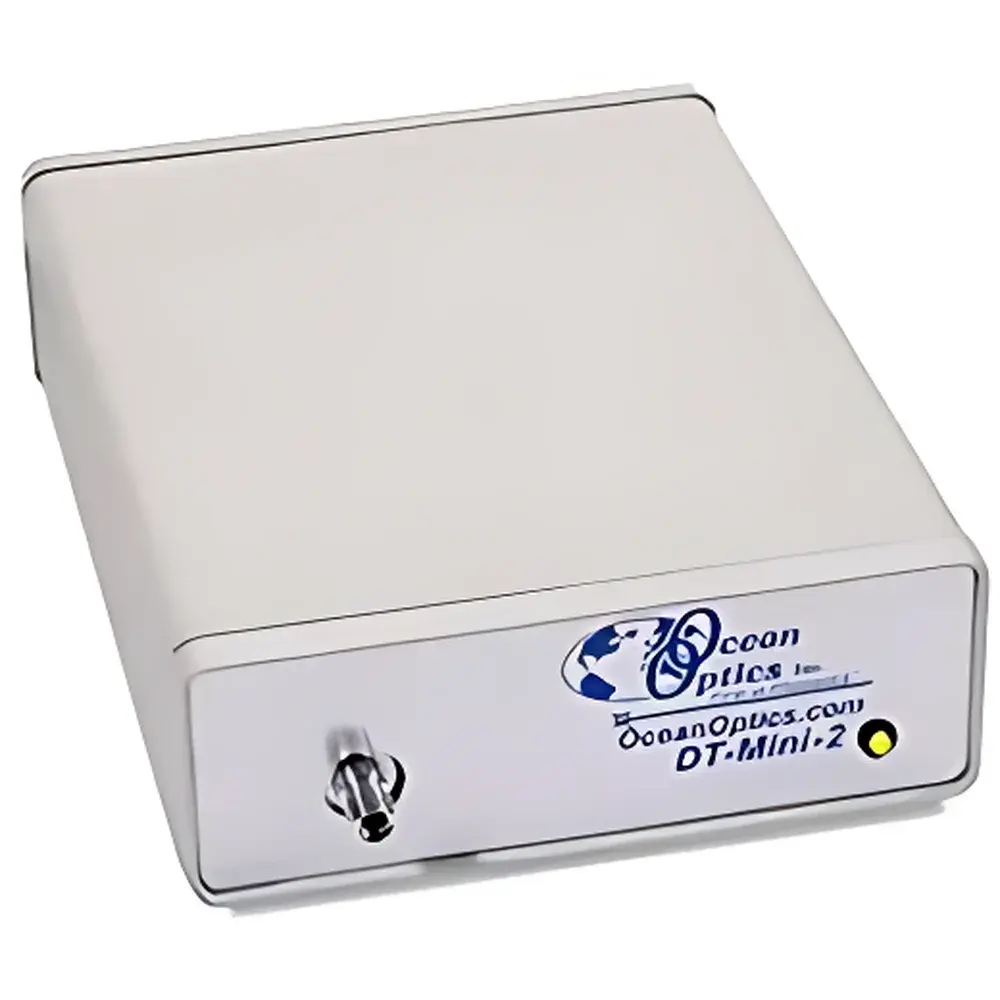
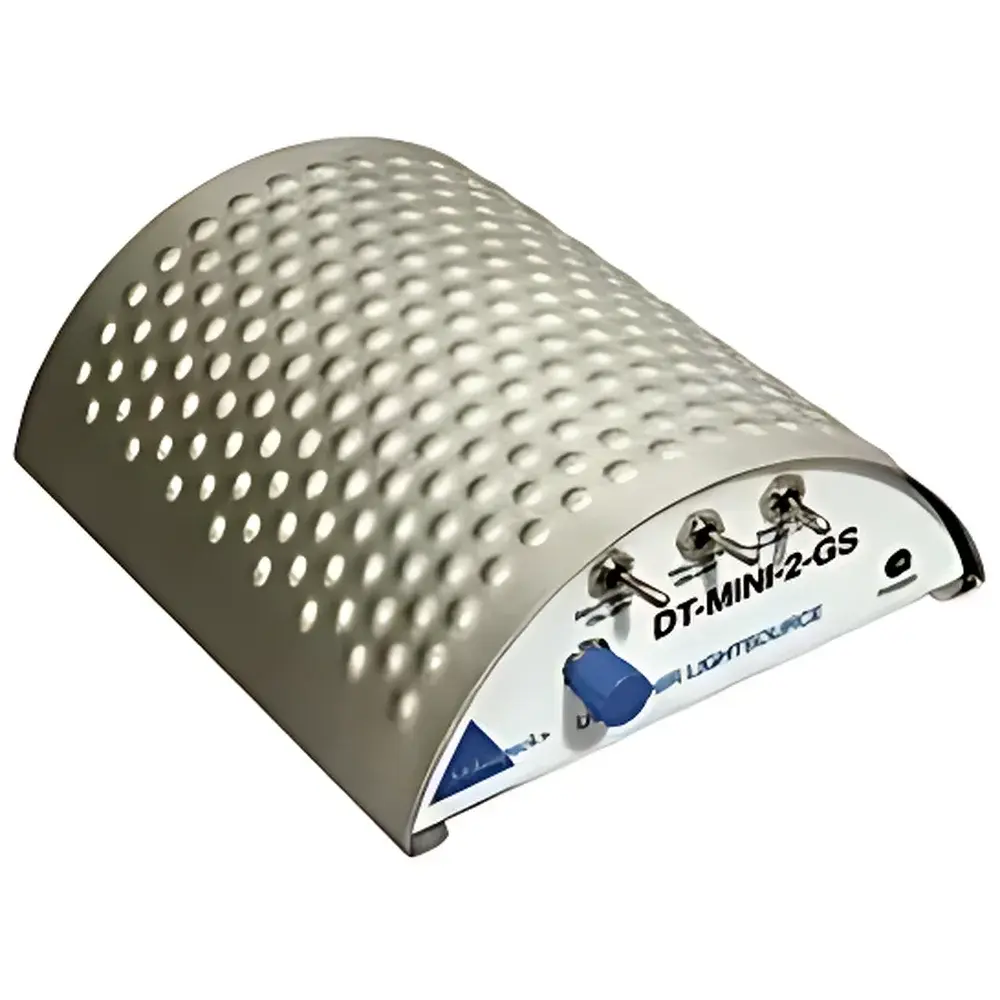
Ocean Optics DT-MINI-2 and DT-MINI-2-GS Deuterium-Tungsten Halogen Miniature Light Source
| Brand | Ocean Optics |
|---|---|
| Origin | USA |
| Model | DT-MINI-2 / DT-MINI-2-GS |
| Wavelength Range | 200–410 nm (deuterium), 360–2000 nm (tungsten halogen) |
| Output Aperture | 0.5 mm |
| Power Consumption | 350 mA @ 12 VDC |
| Deuterium Output | 3.8 W |
| Tungsten Halogen Output | 1.2 W |
| Intensity Stability | ±0.3% peak-to-peak after 30 min warm-up (over 4 h) |
| Warm-up Time | 10 min (deuterium), 1 min (tungsten halogen) |
| Lamp Lifetime | ~1500 h (both lamps) |
| Shutter Option | TTL- and manual-triggered mechanical shutter (DT-MINI-2-GS only) |
| Connector | SMA 905 |
| Dimensions (DT-MINI-2) | 153.4 × 104.9 × 40.9 mm |
| Dimensions (DT-MINI-2-GS) | 140 × 50 × 125 mm |
| Weight (DT-MINI-2) | 330 g |
| Weight (DT-MINI-2-GS) | 475 g |
Overview
The Ocean Optics DT-MINI-2 and DT-MINI-2-GS are compact, dual-lamp deuterium–tungsten halogen light sources engineered for broadband spectral applications requiring stable, continuous output across the ultraviolet, visible, and near-infrared (UV-VIS-NIR) regions. These instruments integrate two physically separate, independently controlled emission sources—deuterium (D₂) for deep UV to near-UV (200–410 nm) and tungsten halogen (W-Hal) for VIS-NIR (360–2000 nm)—within a single optomechanical housing. The overlapping spectral coverage enables seamless, gap-free illumination from 200 nm to 1100 nm in standard configurations, with extended NIR capability up to 2000 nm when coupled with appropriate optical components and detectors. Designed specifically for fiber-optic coupling, both models feature a precision 0.5 mm output aperture that ensures high spatial coherence and uniform beam profile—critical for reproducible throughput into spectrometers, integrating spheres, or custom optical paths. The modular architecture supports integration into OEM systems, benchtop spectroscopic setups, and automated QA/QC platforms where space, thermal management, and electrical efficiency are constrained.
Key Features
- Independent electronic control of deuterium and tungsten halogen lamps via dedicated on/off switches—enabling selective spectral region activation and extended lamp lifetime.
- 0.5 mm collimated output aperture optimized for efficient coupling into SMA 905–compatible optical fibers (core diameters ≥ 200 µm recommended).
- DT-MINI-2-GS variant includes a mechanically actuated shutter with dual triggering options: manual lever and TTL-compatible digital input (5 V logic level, <10 µs response), supporting time-resolved measurements and synchronization with detector gating or data acquisition systems.
- Thermally stabilized lamp housings minimize spectral drift; intensity stability maintained at ±0.3% peak-to-peak over 4 hours following 30-minute preheat (per ASTM E275-22 practice for photometric source stability verification).
- Low-power operation at 12 VDC (350 mA total), compatible with laboratory DC supplies and portable power systems—reducing heat load and enabling integration into vibration-sensitive or confined-space environments.
- Interchangeable lamp modules: DT-MINI-2-B replacement bulbs are certified for use exclusively in DT-MINI-2 and DT-MINI-2-GS units, ensuring consistent radiometric performance and spectral fidelity across service cycles.
Sample Compatibility & Compliance
The DT-MINI-2 series is compatible with a wide range of sample geometries and measurement modalities—including transmission, reflectance, absorbance, and fluorescence excitation—when paired with appropriate accessories (e.g., cuvette holders, diffuse reflectance probes, or integrating spheres). Its broadband output supports method development and validation per ISO/IEC 17025-accredited laboratories performing UV-VIS-NIR spectroscopy. While not inherently compliant with FDA 21 CFR Part 11, the source’s deterministic on/off behavior, stable output, and TTL shutter interface facilitate integration into 21 CFR Part 11–compliant analytical workflows when deployed within validated instrument control software with audit-trail functionality. The device meets IEC 61000-6-3 (EMC emission) and IEC 61010-1 (safety) requirements for laboratory electrical equipment.
Software & Data Management
These light sources operate as hardware-independent illumination modules and do not require proprietary drivers or firmware updates. Control is implemented externally via simple DC switching (for lamp enable) and TTL logic (for DT-MINI-2-GS shutter). When integrated with Ocean Insight’s OceanView or SpectraSuite software—or third-party platforms such as LabVIEW, Python (PyVISA), or MATLAB—the user can script lamp sequencing, synchronize shutter events with spectral acquisition, and log timestamped operational metadata. All intensity calibration data (relative spectral irradiance, NIST-traceable where applicable) is provided in CSV and XML formats for traceable instrument qualification and periodic verification per GLP/GMP Annex 11 guidelines.
Applications
- UV-VIS-NIR spectrophotometer calibration and wavelength verification (e.g., against holmium oxide or didymium filters per USP ).
- Real-time monitoring of chemical reaction kinetics using dual-wavelength ratioing or time-resolved absorbance tracking.
- Reflectance and transmittance measurements of thin films, coatings, and optical filters in R&D and production QC environments.
- Excitation source for fluorescence-based biosensors where broad-spectrum tunability is required prior to monochromator or filter selection.
- OEM integration into handheld or portable analyzers for field-deployable water quality, pharmaceutical, or agricultural testing systems.
- Reference illumination in accelerated aging studies (e.g., ISO 4892-2) where controlled UV/VIS exposure profiles are essential.
FAQ
What is the spectral overlap between the deuterium and tungsten halogen lamps?
The deuterium lamp emits strongly from 200–410 nm; the tungsten halogen lamp provides continuous output from 360–2000 nm. This results in an effective combined coverage of 200–2000 nm, with optimal continuity from 360–410 nm where both sources contribute.
Can the DT-MINI-2-GS shutter be triggered synchronously with a CCD spectrometer acquisition?
Yes—the shutter responds to TTL-level signals with sub-10 µs latency and supports external trigger modes compatible with most scientific-grade spectrometers equipped with programmable GPIO or sync-out ports.
Is NIST-traceable spectral irradiance calibration available?
Ocean Insight offers optional factory calibration services with NIST-traceable spectral irradiance data (in µW/cm²/nm) referenced to a calibrated reference detector, delivered as downloadable reports compliant with ISO/IEC 17025 documentation standards.
How does ambient temperature affect warm-up time and stability?
At ambient temperatures below 15 °C, deuterium lamp warm-up may extend beyond 10 minutes; stability specifications assume operation within 15–30 °C. Active thermal management is not required but recommended for long-term repeatability in uncontrolled environments.
Are replacement lamps user-serviceable?
Yes—lamp replacement is performed via front-access panel without tools. Full instructions, torque specifications, and alignment verification procedures are included in the technical manual; no optical realignment is necessary post-replacement due to kinematic mount design.




