
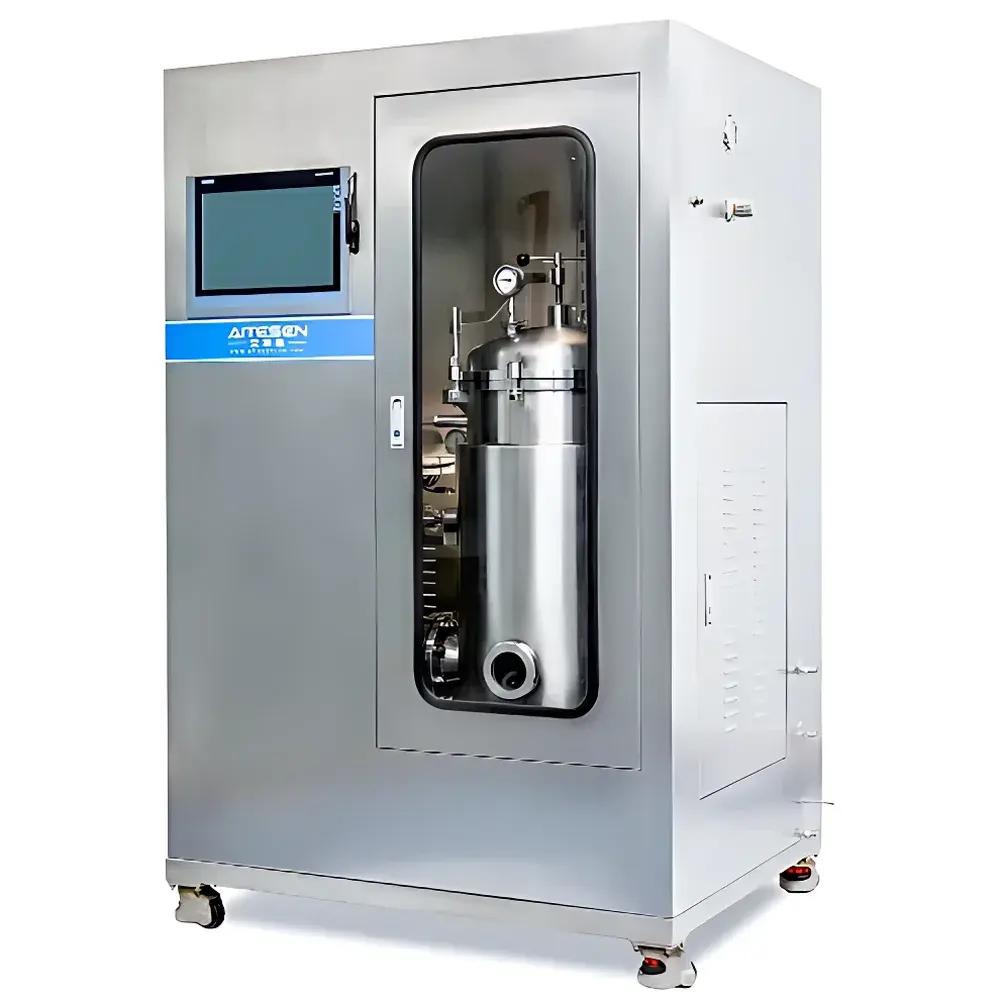
Aitesen RSS-L1 Benchtop Steam Sterilizer with Rotating Chamber
| Brand | Aitesen |
|---|---|
| Origin | Jiangsu, China |
| Model | RSS-L1 |
| Type | Benchtop Sterilizer |
| Max Temperature | 0–150 °C (±0.1 °C) |
| Chamber Volume Capacity | 10–2000 mL |
| Max Working Pressure | 0.3 MPa |
| Total Power | 7.5 kW |
| Sample Capacity | 1–10 vessels |
| Temperature Sensors | ≥3 independent RTD probes |
| Output Parameters | Temperature, Pressure, F₀, Time, Rotation Speed, Steam Flow (where applicable) |
Overview
The Aitesen RSS-L1 is a benchtop steam sterilizer engineered for precise, reproducible wet-heat terminal sterilization of heat-stable liquid and semi-solid samples in research, quality control, and pilot-scale pharmaceutical, food, and personal care laboratories. It operates on the validated principle of saturated steam under pressure—leveraging the lethal effect of moist heat on microorganisms through protein denaturation and nucleic acid disruption. Unlike static autoclaves, the RSS-L1 integrates a motor-driven rotating chamber that continuously reorients sample containers during the sterilization cycle, eliminating thermal stratification and ensuring uniform heat transfer across all vessel orientations. This rotational motion—combined with redundant, calibrated RTD temperature sensors placed at critical thermal zones (chamber wall, load center, and steam inlet)—enables real-time thermal mapping and dynamic process correction. The system calculates and logs the biologically weighted F₀ value (standardized to 121 °C using Geobacillus stearothermophilus as the reference biological indicator), providing quantitative assurance of microbial lethality per ISO 17665-1 and USP <1229> guidelines.
Key Features
- Rotating chamber mechanism with programmable speed (0–15 rpm) and bidirectional rotation to prevent sedimentation and promote homogeneous thermal exposure
- Triple-redundant Class A platinum RTD sensors (IEC 60751), independently traceable to NIST standards, with real-time deviation monitoring and automatic alarm triggering if ΔT > ±0.3 °C between probes
- Integrated F₀ calculation engine compliant with ASTM E2243 and ISO 11138-3; supports user-defined Z-value (typically 10 °C) and reference temperature (121 °C)
- Full-cycle data logging at configurable intervals (1–30 s), recording temperature, pressure, F₀, elapsed time, rotation speed, and steam flow rate (when equipped with mass flow sensor)
- Stainless steel 316L chamber (electropolished finish, Ra ≤ 0.4 µm) with double-jacketed insulation and vacuum-assisted air removal (pre-vacuum cycle) for efficient steam penetration
- Compliance-ready architecture: audit trail with user authentication (role-based access), electronic signatures, and 21 CFR Part 11–compliant data integrity controls
Sample Compatibility & Compliance
The RSS-L1 accommodates vials, bottles, syringes, ampoules, and custom labware ranging from 10 mL to 2000 mL total load volume. Its compact chamber geometry and adaptive rotation profile support heterogeneous loads—including mixed container sizes and fill levels—without compromising thermal uniformity (validated per EN 285 Annex C and ISO 17665-2). All wetted surfaces meet ASME BPE 2023 surface finish and weld criteria. The system is designed and documented to support GMP-compliant validation protocols (IQ/OQ/PQ), including thermocouple mapping studies, biological indicator challenge tests, and F₀ distribution analysis. It satisfies regulatory expectations for sterile process development per FDA Guidance for Industry: Sterile Drug Products Produced by Aseptic Processing (2004) and EU Annex 1 (2022).
Software & Data Management
The embedded sterilization control software (v3.2+) provides a touchscreen HMI with intuitive workflow navigation and multilingual interface (English, German, Chinese, Spanish). Process recipes are stored with version control and digital signature requirements. Raw data—including time-stamped sensor values, event logs, and F₀ integrals—is exported in CSV and PDF formats with embedded cryptographic hash verification. Optional Ethernet/IP or OPC UA connectivity enables integration into LIMS, MES, or SCADA systems. All data files include immutable metadata: operator ID, timestamp (UTC), instrument serial number, calibration status, and firmware revision—ensuring full ALCOA+ compliance (Attributable, Legible, Contemporaneous, Original, Accurate, Complete, Consistent, Enduring, Available).
Applications
- Development and validation of terminal sterilization cycles for parenteral drug products, ophthalmic solutions, and vaccine intermediates
- Microbial reduction studies supporting bioburden limits and sterilization dose establishment (per ISO 11137)
- Process simulation for lyophilization stopper seating, filter integrity testing, and depyrogenation cycle correlation
- QC release testing of sterilized excipients, buffers, and media in compounding pharmacies and contract manufacturing organizations
- Academic and industrial research requiring controlled, repeatable thermal stress profiles for stability-indicating assays
FAQ
What validation documentation is provided with the RSS-L1?
Factory-issued IQ/OQ protocols, calibration certificates for all RTDs and pressure transducers, and a complete Design Qualification (DQ) summary aligned with GAMP 5 are included. PQ support templates and mapping study guidance are available upon request.
Can the RSS-L1 be used for depyrogenation cycles?
No. The RSS-L1 is specifically designed for wet-heat sterilization (steam saturation). Depyrogenation requires dry-heat conditions (>250 °C) and is outside its operational envelope.
Is remote monitoring supported?
Yes—via optional secure TLS-enabled web server (HTTPS) with role-limited dashboard access. Real-time alarms and historical trend review are available without proprietary client software.
How is F₀ calculated during a cycle?
F₀ is computed continuously using the integral method: F₀ = ∫10(T−121)/z dt, where T is measured chamber temperature (°C), z = 10 °C (configurable), and dt is the time interval (seconds). Calculation adheres to ISO 11138-3 Annex A.
Does the system comply with 21 CFR Part 11?
Yes—through built-in electronic signatures, audit trail with immutable records, and system-level password policies meeting FDA requirements for closed systems. Full Part 11 readiness package includes risk assessment and configuration management documentation.
Related Products



