
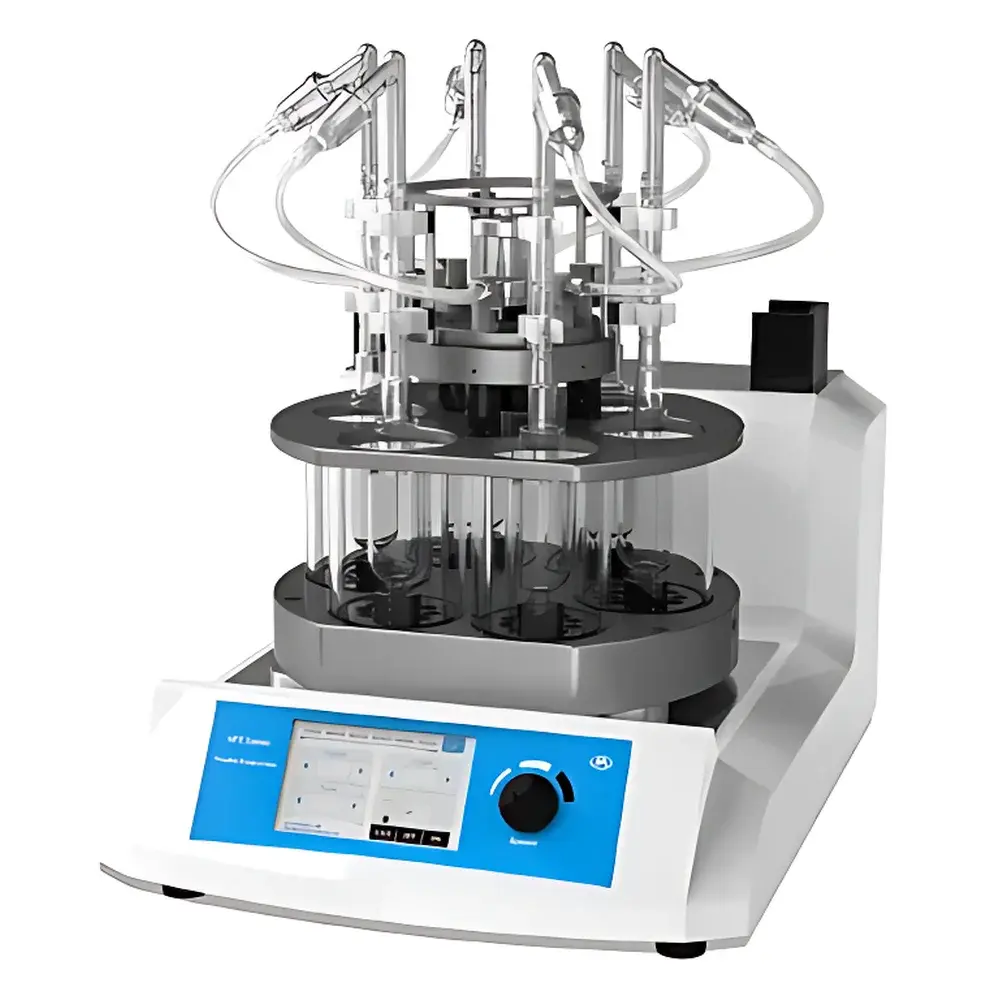
HengAo HPE-6K Parallel Vacuum Concentrator
| Brand | Tianjin HengAo |
|---|---|
| Origin | Tianjin, China |
| Manufacturer Type | Direct Manufacturer |
| Instrument Type | Automated Quantitative Concentrator |
| Temperature Range | Ambient to 100 °C |
| Temperature Control Accuracy | ±0.5 °C |
| Sample Capacity per Position | 200 mL |
| Vacuum System | HVS-03 Integrated Controller (PTFE-lined pump head, diaphragm, and valves) |
| Ultimate Vacuum | 20 mbar |
| Adjustable Vacuum Range | 20–1000 mbar |
| Vacuum Control Resolution | 1 mbar (display), ±5 mbar (control accuracy) |
| Gradient Stages | Up to 5 programmable segments |
| Max Program Duration | 42.5 h |
| Pump Flow Rate | 50 L/min |
| Vacuum Port Diameter | 8 mm |
| Motor Power Rating | 100 W |
| Collection Flask Options | 1000 mL or 2000 mL |
| Cooling System | Integrated recirculating chiller unit |
| Control Interface | 5-inch capacitive touchscreen with real-time pressure curve logging |
Overview
The HengAo HPE-6K Parallel Vacuum Concentrator is an engineered solution for high-throughput, gentle sample concentration in analytical, pharmaceutical, and environmental laboratories. It operates on the principle of simultaneous vacuum-assisted evaporation under controlled heating and orbital agitation—enabling rapid solvent removal while minimizing thermal degradation of thermolabile analytes such as peptides, nucleotides, metabolites, and residual pesticides. Unlike single-vessel rotary evaporators, the HPE-6K supports up to six independent sample positions, each equipped with individual temperature and vortex motion control, ensuring uniform evaporation kinetics across replicates. Its design prioritizes process reproducibility, operator safety, and regulatory traceability—making it suitable for routine QC workflows aligned with GLP and ISO/IEC 17025 frameworks.
Key Features
- Parallel processing capability for up to six 200 mL samples under identical or independently programmed conditions
- Precise temperature regulation from ambient to 100 °C with ±0.5 °C stability over time
- Integrated HVS-03 vacuum controller featuring five-stage gradient pressure programming, enabling method-driven optimization of solvent removal rates (e.g., rapid initial bulk removal followed by gentle final drying)
- PTFE-wetted vacuum path—including pump head, diaphragm, and valve components—ensuring chemical compatibility with acidic, basic, and halogenated solvents (e.g., HCl, NaOH, chloroform, acetonitrile)
- Real-time vacuum pressure monitoring and graphical logging via a 5-inch industrial-grade touchscreen interface; all methods and pressure curves are timestamped and exportable as CSV files
- Orbital shaking mechanism (variable speed, non-contact drive) prevents bumping and promotes surface renewal without cross-contamination
- Recirculating chiller system maintains condenser temperature below dew point across extended runs, achieving >95% solvent recovery efficiency for common organic solvents
Sample Compatibility & Compliance
The HPE-6K accommodates standard 200 mL round-bottom flasks, test tubes, and custom vessels with compatible neck diameters (≤35 mm). It supports aqueous, polar aprotic, and moderately volatile organic solvents—including methanol, ethanol, ethyl acetate, dichloromethane, and acetone—without requiring solvent-specific hardware modifications. All vacuum and thermal parameters are fully programmable and auditable, satisfying documentation requirements for FDA 21 CFR Part 11 compliance when paired with validated electronic lab notebook (ELN) integration. The instrument’s mechanical architecture conforms to IEC 61010-1 safety standards for laboratory electrical equipment, and its PTFE-based fluid path meets USP Class VI biocompatibility criteria for extractables testing applications.
Software & Data Management
The embedded HVS-03 control firmware provides full method management: users can store, recall, duplicate, and version-control up to 100 vacuum-temperature-shake profiles. Each method includes start/stop timestamps, pressure ramping logic, dwell times, and alarm thresholds (e.g., vacuum loss >10 mbar for >30 s triggers audible/visual alert and automatic pause). Pressure curves are logged at 1-second intervals and retained onboard for ≥72 hours; data export occurs via USB-C port in plain-text CSV format compatible with LIMS, JMP, or Python-based analysis pipelines. Audit trails record user login events, parameter changes, and run completions—supporting internal quality audits and external inspections per ISO 17025 clause 7.7.
Applications
- Preparative cleanup in pesticide residue analysis (e.g., QuEChERS extracts prior to GC-MS/MS injection)
- Concentration of low-abundance biomarkers from plasma, urine, or cerebrospinal fluid in clinical metabolomics
- Lyophilization pre-concentration steps in oligonucleotide synthesis QA/QC
- Environmental water extract concentration per EPA Method 1694 and 525.3
- Pharmaceutical impurity profiling where thermal lability prohibits nitrogen blow-down or oven drying
- High-throughput library preparation for next-generation sequencing (NGS) sample normalization
FAQ
What vacuum level range is supported, and how is pressure stability maintained during long runs?
The HPE-6K operates between 20 mbar and 1000 mbar, with closed-loop feedback control maintaining setpoints within ±5 mbar tolerance. The PTFE diaphragm pump features active thermal compensation and continuous pressure sensing to counteract solvent vapor load fluctuations.
Can the instrument be integrated into a networked lab environment for remote monitoring?
While the HPE-6K lacks native Ethernet or Wi-Fi, its USB-C data export and standardized CSV output enable seamless ingestion into centralized lab informatics platforms via scheduled script-based transfers or middleware gateways.
Is validation support documentation available for IQ/OQ/PQ protocols?
Yes—HengAo provides a comprehensive Validation Support Package including factory calibration certificates, traceable temperature/vacuum verification procedures, and blank run templates compliant with ASTM E2656 and ISO 21748 guidelines.
How does the orbital agitation mechanism differ from traditional vortexing in concentrators?
The HPE-6K employs a brushless DC motor-driven eccentric cam system delivering consistent 20–250 rpm orbital motion with amplitude ≤12 mm—eliminating mechanical wear, noise, and sample splashing associated with direct-contact vortex shakers.
What maintenance intervals are recommended for the vacuum system?
PTFE diaphragms and valves require replacement every 12 months under continuous operation; the chiller coolant should be refreshed annually, and condenser coils inspected quarterly for frost accumulation or particulate buildup.



