
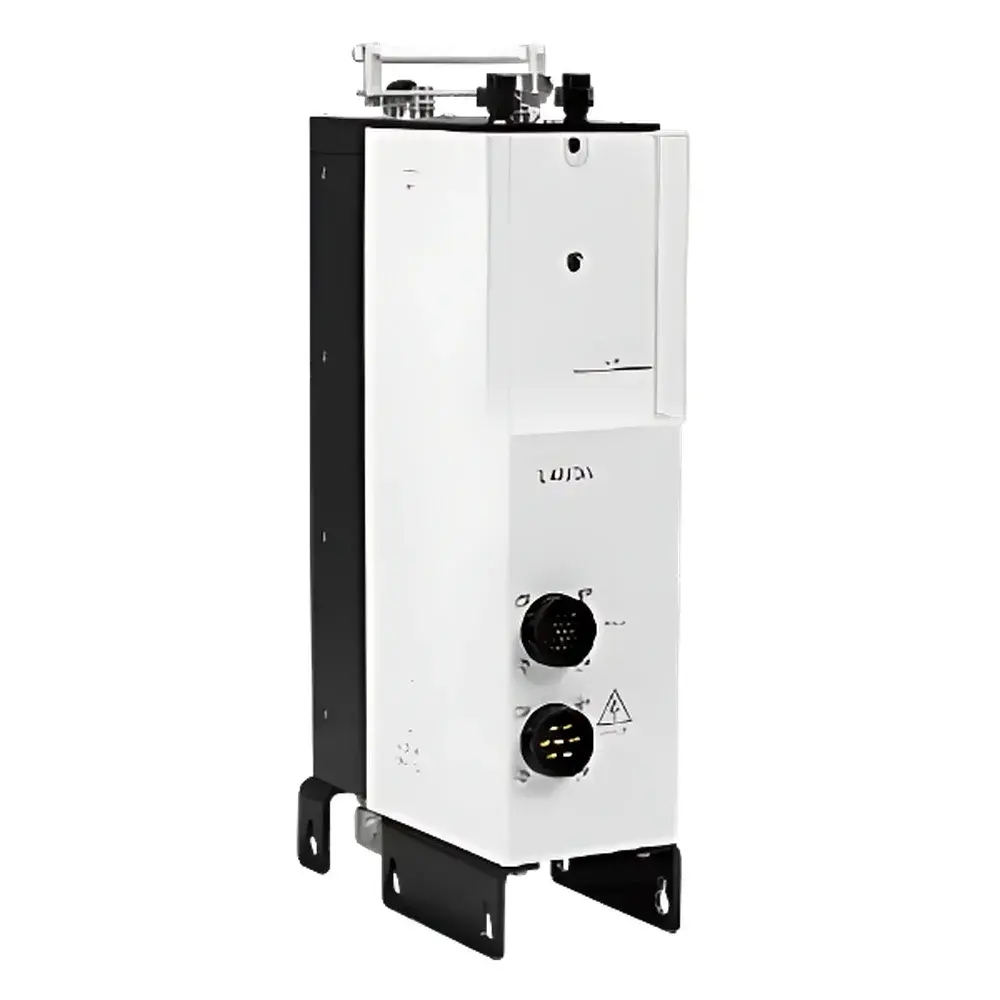
Lauda Semistat Semiconductor-Process Thermoregulator
| Brand | LAUDA |
|---|---|
| Origin | Germany |
| Model | Semistat S1200 / S2400 / S4400 |
| Temperature Range | −20 to +90 °C |
| Control Stability | ±0.1 K |
| Cooling Principle | Solid-State Peltier (Thermoelectric) |
| Fluid Volume | Minimal (Typ. < 1.5 L) |
| Footprint | Floor-Mountable or Sub-Fab Integrated |
| Energy Consumption | Up to 90% Lower vs. Compressor-Based Systems |
| Compliance | Designed for ISO Class 1–5 Cleanroom Integration |
| Application Focus | Electrostatic Chuck (ESC) Thermal Management in Plasma Etch Tools |
Overview
The Lauda Semistat Semiconductor-Process Thermoregulator is a purpose-engineered solid-state temperature control system designed exclusively for high-precision thermal management of electrostatic chucks (ESCs) in semiconductor plasma etch and deposition tools. Unlike conventional compressor-driven chillers or glycol-based circulators, the Semistat leverages thermoelectric (Peltier) technology to deliver rapid, bidirectional heat transfer—enabling precise dynamic regulation of ESC surface temperature across a wide operating range (−20 to +90 °C). Its architecture eliminates refrigerants, mechanical compressors, and oil-lubricated components, thereby minimizing particulate generation, vibration transmission, and maintenance overhead—critical requirements in sub-10 nm fab environments. The system achieves thermal stability of ±0.1 K under dynamic process loads, directly supporting improved within-wafer temperature uniformity (WTU), reduced edge exclusion, and enhanced critical dimension (CD) repeatability across successive etch cycles.
Key Features
- Solid-state Peltier-based thermal actuation—no moving parts, no refrigerants, no oil contamination risk
- Modular footprint design: fully compatible with floor-integrated or sub-fab installation (e.g., beneath cleanroom raised floors), reducing cleanroom real estate usage by >95%
- Ultra-low thermal fluid inventory (<1.5 L typical fill volume), minimizing potential leak impact and easing qualification for Class 1–5 cleanrooms
- Dynamic response time <3 s to 90% setpoint convergence under 100 W thermal load step, enabling tight tracking of complex ramp/soak profiles
- Integrated PID+ feedforward control algorithm optimized for ESC thermal mass and plasma-induced transient heating
- CE-marked, RoHS-compliant, and designed to meet SEMI S2/S8 safety and environmental guidelines for semiconductor tool integration
Sample Compatibility & Compliance
The Semistat is not a sample-handling instrument but a subsystem-level thermal controller engineered for OEM integration into plasma etch platforms (e.g., Lam Research, Applied Materials, Tokyo Electron). It interfaces directly with ESC cooling channels via standardized 1/4″ VCR or Swagelok fittings and supports both deionized water and low-conductivity aqueous glycol mixtures (≤10 µS/cm). All wetted materials—including stainless steel 316L manifolds, EPDM-free fluorosilicone tubing, and ceramic-coated Peltier modules—are selected per SEMI F57 (Materials Compatibility) and ASTM F2130 (Cleanroom-Compatible Elastomers). The unit complies with IEC 61000-6-2/6-4 for electromagnetic immunity and emissions, and its firmware architecture supports audit-ready event logging aligned with FDA 21 CFR Part 11 Annex 11 principles for GMP-relevant tool subsystems.
Software & Data Management
The Semistat operates via a deterministic real-time controller with dual communication interfaces: analog (0–10 V / 4–20 mA) for legacy tool integration and digital (EtherCAT or Modbus TCP) for synchronized operation with host tool controllers. Local HMI provides full access to temperature setpoints, PID parameters, fluid flow rate, and diagnostic logs—including Peltier junction voltage/current, thermal gradient across cold/hot sides, and fluid conductivity monitoring. All operational data are timestamped with microsecond resolution and exportable in CSV or OPC UA format. Optional Lauda ProcessLink™ software enables centralized fleet monitoring, predictive maintenance alerts (e.g., Peltier degradation trend analysis), and automated calibration traceability compliant with ISO/IEC 17025 requirements for metrology-critical subsystems.
Applications
- Real-time ESC temperature stabilization during reactive ion etching (RIE), inductively coupled plasma (ICP), and capacitively coupled plasma (CCP) processes
- Thermal conditioning of wafer backside helium gas gaps to optimize heat transfer efficiency in high-power etch steps
- Supporting advanced node patterning (7 nm, 5 nm, 3 nm) where ±0.1 K thermal drift directly impacts line-edge roughness (LER) and etch rate uniformity
- Enabling low-k dielectric etch processes requiring sub-zero chuck temperatures to suppress polymer redeposition
- Integration into cluster tools with multi-chamber thermal coordination protocols (e.g., synchronized cooldown between etch and ash modules)
FAQ
Can the Semistat replace an existing compressor-based chiller on my etch tool?
Yes—provided mechanical, fluidic, and electrical interfaces are adapted per Lauda’s OEM Integration Kit (Part No. SEMI-KIT-INT-01), which includes mounting brackets, fluid manifold adapters, and signal translation modules.
Does it support remote diagnostics over factory network infrastructure?
Yes—via embedded EtherCAT slave or Modbus TCP server; all alarms, sensor readings, and controller states are accessible through standard industrial Ethernet protocols without proprietary gateways.
What is the expected service life of the Peltier modules under continuous 24/7 operation?
Rated minimum lifetime is 50,000 hours at ≤80% of maximum current rating, validated per JEDEC JESD22-A108F accelerated life testing protocols.
Is fluid conductivity monitoring mandatory for cleanroom use?
Yes—integrated conductivity sensing (range: 0.1–20 µS/cm) is required to detect early-stage DI water degradation or particle-induced electrolyte leakage, triggering automatic system hold and alert.
How is calibration traceability maintained across production units?
Each unit ships with NIST-traceable calibration certificate (ISO/IEC 17025 accredited lab), covering temperature sensor linearity (PT1000, Class A), flow meter accuracy (±1.5% FS), and power measurement (±0.5% of reading).



