
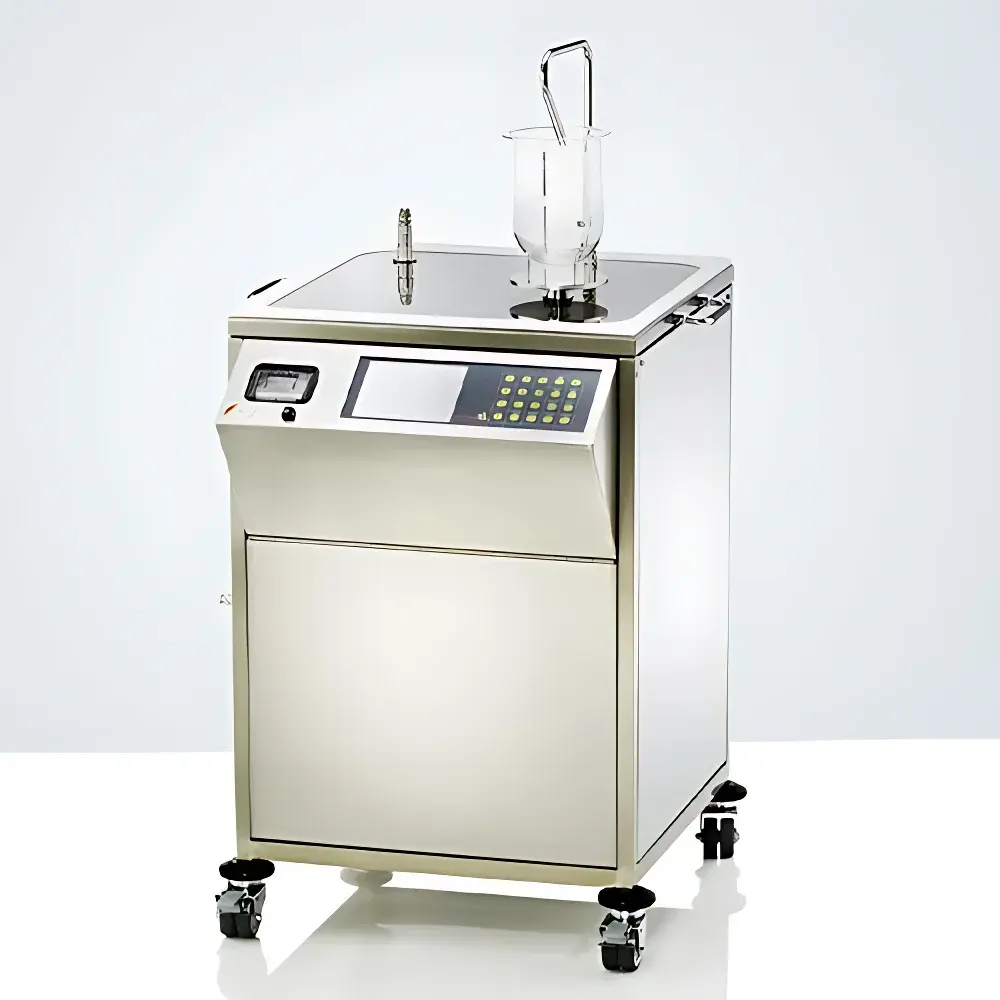
Pharma Test PT-DDS4 Solvent Preparation and Degassing System
| Brand | Pharma Test |
|---|---|
| Origin | Germany |
| Model | PT-DDS4 |
| Degassing Residual Oxygen | <5 ppm |
| Preheating Temperature | 37 °C ± 0.1 °C |
| Delivery Method | Pressurized (direct connection to deionized water supply) or Vacuum-assisted (from external reservoir) |
| Compliance | Designed in alignment with USP <711>, FDA Guidance for Industry on Dissolution Testing, and ICH Q5C stability requirements |
| Cleaning | Fully drainable, CIP-compatible design |
Overview
The Pharma Test PT-DDS4 Solvent Preparation and Degassing System is an automated, laboratory-grade platform engineered to prepare, thermoregulate, degas, and precisely deliver dissolution media in strict accordance with pharmacopeial and regulatory expectations. It operates on the principle of integrated vacuum-membrane degassing combined with PID-controlled thermal stabilization, ensuring consistent media physicochemical properties prior to introduction into dissolution vessels. As defined by USP and FDA’s 2022 Guidance on Dissolution Testing of Immediate-Release Solid Oral Dosage Forms, incomplete degassing introduces interfacial gas nucleation on tablet surfaces—distorting hydrodynamic boundary layers and compromising sink condition integrity. The PT-DDS4 addresses this root cause by achieving residual dissolved oxygen levels below 5 ppm in aqueous buffers preheated to 37 °C with ±0.1 °C stability, thereby minimizing assay variability attributable to media-related artifacts.
Key Features
- Integrated dual-mode delivery: supports both pressurized filling (via direct connection to facility-grade deionized water supply) and vacuum-assisted aspiration (from standard laboratory carboys or IBCs), enabling flexible integration into existing lab infrastructure.
- Real-time dissolved oxygen monitoring via electrochemical sensor with automatic logging and pass/fail threshold alerts at 5 ppm—traceable to NIST-traceable calibration standards.
- Stainless-steel 316L fluid path with electropolished interior (Ra ≤ 0.4 µm) and zero dead-leg geometry, compliant with ASME BPE-2022 surface finish requirements for pharmaceutical fluid systems.
- Programmable multi-step protocol engine: users define sequences including initial rinse, degas cycle duration (1–30 min), temperature equilibration hold time, and final delivery volume—all stored with electronic signature and audit trail per 21 CFR Part 11.
- Self-diagnostic pressure and temperature validation routines executed automatically prior to each batch, generating IQ/OQ-ready reports exportable as PDF or CSV.
Sample Compatibility & Compliance
The PT-DDS4 accommodates all USP-recommended dissolution media—including phosphate buffers (pH 4.5–7.4), simulated gastric/intestinal fluids (SGF/FeSSIF), and organic-aqueous mixtures up to 20% v/v ethanol or isopropanol. Its non-reactive wetted materials (EPDM gaskets, PTFE-coated diaphragms, 316L SS) ensure chemical compatibility across pH 1.2–10.0 and temperatures from 20 °C to 45 °C. System validation documentation supports compliance with EU Annex 15, WHO TRS 986, and ASTM E2503-21 (Standard Guide for Validation of Automated Dissolution Apparatus). All firmware revisions are version-controlled and retain backward compatibility with legacy method files.
Software & Data Management
Controlled via Pharma Test’s DDS Control Suite v4.2—a Windows-based application validated under GAMP 5 Category 3 architecture. The software enforces role-based access control (RBAC) with configurable permissions for operators, supervisors, and QA reviewers. All critical process parameters (temperature, O₂ level, fill volume, cycle time) are timestamped, digitally signed, and archived with immutable audit trails meeting ALCOA+ principles. Raw data exports support CSV, XML, and PDF formats; optional integration with LIMS via HL7 or OPC UA is available through certified middleware modules.
Applications
- Routine QC release testing of immediate-release and modified-release tablets/capsules per USP and Ph. Eur. 2.9.3.
- Method development and robustness studies requiring high-fidelity media reproducibility across multiple dissolution apparatuses (e.g., USP Apparatus 1–4).
- Stability-indicating dissolution profiling during accelerated and long-term storage studies (ICH Q1A–Q5C).
- Supporting biowaiver submissions where media composition and degassing rigor directly impact discriminatory power of dissolution methods.
- Facilitating GLP-compliant dissolution testing in contract research organizations (CROs) serving global regulatory submissions.
FAQ
Does the PT-DDS4 require external compressed air or nitrogen for operation?
No—it operates solely on electrical power and either facility deionized water (for pressurized mode) or ambient atmospheric vacuum (for vacuum mode); no auxiliary gas sources are needed.
Can the system be validated for use in a GMP environment?
Yes—full IQ/OQ/PQ protocols, traceable calibration certificates, and 21 CFR Part 11 compliance documentation are provided with each unit.
What maintenance intervals are recommended for the degassing module?
The hydrophobic membrane degasser requires replacement every 12 months or after 500 operational cycles, whichever occurs first; preventive maintenance logs are auto-generated within DDS Control Suite.
Is remote monitoring or alarm notification supported?
Optional Ethernet-enabled SNMP v3 integration allows real-time status polling and email/SMS alerts for out-of-spec conditions via configurable thresholds.
How is cleaning verification performed?
The system includes a built-in conductivity-based rinse validation sequence that confirms removal of residual buffer salts to <1.0 µS/cm, with results logged alongside operator ID and timestamp.





