
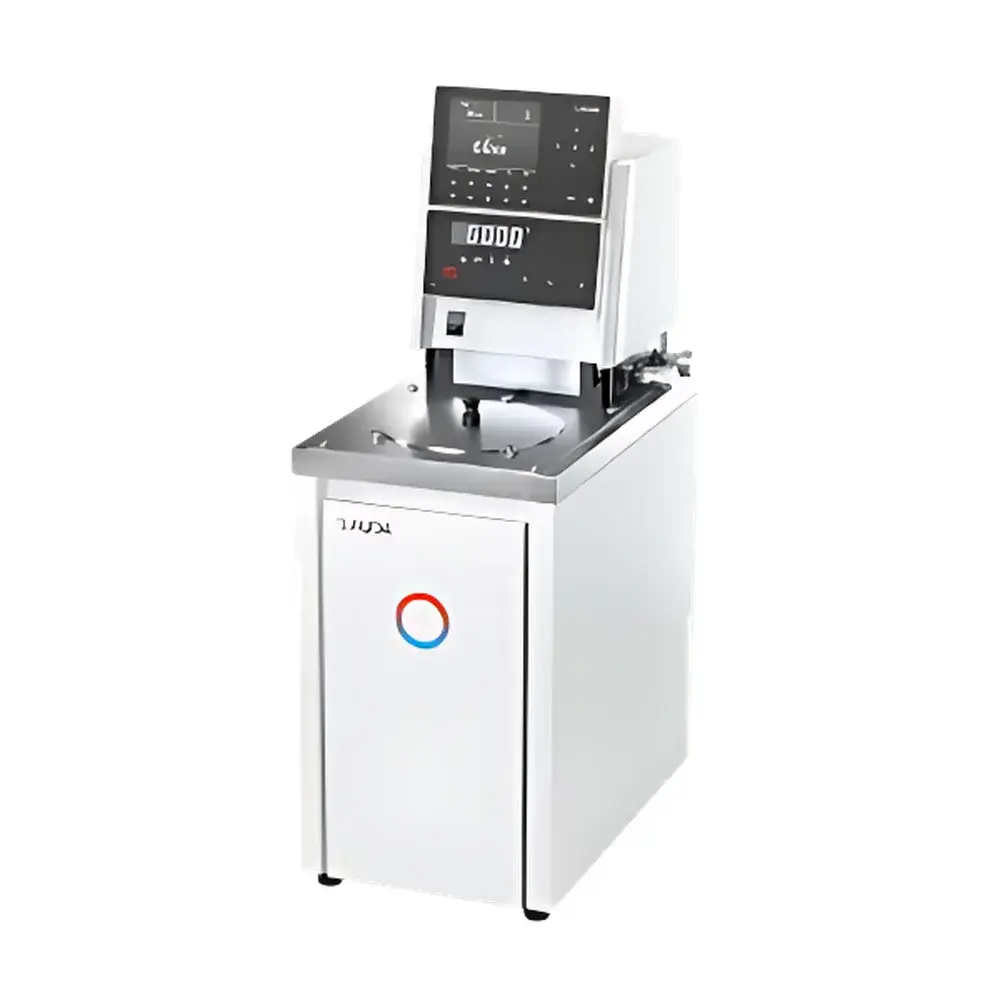
LAUDA Proline Calibration Circulating Bath
| Brand | LAUDA |
|---|---|
| Origin | Germany |
| Model | Proline PJ12 / PJ12 C / PJL12 / PJL12 C |
| Temperature Range | –40 °C to +300 °C |
| Heating/Cooling Medium | Liquid (e.g., silicone oil, water-glycol) |
| Control System | Microprocessor-based PID with PowerAdapt and SelfCheck diagnostics |
| Pump Type | LAUDA Varioflex pressure pump (8 adjustable levels) |
| Display | Green LED, EasyUse 3-button interface |
| Communication Interfaces | RS-232/485, Profibus, analog/contact modules, Ethernet/USB (optional) |
| Safety Features | Dual-stage overtemperature protection, audible alarm, flammable/non-flammable liquid mode |
Overview
The LAUDA Proline Calibration Circulating Bath is a high-precision, microprocessor-controlled temperature calibration system engineered for metrological traceability in laboratory, quality control, and calibration service environments. Operating on the principle of forced liquid circulation, it delivers exceptional thermal stability (±0.01 °C typical) and uniformity (≤0.02 °C across working volume) across its full operational range of –40 °C to +300 °C. Unlike air-based or dry-block calibrators, the Proline leverages the superior thermal conductivity of liquids—up to 60× higher than air—to achieve rapid equilibration, minimal gradient deviation, and repeatable thermal profiles essential for ISO/IEC 17025-accredited calibration procedures. Its design complies with fundamental requirements of ASTM E74, ISO 17025 Clause 6.4.3 (environmental monitoring), and EURAMET cg-18 (guidelines for thermometer calibration), making it suitable as a primary reference bath in accredited calibration laboratories.
Key Features
- Wide operating range: –40 °C to +300 °C enabled by integrated cooling coil and high-temperature heating elements, compatible with LAUDA DC-series chillers for sub-zero operation
- Varioflex pressure pump with eight selectable flow levels ensures precise fluid delivery to external devices (e.g., probe wells, jacketed reactors) while maintaining bath homogeneity
- EasyUse 3-button navigation interface with green LED display provides intuitive access to setpoint, actual temperature, ramp rate, and status indicators
- SelfCheck diagnostic assistant performs automated verification of sensor integrity, heater function, pump performance, and safety circuitry at startup and on demand
- Fully electronic PID controller with PowerAdapt technology dynamically modulates power output based on real-time load and line voltage fluctuations, minimizing overshoot and energy waste
- Dual-stage overtemperature protection with audible alarm—configurable for flammable or non-flammable heat transfer media per IEC 61010-1
- Modular communication expansion: optional RS-232/485, Profibus DP, analog 0–10 V / 4–20 mA, dry-contact, or Ethernet/USB interfaces support integration into LIMS, SCADA, or automated calibration workflows
Sample Compatibility & Compliance
The Proline series accommodates a broad spectrum of temperature sensors—including RTDs (Pt100, Pt1000), thermistors, liquid-in-glass thermometers, bimetallic gauges, and digital probes—within standardized immersion depths defined by ITS-90 and ASTM E74. Bath vessels are available in multiple configurations (PJ12, PJ12 C, PJL12, PJL12 C) differing in tank geometry, opening diameter, and usable depth to match probe length and calibration fixture requirements. All models are CE-marked and conform to EN 61010-1 (safety) and EN 61326-1 (EMC). Optional GLP/GMP-compliant firmware supports audit-trail logging, user access levels, and electronic signatures aligned with FDA 21 CFR Part 11 when paired with LAUDA’s LabView-compatible software suite.
Software & Data Management
While the Proline operates autonomously via front-panel controls, its optional digital interfaces enable seamless data acquisition and remote supervision. The LAUDA Pegasus software (Windows-based) provides real-time graphing, multi-channel logging, calibration report generation (PDF/CSV), and compliance-ready documentation including uncertainty budgets per GUM (JCGM 100). When configured with Ethernet or USB modules, the unit supports time-stamped event logging (start/stop, alarms, setpoint changes), user authentication, and secure firmware updates. All communication protocols are openly documented, facilitating custom integration with third-party calibration management systems adhering to ISO/IEC 17025 clause 7.7 (results reporting).
Applications
- Primary and secondary calibration of contact temperature sensors in national metrology institutes and commercial calibration labs
- Thermal validation of pharmaceutical manufacturing equipment (autoclaves, lyophilizers, stability chambers) per USP and EU Annex 15
- Reference bath for thermocouple wire verification, thermometer drift studies, and sensor interchangeability testing
- Temperature uniformity mapping of environmental test chambers and incubators
- Stabilized thermal source for material property testing (e.g., coefficient of thermal expansion, viscosity-temperature dependence)
- Supporting ISO 9001 and ISO 13485 quality systems requiring documented traceability to national standards
FAQ
What temperature stability and uniformity can be expected across the working volume?
Typical stability is ±0.01 °C at setpoint; axial and radial uniformity remains ≤0.02 °C within the central 50 mm zone when using recommended immersion depth and circulation settings.
Is the Proline suitable for calibrating probes with long stems or large thermal mass?
Yes—the PJL variants offer extended depth and larger bath volumes optimized for deep immersion and reduced self-heating effects during prolonged calibration cycles.
Can the unit operate unattended overnight during extended calibration runs?
Yes—integrated safety systems, SelfCheck diagnostics, and configurable alarm outputs allow reliable 24/7 operation under supervised laboratory conditions.
Does LAUDA provide calibration certificates with NIST-traceable documentation?
Factory calibration certificates are supplied with each unit; optional on-site or accredited third-party calibration services (ISO/IEC 17025) are available upon request.
How does PowerAdapt improve energy efficiency and thermal response?
PowerAdapt continuously monitors supply voltage and thermal load to adjust heater duty cycle in real time—reducing overshoot by up to 40% and extending component life without compromising setpoint accuracy.



