
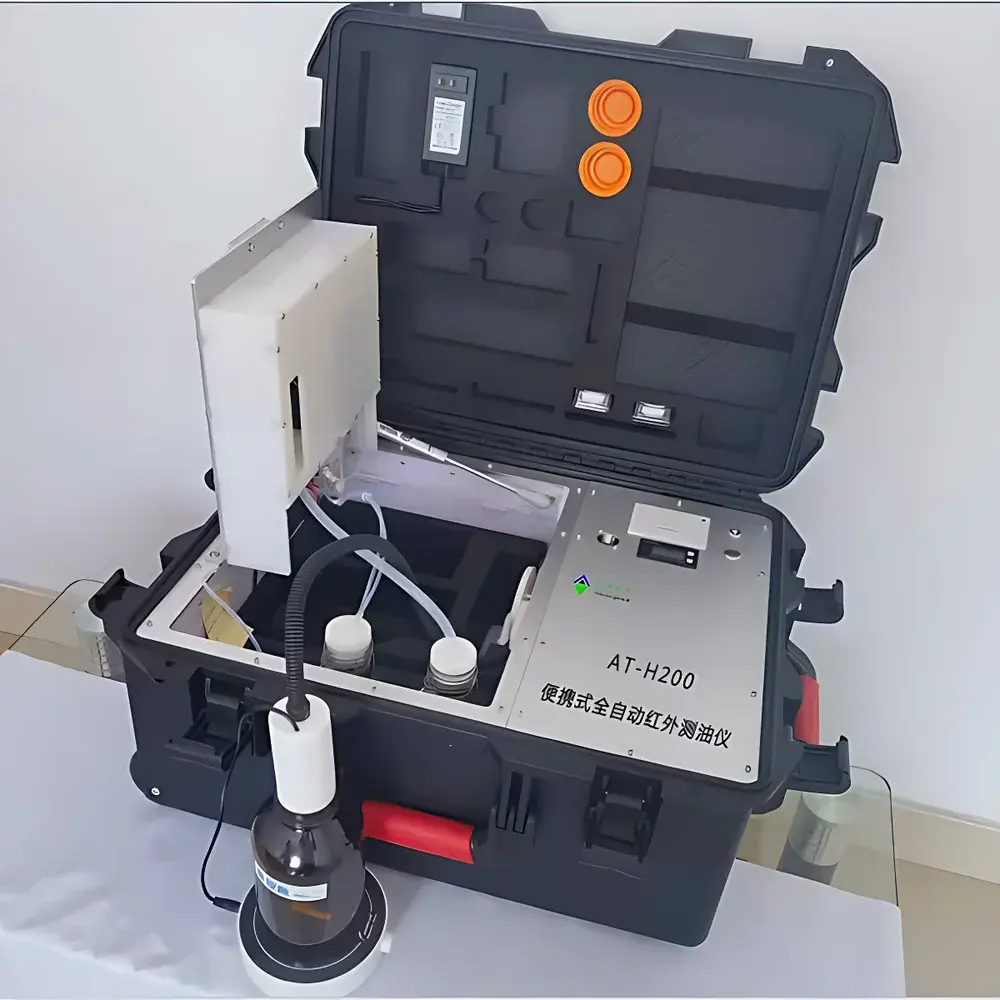
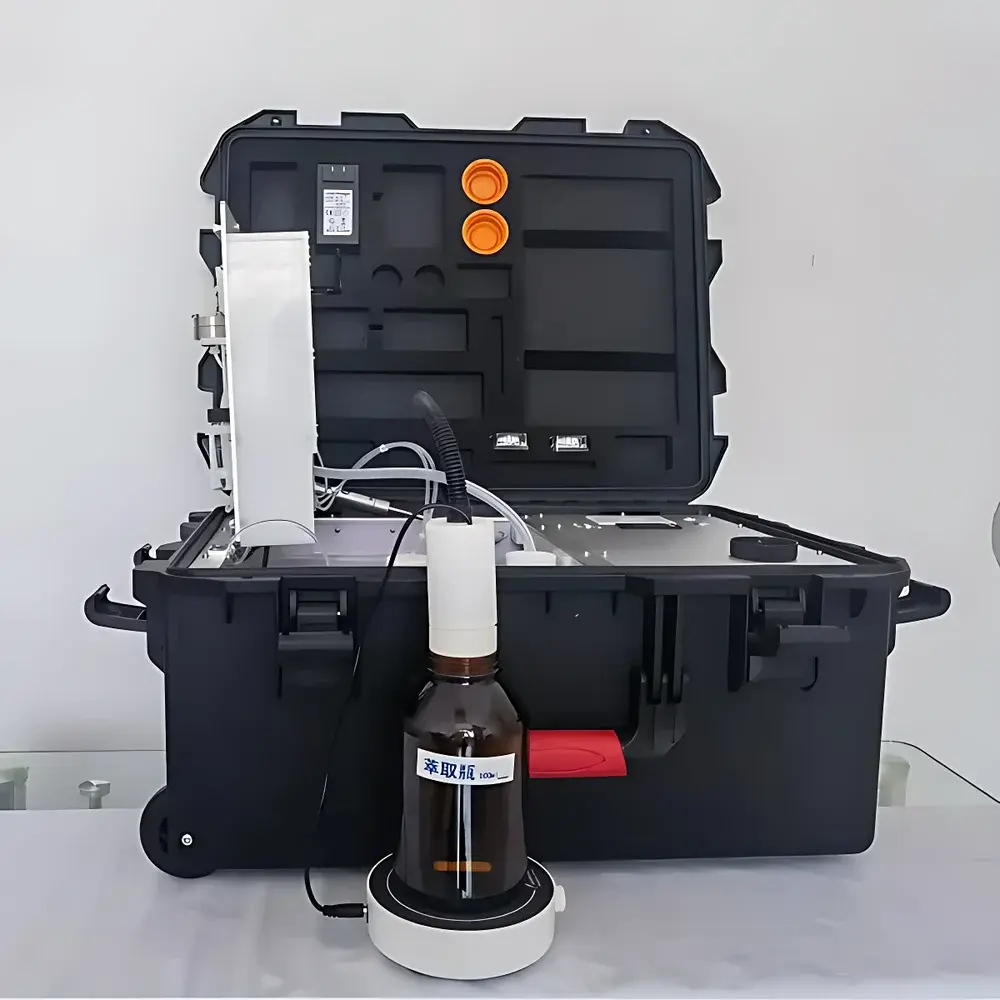
Agilent General AT-H200 Portable Fully Automated Infrared Oil-in-Water Analyzer
| Brand | Agilent General |
|---|---|
| Origin | Beijing, China |
| Manufacturer Type | Direct Manufacturer |
| Product Category | Domestic |
| Model | AT-H200 |
| Instrument Type | Portable |
| Measurement Principle | Infrared Spectrophotometry (C–H Stretch Absorption at 2930 cm⁻¹, 2960 cm⁻¹, and 2850 cm⁻¹) |
| Measurement Range | 0.002 – 64,000 mg/L |
| Detection Limit | < 0.2 mg/L |
| Accuracy | ±2% (relative error, certified reference standards) |
| Resolution | 0.001 mg/L |
| Analysis Time | 7 minutes per sample |
| Compliance | HJ 637–2018 (PRC Environmental Standard), JJF 1830–2020 (National Metrological Verification Regulation for Oil-in-Water Analyzers) |
Overview
The Agilent General AT-H200 Portable Fully Automated Infrared Oil-in-Water Analyzer is an integrated field-deployable instrument engineered for precise quantification of total petroleum hydrocarbons (TPH), mineral oil, and non-polar extractable organic matter—including animal and vegetable oils—in aqueous matrices. It operates on the principle of mid-infrared absorption spectroscopy, specifically measuring the asymmetric and symmetric C–H stretching vibrations of aliphatic hydrocarbons at 2960 cm⁻¹, 2930 cm⁻¹, and 2850 cm⁻¹. These spectral bands are mathematically resolved using a three-wavelength algorithm per HJ 637–2018, enabling selective differentiation between petroleum hydrocarbons and biogenic oils based on their distinct absorbance ratios. The system employs a high-stability silicon carbide IR source, thermoelectrically cooled MCT detector, and precision optical path with < 10 nm spectral bandwidth—ensuring reproducible baseline stability and minimal drift over extended operation. Designed for regulatory compliance and method traceability, the AT-H200 delivers laboratory-grade performance in a ruggedized portable form factor.
Key Features
- Fully automated workflow: Integrated syringe pump-driven sample volume metering (10–100 mL programmable), solvent-assisted liquid–liquid extraction (using CCl₄ or alternative non-chlorinated solvents per updated protocols), phase separation via membrane filtration, water removal using anhydrous Na₂SO₄ cartridges, and infrared spectral acquisition—all within a single sealed reaction loop.
- Hermetic process architecture: All fluidic paths operate under positive-pressure inert gas purge; waste solvents and aqueous phases are segregated into dual-compartment collection reservoirs; volatile organic exhaust is routed through activated carbon traps prior to venting.
- Dual-operation mode: Embedded ARM-based industrial computer supports standalone analysis with touchscreen GUI and real-time spectral preview; alternatively, full remote control, method scheduling, and audit log export are available via Ethernet or Wi-Fi when connected to external Windows/Linux workstations.
- Transport-optimized mechanical design: Encased in impact-resistant ABS polymer housing (IP65-rated), fitted with shock-absorbing corner mounts, integrated rechargeable Li-ion battery (≥8 h continuous operation), and foldable ergonomic handle—certified for transport in standard airline carry-on dimensions.
- Traceable metrology framework: Factory-calibrated against NIST-traceable oil-in-water reference standards (SRM 2781, SRM 1649b); software includes built-in verification routines aligned with JJF 1830–2020 requirements for linearity, repeatability, and detection limit validation.
Sample Compatibility & Compliance
The AT-H200 accommodates raw wastewater, treated effluent, surface water, groundwater, leachate, and homogenized soil extracts (post-SOXHLET or ultrasonic extraction). It supports direct analysis of fixed-source stack emissions via condensate capture from impingers or filter membranes (for油烟/oil mist per GB/T 16157–1996). All operational parameters—including wavelength calibration, zero-point drift compensation, and solvent blank subtraction—are programmable per matrix-specific method templates. Regulatory alignment includes full adherence to HJ 637–2018 (China’s mandatory method for petroleum and edible oil determination in water), as well as technical equivalency assessments supporting ISO 9377-2:2000 (petroleum hydrocarbons in water) and ASTM D7066–19 (infrared determination of oil and grease). Data integrity meets GLP/GMP documentation prerequisites, with electronic signatures and 21 CFR Part 11–compliant audit trails available via optional software license.
Software & Data Management
The AT-H200 Control Suite (v4.2+) provides intuitive method configuration, real-time spectral visualization, peak integration diagnostics, and automatic report generation in PDF/XLSX formats. Raw interferograms and absorbance spectra are stored in HDF5 format with embedded metadata (operator ID, timestamp, environmental conditions, calibration history). The system logs all critical events—including reagent depletion alerts, pressure anomalies, and detector saturation—with time-stamped entries compliant with ALCOA+ principles (Attributable, Legible, Contemporaneous, Original, Accurate, Complete, Consistent, Enduring, Available). Remote firmware updates and method library synchronization are supported over secure TLS 1.2 connections.
Applications
- Environmental monitoring: Routine surveillance of municipal wastewater treatment plants (WWTPs), industrial discharge points, and river/lake sediment porewater.
- Regulatory compliance testing: Submission-ready data packages for ecological environment bureaus (e.g., MEP Order No. 48 reporting), environmental impact assessments (EIAs), and permit renewal applications.
- Soil contamination screening: Quantification of petroleum hydrocarbon residues in excavated soils prior to thermal desorption or bioremediation.
- Occupational health & safety: Monitoring of cooking oil aerosols in commercial kitchen exhaust systems and lubricating oil mist in machining facilities.
- Research & development: Method development for alternative solvents, inter-laboratory comparison studies, and validation of solid-phase extraction (SPE) workflows.
FAQ
Does the AT-H200 comply with international standards beyond Chinese regulations?
Yes—the optical architecture and algorithmic processing satisfy the fundamental measurement criteria of ISO 9377-2 and ASTM D7066, though formal certification requires local validation per jurisdictional requirements.
Can the instrument analyze samples containing suspended solids or emulsified oil?
Pre-filtration (0.45 µm membrane) is recommended for turbid samples; the integrated phase separation module effectively handles stable emulsions when paired with demulsifier additives per HJ 637–2018 Annex B.
Is third-party calibration verification supported?
Absolutely—the system exports raw spectral data and intermediate calculation matrices, enabling independent verification by accredited metrology laboratories using certified reference materials.
What maintenance intervals are recommended for field deployment?
Optical window cleaning every 50 analyses; Na₂SO₄ cartridge replacement after 20 extractions; annual full-system verification including wavelength accuracy and photometric linearity checks.
How is data security ensured during networked operation?
All remote communications employ certificate-based mutual authentication; local database encryption uses AES-256; audit logs are write-once and tamper-evident.







