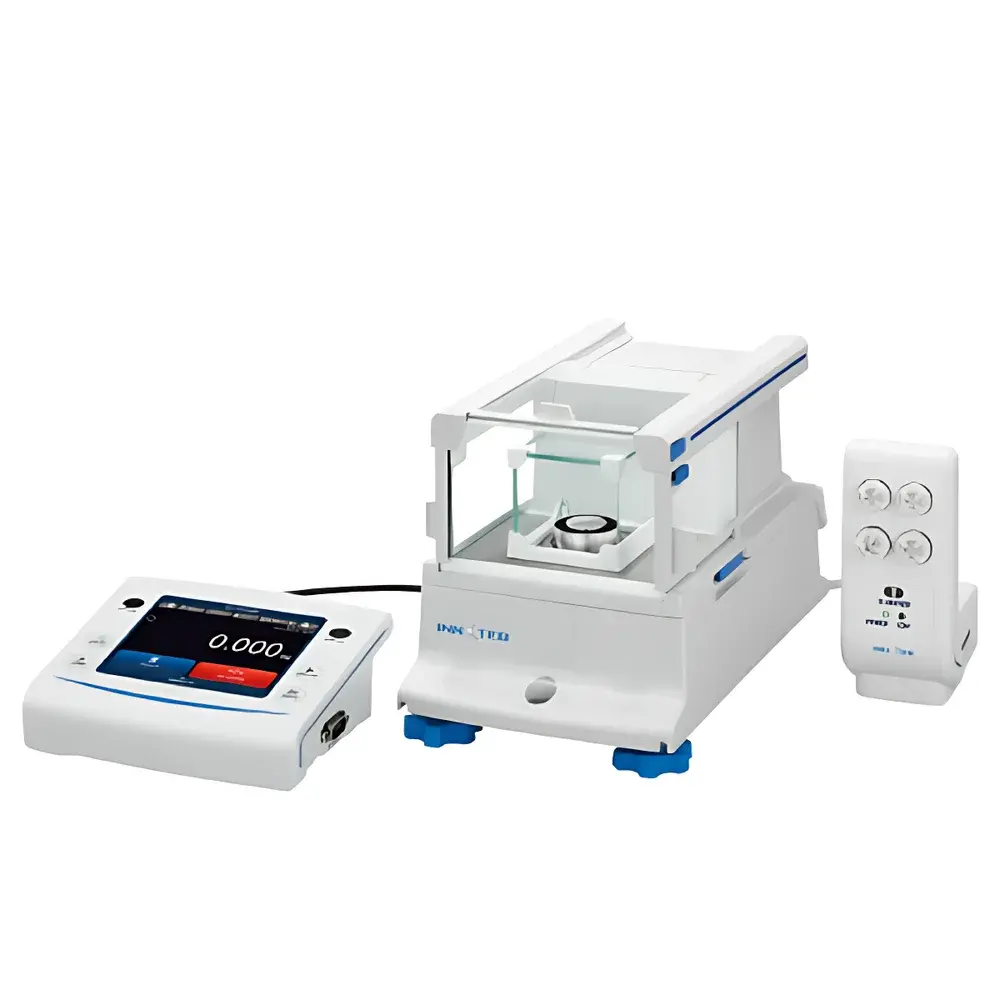
INNOTEG IA/IAm Series Microbalance (1 µg & 0.01 mg Precision Analytical Balance)
| Brand | INNOTEG |
|---|---|
| Origin | Guangdong, China |
| Model | IA/IAm |
| Instrument Type | Analytical Balance |
| Maximum Capacity | 6.1 g (IAm) / 219 g (IA) |
| Readability | 1 µg (IAm) / 0.01 mg (IA) |
| Repeatability | 0.001 mg (IAm-1 µg) / 0.015 mg (IA-0.01 mg) |
| Calibration | Internal Automatic Calibration |
| Minimum Weight Detection | 1.8 mg (IAm) / 20 mg (IA) |
| Linearity Error | ±0.01 mg (IAm) / ±0.015 mg (IA) |
| Stabilization Time | ~8 s (IAm) / ~6 s (IA) |
| Display | Color TFT Touchscreen (IA-C/IAm-C) or Monochrome LCD (IA/IAm standard) |
| Electrostatic Neutralization | DC Ionizer (Standard on IAm-J/IA-J) |
| Weighing Pan Diameter | Φ25 mm (IAm) / Φ85 mm (IA) |
| Dimensions (Display Unit) | 181 × 137 × 72 mm |
| Dimensions (Weighing Unit) | 172 × 304 × 203 mm (IAm) / 172 × 304 × 283 mm (IA) |
| Compliance | USP <41>, GLP/GMP/GCP Data Integrity, ISO/IEC 17025 Traceable Operation |
Overview
The INNOTEG IA/IAm Series Microbalance is a high-precision analytical balance engineered for trace-level mass measurement in regulated laboratory environments. Operating on electromagnetic force compensation (EMFC) principle, it delivers true 1 µg (0.001 mg) readability for the IAm sub-series and 0.01 mg readability for the IA sub-series — meeting the stringent requirements of elemental analysis, quantitative sample preparation for ICP-MS and GC-MS, pharmaceutical reference standard weighing, and nanomaterial dosing. Designed to comply with USP minimum weight validation protocols, each unit integrates real-time repeatability assessment and automatic minimum weight (MinW) calculation based on user-defined confidence intervals (k = 2). Its robust monolithic sensor architecture minimizes thermal drift and mechanical hysteresis, ensuring long-term stability under ambient laboratory conditions (20–25 °C, 40–60% RH).
Key Features
- DC ionizer-based electrostatic neutralization (standard on IAm-J/IA-J models) eliminates airborne particle dispersion caused by static charge without airflow disturbance — critical for hygroscopic or low-mass powders.
- Dual-chamber draft shield design (IAm-CJ/IAm-SCJ) reduces convective interference and improves repeatability in non-controlled environments.
- Intelligent auto-response adjustment dynamically optimizes filter response time (fast/medium/slow) based on real-time vibration and air current detection — preserving accuracy without manual intervention.
- IR proximity sensor enables touchless door control: hand-waving gesture opens/closes draft shield, minimizing operator-induced disturbances and contamination risk.
- GLP/GMP-compliant data handling: timestamped audit trail, electronic signature support, user access levels (admin/operator/technician), and password-protected configuration changes.
- Integrated buffer preparation module supports molarity-based mass calculation for HPLC mobile phase preparation — stores up to 300 custom recipes and includes built-in molecular weights for 13 common reagents (e.g., NaH₂PO₄, Tris-HCl, EDTA).
Sample Compatibility & Compliance
The IA/IAm series accommodates diverse sample forms — from sub-milligram crystalline standards to viscous solutions in tared vials — via interchangeable pan assemblies and optional anti-static weighing boats. All models conform to ISO 9001 calibration traceability requirements and support full compliance with FDA 21 CFR Part 11 (when used with validated software configurations). Built-in environmental monitoring logs temperature, humidity, and barometric pressure at every weighing event — enabling post-hoc uncertainty budgeting per GUM (Guide to the Expression of Uncertainty in Measurement). Minimum weight verification adheres strictly to USP Annex, with automated reporting of expanded uncertainty (k=2) and pass/fail status relative to defined tolerances.
Software & Data Management
Data output follows standardized formats including CSV, PDF, and XML, with configurable headers for LIMS integration. Print templates are fully customizable (user-defined fields, logo insertion, regulatory footer text). Historical records retain raw values, metadata (operator ID, location tag, environmental readings), and calibration logs for ≥10,000 entries. Optional PC connectivity via RS232, USB, or Ethernet enables bidirectional control through METTLER TOLEDO-compatible ASCII command sets or proprietary INNOTEG Link software — supporting remote calibration scheduling, firmware updates, and batch report generation compliant with ISO/IEC 17025 clause 7.7.
Applications
- Pharmaceutical QC: Reference standard weighing, assay dilution preparation, and residual solvent quantification per ICH Q2(R2).
- Materials science: Nanoparticle mass dosing for TEM grid preparation, catalyst loading optimization, and thin-film thickness validation.
- Environmental testing: Filter membrane weighing pre/post-extraction for PM2.5/PM10 gravimetric analysis (EPA Method IO-3.2).
- Clinical research: Radioisotope tracer dose calibration, stable isotope-labeled internal standard preparation.
- Academic labs: Teaching metrology principles, uncertainty propagation exercises, and inter-laboratory comparison studies.
FAQ
What is the difference between IAm and IA models?
The IAm series offers 1 µg readability (up to 6.1 g capacity) for ultra-trace applications; the IA series provides 0.01 mg readability (up to 219 g capacity) for high-precision routine analysis.
Does the balance meet USP minimum weight requirements?
Yes — all units perform real-time repeatability assessment and calculate minimum weight automatically using k=2 coverage factor, with configurable tolerance thresholds and on-screen alerting.
Can the balance be integrated into a regulated QA/QC workflow?
Yes — it supports electronic signatures, role-based access control, full audit trail logging, and export formats compatible with 21 CFR Part 11-compliant systems when deployed with validated software configurations.
Is external calibration required after internal self-calibration?
Internal calibration verifies linearity and sensitivity using factory-traceable weights; however, periodic external verification using certified mass standards (e.g., ASTM E617 Class E2) is recommended per ISO/IEC 17025 clause 6.5.2.
How does the DC ionizer differ from conventional AC ionizers?
Unlike AC ionizers that generate alternating ion streams causing powder suspension, the DC ionizer emits unidirectional balanced ions — eliminating electrostatic repulsion without inducing airflow turbulence or particle migration.