
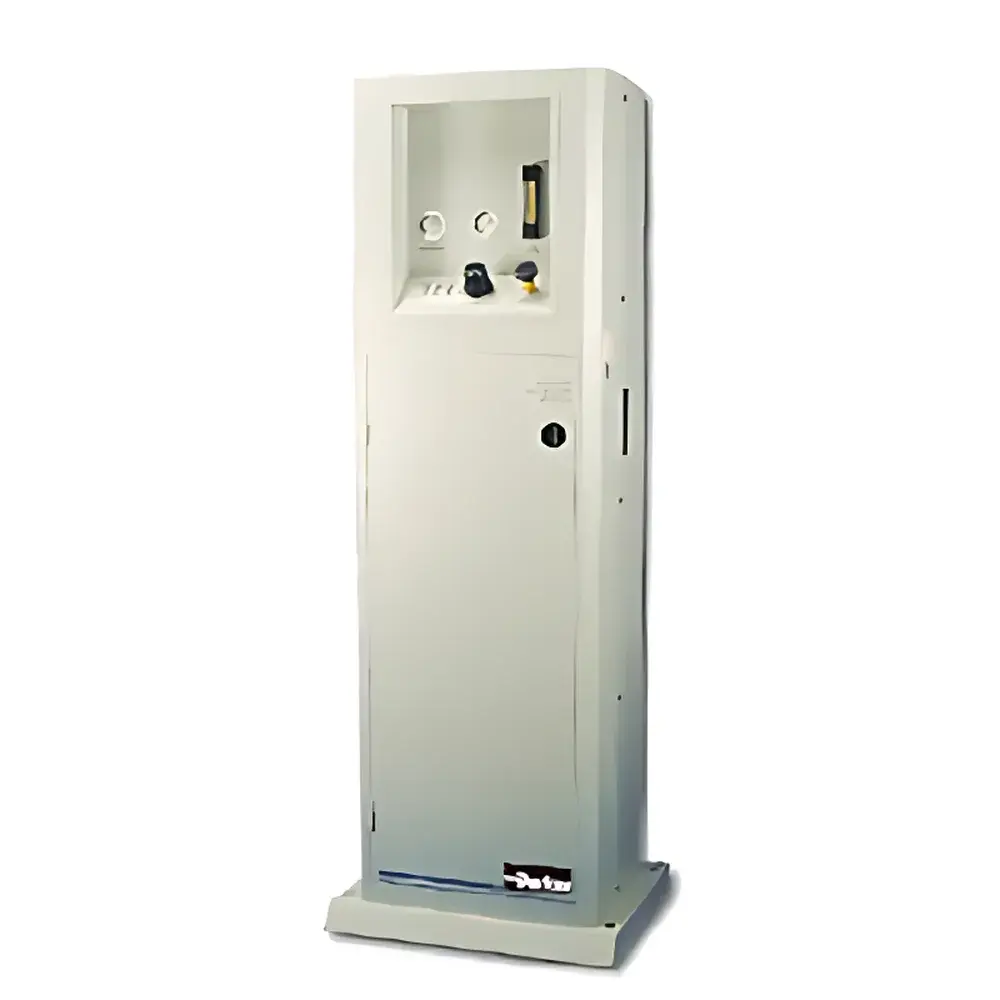
Parker DH HFX Series Nitrogen Generator
| Brand | Parker DH |
|---|---|
| Origin | United Kingdom |
| Model | HFX |
| Nitrogen Generation Principle | Membrane Separation |
| Output Flow Rate | 40–1200 L/min |
| Output Pressure | 4–10 bar |
| Nitrogen Purity | 95–99.5% |
| Dew Point | −50 °C |
Overview
The Parker DH HFX Series Nitrogen Generator is an engineered-on-demand gas supply system designed for continuous, on-site nitrogen production in analytical laboratories and research facilities. Utilizing proprietary hollow-fiber membrane separation technology, the HFX series separates nitrogen from clean, oil-free compressed air by exploiting differential permeation rates of oxygen, water vapor, and carbon dioxide through asymmetric polymeric membranes. This physical separation process yields a consistent stream of dry, phthalate-free nitrogen without chemical consumables, catalytic beds, or cryogenic components. The system operates at ambient temperature and pressure, requiring only a stable supply of ISO Class 1.2.3 (or better) compressed air — typically delivered via an integrated or external oil-free compressor. With output capacities spanning 40 to 1200 L/min and regulated delivery pressures between 4 and 10 bar, the HFX platform supports both single-instrument deployment (e.g., LC-MS, GC-NPD, FTIR purge) and multi-user configurations across centralized lab gas networks.
Key Features
- Stable nitrogen purity of 95–99.5% — independently verified per ISO 8573-1:2010 Class 2:2:2 for particulates, water, and oil
- Dew point performance down to −50 °C, ensuring compatibility with moisture-sensitive detectors and optical components
- Integrated three-stage filtration: particulate pre-filter (1 µm), activated carbon coalescer (removes hydrocarbons and trace oils), and final membrane module with >10,000-hour service life under nominal load
- Compact footprint and modular chassis design — optimized for benchtop, under-bench, or rack-mount installation without dedicated utility rooms
- No electrical connection required for core nitrogen generation (only optional control panel or dew point monitor may draw low-voltage power)
- Zero reliance on high-pressure cylinders — eliminates logistical risk, regulatory documentation (DOT/ADR), and storage compliance overhead
- Designed and manufactured in the UK to meet CE, UKCA, and RoHS directives; compliant with ISO 9001:2015 quality management systems
Sample Compatibility & Compliance
The HFX series delivers nitrogen meeting critical specifications for routine and regulated analytical workflows. Its output satisfies ASTM D6349–22 requirements for carrier and purge gases in chromatographic applications and aligns with USP and EP 2.5.27 guidelines for inert gas quality in pharmaceutical stability testing. When paired with validated air compressors and desiccant dryers, the system achieves ISO 8573-1:2010 Class 2:2:2 air quality upstream — a prerequisite for maintaining membrane integrity and long-term purity consistency. All wetted materials are FDA-compliant polymers and stainless steel (316L), with no leachable plasticizers (e.g., phthalates) — essential for LC-MS, elemental analysis, and cell culture incubation support. The generator is routinely deployed in GLP and GMP environments where audit-ready documentation, calibration traceability (NIST-traceable dew point sensors), and failure-mode logging are required.
Software & Data Management
While the base HFX model operates as a fully pneumatic, analog-controlled system, optional digital modules provide RS-485 Modbus RTU or Ethernet/IP interfaces for integration into laboratory building management systems (BMS) or instrument control networks. These modules log real-time parameters including inlet pressure, outlet flow, dew point, and cumulative runtime — supporting preventive maintenance scheduling and 21 CFR Part 11-compliant electronic records when used with validated data acquisition software. Optional local HMI displays allow operators to verify status, initiate self-diagnostics, and access historical trend data for root-cause analysis during method validation or equipment qualification (IQ/OQ/PQ).
Applications
- LC-MS and GC-MS carrier/purge gas supply — reducing baseline noise and improving signal-to-noise ratio through consistent purity and dew point control
- Nitrogen blow-down (evaporative concentration) for sample prep in environmental, clinical, and forensic labs
- Instrument purging for FTIR, Raman, and UV-Vis spectrometers to minimize atmospheric CO₂ and H₂O interference
- Blanketing and inerting in glove boxes, synthesis reactors, and solvent handling stations
- Supporting nitrogen-dependent accessories such as ESI ion sources, APCI probes, and nitrogen laser cooling systems
- Backup or primary gas source for QA/QC labs operating under ISO/IEC 17025 accreditation requirements
FAQ
Does the HFX require a dedicated air compressor?
Yes — it must be fed with clean, dry, oil-free compressed air meeting ISO 8573-1 Class 1.2.3 specifications. Parker DH recommends pairing it with certified oil-free scroll or diaphragm compressors.
Can the nitrogen purity be adjusted in real time?
No — purity is determined by membrane surface area, feed air quality, and operating pressure; it is fixed per model configuration. Selection of the appropriate HFX variant (e.g., HFX-200 vs. HFX-1200) ensures optimal purity–flow balance for the intended application.
What maintenance intervals are recommended?
Pre-filters every 6 months; carbon filters annually; membrane modules inspected every 3 years or after 10,000 hours of operation — documented in the manufacturer’s PQ protocol.
Is the system suitable for use in explosion-hazard areas?
Standard HFX units are not ATEX-certified; however, custom intrinsically safe variants can be supplied upon request for Zone 2/22 installations.
How does membrane aging affect long-term performance?
Hollow-fiber membranes exhibit gradual flux decline rather than sudden failure; Parker DH provides predictive lifetime modeling based on inlet air quality logs and pressure differentials — enabling proactive replacement planning.



