
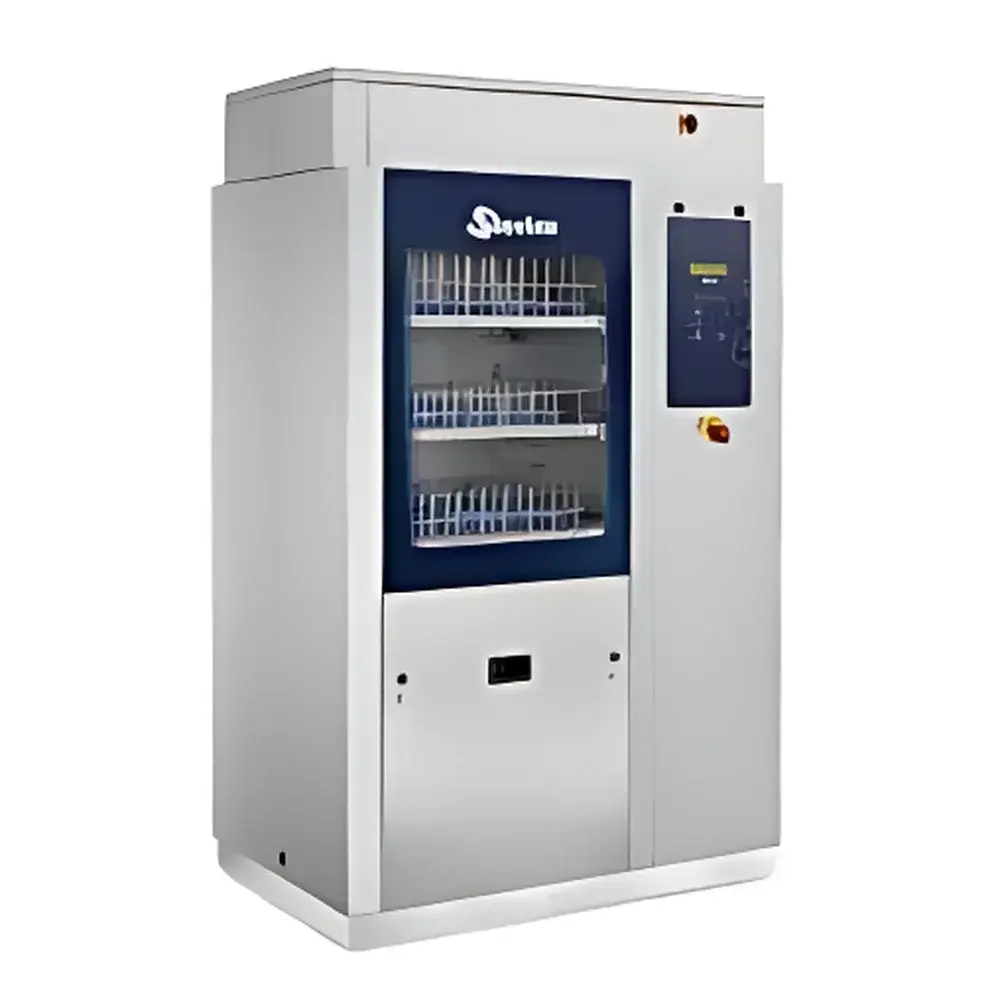
Steelco LAB900 Laboratory Bottle Washer & Thermal Disinfector
| Brand | Steelco |
|---|---|
| Origin | Italy |
| Model | LAB900 |
| Chamber Volume | 500 L |
| Heating Power | 5100 W |
| Wash Temperature | Adjustable |
| Compatible Detergent Types | Alkaline and Acidic |
| External Dimensions (L×W×D) | 1140 × 915 × 1900 mm |
Overview
The Steelco LAB900 is a fully automated, thermally validated laboratory bottle washer and thermal disinfector engineered for high-throughput, reproducible cleaning and EN ISO 15883-1/-2 compliant thermal disinfection of reusable labware. Designed for demanding environments—including pharmaceutical QC labs, biotech R&D facilities, clinical diagnostics centers, and GLP-compliant research institutions—the LAB900 employs a multi-stage cycle architecture comprising pre-rinse, alkaline wash, acid rinse, final rinse (with optional deionized water), thermal disinfection at 93 °C, and HEPA-filtered hot-air drying. Its 500 L stainless steel chamber—fabricated from electropolished AISI 316L stainless steel with seamless, weld-free corner radii and sloped floor—ensures complete drainage, minimizes microbial retention, and resists corrosion from aggressive alkaline and acidic detergents. The system integrates triple independent water reservoirs to preheat incoming water, reducing thermal lag and shortening total cycle time without compromising validation integrity.
Key Features
- Compliance-certified architecture: Fully conforms to EN ISO 15883-1/-2 (washer-disinfectors), EN 61010-1 (safety), EN 61010-2-040 (particular safety requirements), EN 61326 (EMC), and EU Directives 98/37/EEC, 06/95/EEC, 89/336/EEC, 92/31/EEC, and 93/68/EEC.
- Four-tier basket rack system supporting up to three loaded baskets simultaneously for optimized throughput and flexible load configuration.
- Dual PT1000 temperature sensors—one for process display, one for closed-loop disinfection temperature control—ensuring traceable, real-time thermal monitoring per ISO 15883 validation protocols.
- Integrated HEPA-filtered hot-air drying module with adjustable temperature range (ambient to 140 °C) and programmable duration, eliminating residual moisture and preventing recontamination.
- RS232 serial interface enabling bidirectional program upload/download, remote diagnostic logging, and direct connection to thermal printers for audit-ready cycle reports.
- Automated detergent dosing via two standard peristaltic pumps (expandable to four), calibrated for precise delivery of both alkaline and acidic solutions in accordance with manufacturer specifications and user-defined concentration profiles.
- Triple-layer stainless steel filtration system (100 µm, 50 µm, 25 µm) intercepting particulate debris upstream of the circulation pump to extend service life and maintain consistent spray pressure.
- Double-insulated door with acoustic damping reduces operational noise to ≤58 dB(A); integrated steam condenser eliminates need for external venting or cooling-down delays.
Sample Compatibility & Compliance
The LAB900 accommodates a full spectrum of laboratory glassware and plasticware—including volumetric flasks, conical flasks, beakers, Petri dishes, test tubes, pipettes, graduated cylinders, and culture bottles—via configurable stainless steel baskets and specialized fixtures. All cycles are designed to meet material compatibility requirements for borosilicate glass (e.g., DIN ISO 3585), polypropylene, polycarbonate, and PTFE-lined components. Validation documentation supports compliance with FDA 21 CFR Part 11 (when paired with compliant LIMS or data management software), EU GMP Annex 15 (Qualification & Validation), and ISO 13485:2016 (for medical device manufacturing support). Optional IQ/OQ documentation packages and third-party qualification services are available upon request.
Software & Data Management
The embedded microprocessor-based controller provides intuitive touchscreen navigation with LED status display showing phase progression, setpoints, actual temperatures, error codes, and elapsed time. Forty preconfigured programs—including 20 standardized cycles aligned with common labware types and contamination profiles, plus 20 customizable user-defined protocols—support repeatable execution across shifts and operators. Cycle logs (including temperature/time curves, pump actuation events, and fault timestamps) are stored internally and exportable via RS232 for integration into electronic lab notebooks (ELN) or quality management systems (QMS). Audit trail functionality records all parameter modifications, user logins, and program executions—meeting ALCOA+ principles for data integrity in regulated environments.
Applications
The LAB900 serves as a critical utility in laboratories requiring validated cleaning prior to analytical testing (e.g., HPLC vial preparation), sterility assurance (e.g., media container reprocessing), regulatory submission support (e.g., USP , EP 2.1.12), and routine maintenance of reusable instrumentation components (e.g., autosampler vials, reaction vessels, sensor housings). It is routinely deployed in pharmaceutical stability studies, vaccine production support labs, academic core facilities, food safety testing centers, and contract development and manufacturing organizations (CDMOs) where traceability, cycle reproducibility, and documented thermal lethality (≥log6 reduction of Geobacillus stearothermophilus spores at 93 °C) are mandatory.
FAQ
Does the LAB900 support connection to purified water (DI) and steam supply?
Yes—it accepts three independent inlet connections: cold tap water, preheated utility hot water (≤80 °C), and deionized water—each selectable per program stage to optimize rinsing efficacy and energy efficiency.
Is the chamber volume verified and documented for validation purposes?
Yes—the 500 L internal chamber volume is certified during factory acceptance testing (FAT) and included in the delivered IQ/OQ documentation package.
Can the LAB900 be integrated into a centralized laboratory automation network?
While native Ethernet or OPC UA is not standard, RS232 output enables integration with SCADA or MES platforms via protocol converters; custom Modbus RTU firmware upgrades are available under engineering support agreement.
What is the expected service life of consumables such as filters and gaskets?
Stainless steel filters require periodic visual inspection and ultrasonic cleaning; elastomeric door gaskets are rated for ≥5,000 cycles and supplied with replacement kits and torque-specified installation instructions.
Are validation templates and cycle development support included?
Standard FAT/SAT documentation is provided; comprehensive validation support—including risk assessment (FMEA), PQ protocol drafting, and thermocouple mapping services—is offered through Steelco’s global validation team on a project basis.



