
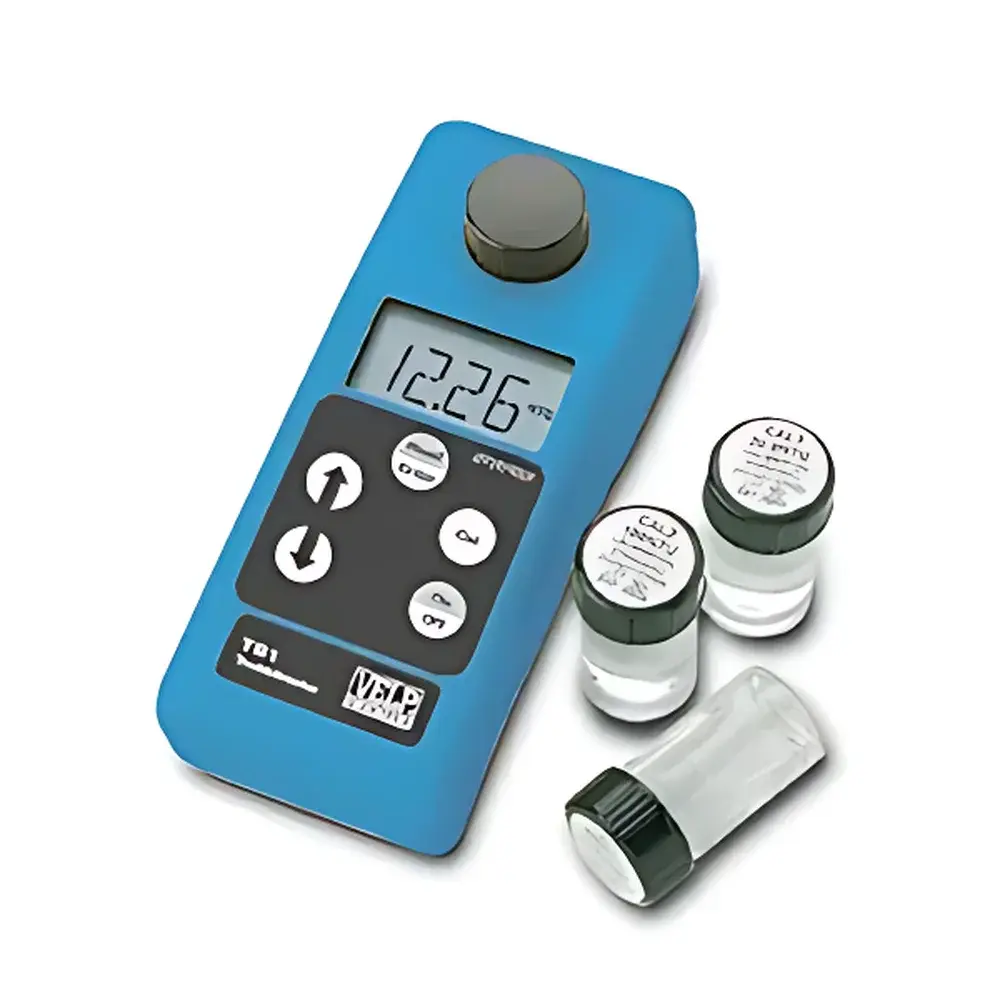
VELP TB1 Portable Turbidimeter
| Brand | VELP |
|---|---|
| Origin | Italy |
| Model | TB1 |
| Type | Portable |
| Measurement Range | 0–1000 NTU |
| Repeatability | ±0.01 NTU or ±1% of reading (higher repeatability for gel samples) |
| Light Source | Infrared LED (850 nm) |
| Detection Angle | 90° (ISO 7027 compliant) |
| IP Rating | IP67 (waterproof) |
| Weight | 200 g |
| Dimensions | 68 × 50 × 155 mm |
| Calibration | Single-point using standard reference solutions (e.g., Formazin or StablCal) |
Overview
The VELP TB1 Portable Turbidimeter is a compact, field-ready optical instrument engineered for rapid, reliable turbidity assessment in potable water, wastewater effluents, and process streams. It operates on the principle of nephelometry—measuring light scattered at a 90° angle from an incident infrared beam (850 nm)—in strict accordance with ISO 7027:2016, the internationally recognized standard for turbidity measurement in drinking water and environmental applications. Unlike visible-light turbidimeters, the infrared source minimizes interference from sample coloration and reduces photoreactive artifacts, ensuring high fidelity in colored or UV-absorbing matrices. Its solid-state optical architecture eliminates moving parts and lamp aging effects, delivering long-term stability without recalibration drift. Designed for routine compliance monitoring and on-site verification, the TB1 bridges laboratory-grade accuracy with handheld operational simplicity—making it suitable for field technicians, municipal water operators, and QA/QC personnel conducting daily checks under variable ambient conditions.
Key Features
- ISO 7027-compliant 90° nephelometric detection using a stable 850 nm infrared LED source
- Measurement range of 0–1000 NTU with resolution of 0.01 NTU across the full scale
- Repeatability of ±0.01 NTU or ±1% of reading (whichever is greater); enhanced repeatability observed with viscous or gelatinous samples due to reduced sedimentation artifacts during measurement
- IP67-rated enclosure—fully dust-tight and submersible up to 1 m for 30 minutes—enabling use in humid, outdoor, or wet-lab environments
- Ergonomic, one-handed operation with tactile membrane buttons and intuitive three-step workflow: rinse → fill → measure
- Integrated cuvette holder with automatic alignment and zero-background optical path compensation
- Battery-powered operation (4 × AAA, ~2000 measurements per set) with low-power sleep mode and auto-shutdown
Sample Compatibility & Compliance
The TB1 accepts standard 25-mm round glass or disposable plastic cuvettes (10 mm path length), supporting both clear and mildly turbid aqueous samples—including chlorinated drinking water, filtered surface water, and clarified secondary effluent. It is validated for use with Formazin standards (primary reference) and traceable StablCal® suspensions (secondary NIST-traceable standards). The device complies with regulatory frameworks governing water quality testing, including EPA Method 180.1 (for drinking water), ISO 7027:2016 (turbidity measurement principles), and EU Directive 98/83/EC (Drinking Water Quality). While not FDA 21 CFR Part 11–enabled (as it lacks electronic audit trail functionality), its calibration logs, date/time stamps, and manual record-keeping support GLP-aligned documentation practices when paired with standardized lab notebooks or LIMS-integrated reporting workflows.
Software & Data Management
The TB1 operates as a standalone instrument with no embedded software or connectivity interfaces (e.g., Bluetooth, USB, or Wi-Fi). All data are displayed on a high-contrast LCD screen and must be manually recorded. However, its consistent output format (NTU, timestamp, and calibration status indicator) facilitates structured transcription into electronic lab notebooks (ELNs), LIMS platforms, or Excel-based QA registers. For laboratories requiring digital traceability, VELP recommends pairing the TB1 with their optional TB-LOG companion app (used with TB2/TB3 models) via external barcode scanning of calibration standards—though this functionality is not natively supported by the TB1 hardware. Calibration history is retained only as physical records; no internal memory or firmware-based audit trail is implemented.
Applications
- Routine verification of finished drinking water turbidity prior to distribution (target ≤ 0.3 NTU per WHO and US EPA guidelines)
- Monitoring filter performance and breakthrough events in conventional and membrane filtration plants
- Field assessment of source water variability during seasonal algal blooms or storm runoff events
- Process control in beverage production (e.g., beer clarity, juice stabilization)
- Educational demonstrations of colloid behavior, coagulation efficiency, and flocculation kinetics
- Emergency response testing following infrastructure failure or natural disasters affecting water supply integrity
FAQ
Does the TB1 require annual factory recalibration?
No. The TB1 is designed for user-performed single-point calibration using certified turbidity standards; periodic verification against reference materials (e.g., every 30 days or per SOP) is recommended, but factory recalibration is not required under normal operating conditions.
Can the TB1 measure samples with high absorbance or strong coloration?
Yes. The 850 nm infrared source significantly reduces spectral interference from yellow-to-brown humic substances, iron complexes, or dissolved organic carbon—common sources of positive bias in visible-light turbidimeters.
Is the cuvette included with the instrument?
A single precision-ground glass cuvette (25 mm OD, 10 mm path length) is supplied with each TB1 unit; additional cuvettes and cleaning tools are available as optional accessories.
What is the minimum sample volume required?
10 mL is sufficient to fill the cuvette to the designated meniscus line; no sample pumping or flow cell is needed.
How does the TB1 handle air bubbles or particulate settling during measurement?
The instrument’s short measurement cycle (< 3 seconds) and fixed cuvette orientation minimize bubble entrapment artifacts; for gel-like or slow-settling suspensions, the improved repeatability reflects reduced temporal variance in particle distribution during acquisition.





