
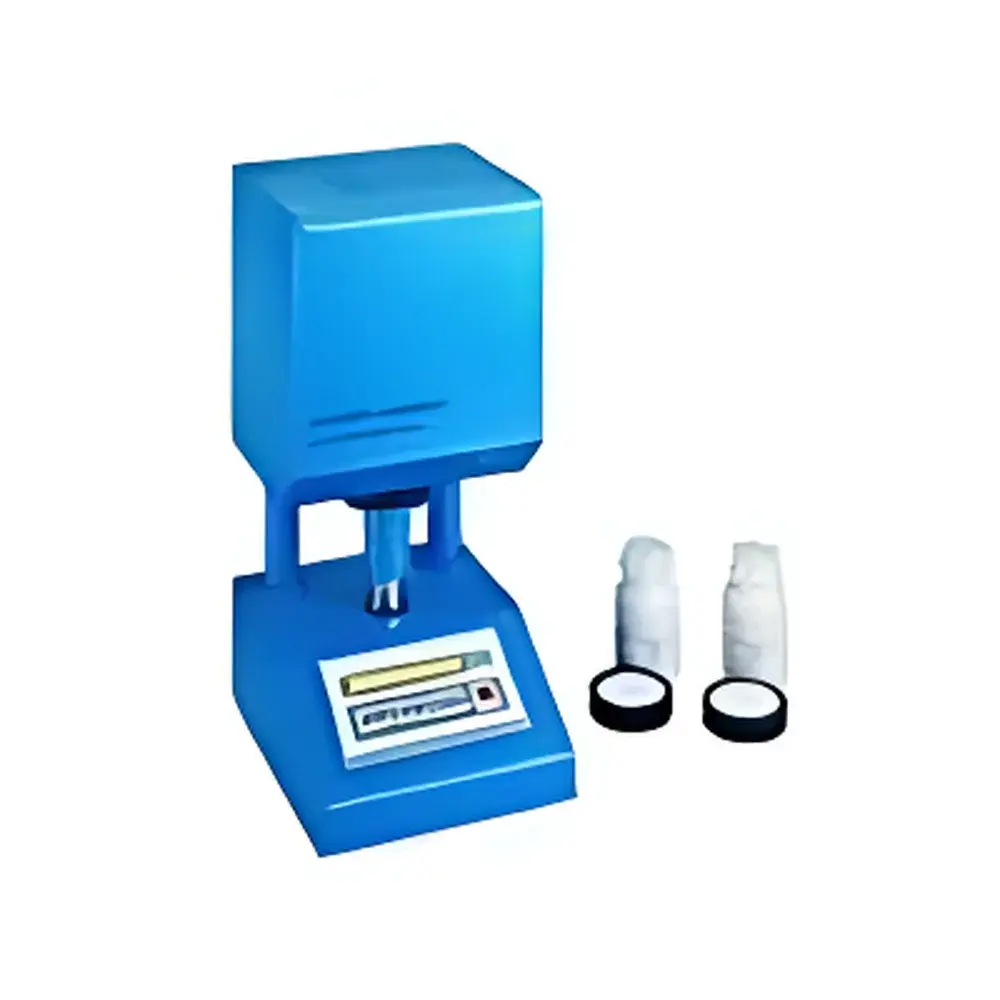
Schmidt+Haenscher Saccharoflex 2000 Solid-Phase Colorimeter
| Brand | Schmidt+Haenscher |
|---|---|
| Origin | Germany |
| Model | Saccharoflex 2000 |
| Measurement Range | 0–19.99 CTU |
| Resolution | 0.01 CTU (low range), 0.05 CTU (high range) |
| Optical Wavelengths | 495 nm and 620 nm |
| Display | 30-character LCD |
| Interface | 4-button membrane keypad |
| Compliance | ICUMSA Method GS2/3-13 (2013) for sucrose color determination |
| Sample Form | Solid, granular, or powdered materials (e.g., crystalline sugar, ceramic powders, cement clinker) |
| Calibration Standards | Certified CTU reference standards (0 CTU and 6 CTU, sugar- or ceramic-matrix matched) |
Overview
The Schmidt+Haenscher Saccharoflex 2000 is a dedicated solid-phase colorimeter engineered for precise, repeatable color quantification of dry, non-liquid materials in accordance with the International Commission for Uniform Methods of Sugar Analysis (ICUMSA) standard method GS2/3-13 (2013). Unlike general-purpose spectrophotometers or liquid-colorimeters, the Saccharoflex 2000 employs a dual-wavelength photometric architecture centered at 495 nm (blue-green) and 620 nm (orange-red), optimized to resolve the characteristic yellow-brown chromophore absorbance profile of caramelized and oxidized impurities in refined sucrose crystals. Its optical design incorporates fixed-path-length sample illumination geometry, temperature-stabilized LED sources, and precision interference filters—ensuring long-term photometric stability without recalibration drift. The instrument is purpose-built for quality control laboratories in sugar refineries, food ingredient manufacturers, and industrial ceramics producers where batch-to-batch color consistency directly correlates with purity, thermal history, and process adherence.
Key Features
- Dual-band photometric detection at 495 nm and 620 nm—aligned with ICUMSA’s defined spectral sensitivity for CTU (Color Technical Units) calculation
- Fixed optical geometry optimized for homogeneous solid samples: no cuvettes, no dilution, no solvent interference
- High-resolution LCD display (30-character line) with intuitive 4-button interface—designed for glove-compatible operation in production environments
- CTU resolution of 0.01 (0–9.99 CTU) and 0.05 (10.00–19.99 CTU), meeting ICUMSA repeatability requirements (±0.1 CTU for duplicate measurements)
- Factory-calibrated using traceable, matrix-matched reference standards—available in sugar-based (0 CTU and 6 CTU) or ceramic-compatible variants
- Robust aluminum housing with IP20-rated enclosure—suitable for controlled laboratory and near-line QC settings
- No software dependency for basic operation; self-contained firmware enables immediate measurement without PC connection
Sample Compatibility & Compliance
The Saccharoflex 2000 accepts free-flowing, uniformly granular solids with particle sizes between 0.2 mm and 2.0 mm—ideal for centrifugally dried sucrose crystals (A-, B-, and C-molasses grades), ground ceramic frits, Portland cement clinker, and pharmaceutical excipient powders. Sample presentation uses a standardized stainless-steel sample cup with optically flat quartz window and consistent packing depth (12.5 mm ± 0.2 mm), ensuring reproducible light-scattering conditions. All measurement protocols comply fully with ICUMSA GS2/3-13, including mandatory dark-current compensation, zero-point verification using certified 0 CTU standard, and inter-laboratory transferability validation. For regulated environments, the device supports GLP-aligned documentation via manual logbook entry; optional RS-232 output (with external serial printer) enables raw CTU value capture for audit trails.
Software & Data Management
While the Saccharoflex 2000 operates autonomously, its firmware supports optional data export via RS-232 serial interface (DB9 connector, TTL-level signals). When connected to a host system running compliant terminal emulation software (e.g., Tera Term, PuTTY), users may capture timestamped CTU readings—including operator ID, sample ID, and calibration status flags—for integration into LIMS or Excel-based QC dashboards. No proprietary drivers or cloud services are required. Firmware versioning (v2.1+) includes configurable auto-zero timeout and user-defined pass/fail thresholds (e.g., “Reject if >4.2 CTU”), supporting automated go/no-go decisions without external logic. All internal calibration constants remain write-protected and are inaccessible to end users—ensuring metrological integrity per ISO/IEC 17025 Clause 6.5.2.
Applications
- Final product release testing of white refined sugar (ICUMSA Grade SPS-1 through SPS-4)
- In-process monitoring of carbonatation and sulfitation efficiency in beet and cane sugar mills
- Quality grading of ceramic glaze raw materials and fired tile body powders
- Stability assessment of heat-treated starch derivatives and dextrins
- Batch acceptance testing of pharmaceutical-grade lactose and microcrystalline cellulose
- Validation of bleaching efficacy in activated carbon regeneration cycles
FAQ
What does CTU stand for, and how is it calculated on the Saccharoflex 2000?
CTU stands for Color Technical Unit—a dimensionless metric defined by ICUMSA as the absorbance difference (A495 − A620) × 100, measured under standardized solid-sample geometry. The Saccharoflex 2000 computes this ratio internally using factory-trimmed analog gain stages and applies no user-adjustable coefficients.
Can the Saccharoflex 2000 measure liquid samples?
No. It is mechanically and optically configured exclusively for solid-phase analysis. Liquid measurements require separate ICUMSA-compliant instruments such as the S+H SaccharoFlex LQ or UV/VIS spectrophotometers with 10-mm pathlength cells.
Is NIST-traceable calibration available for the 0 CTU and 6 CTU standards?
Yes. Certified reference materials (CRMs) are supplied with full uncertainty budgets and certificate numbers traceable to PTB (Physikalisch-Technische Bundesanstalt, Germany) via secondary calibration against ICUMSA Reference Laboratory consensus values.
Does the instrument meet FDA 21 CFR Part 11 requirements?
The base Saccharoflex 2000 does not include electronic audit trail, user authentication, or digital signature functions. However, when integrated with validated third-party data acquisition software and time-stamped serial logging, it can support Part 11 compliance within a documented QMS framework.
How often must the instrument be recalibrated?
ICUMSA recommends annual verification using certified standards. Under stable environmental conditions (20–25°C, <60% RH) and proper handling, optical drift remains below ±0.03 CTU/year—well within method tolerance. Daily zero-check with 0 CTU standard is mandatory before sample analysis.






