
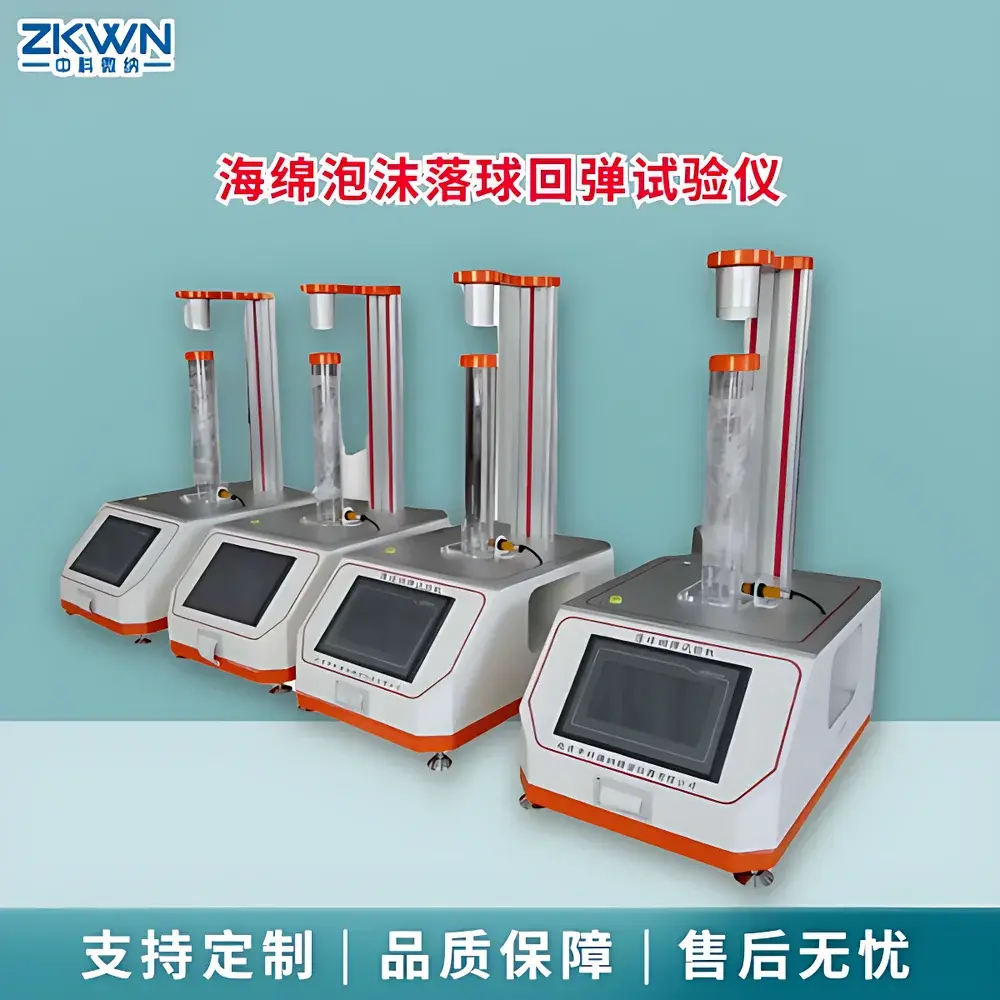
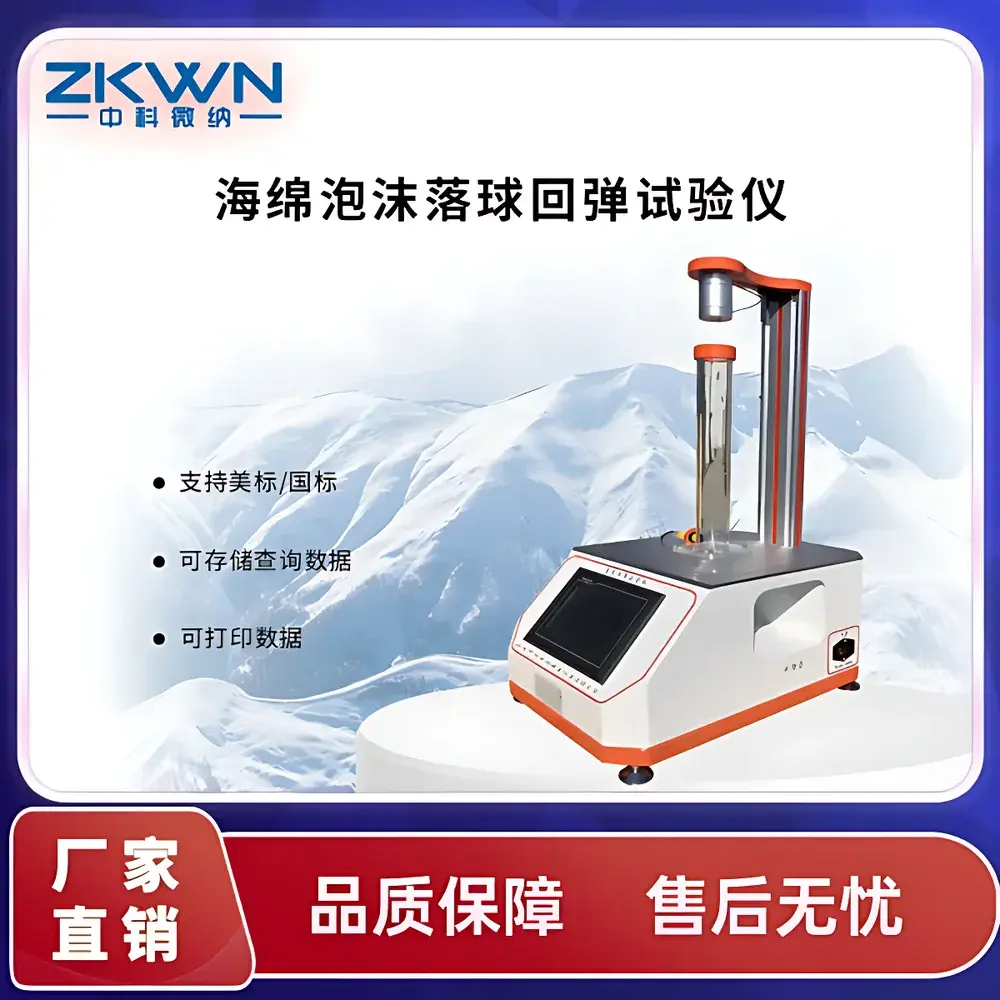
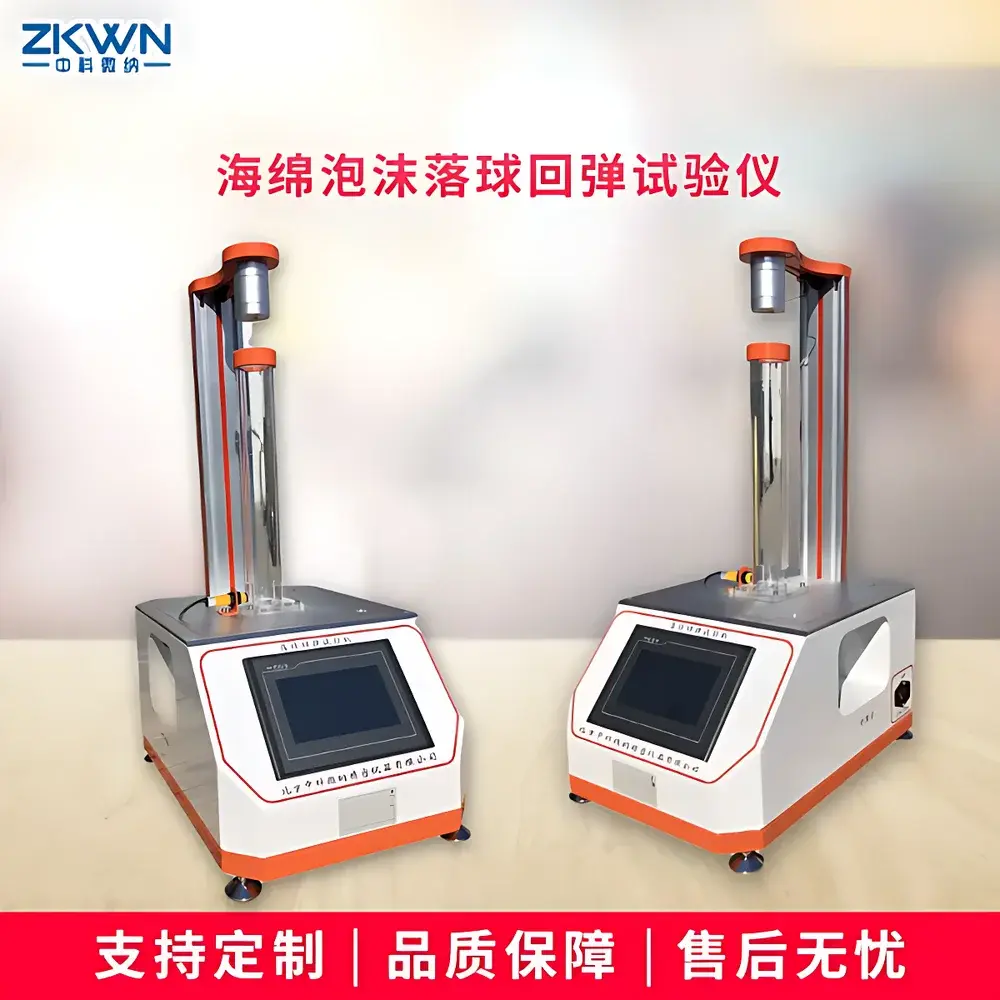
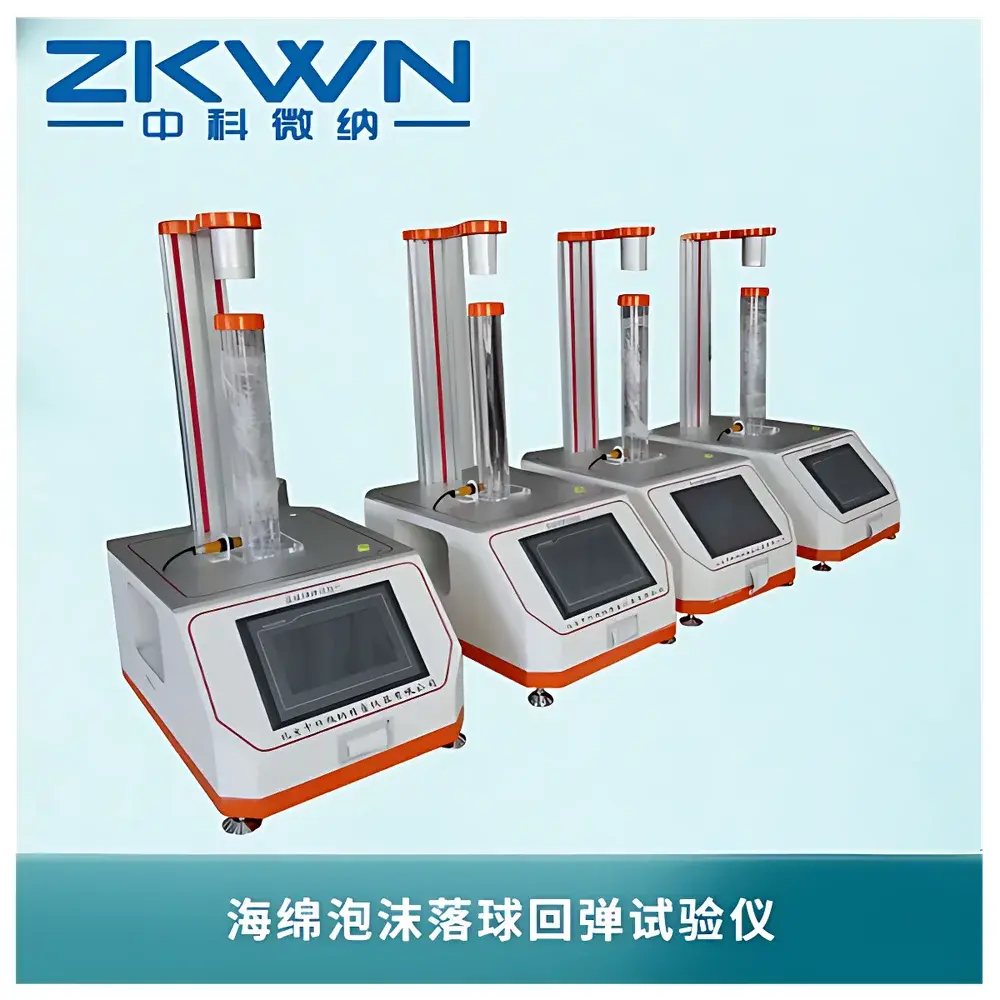
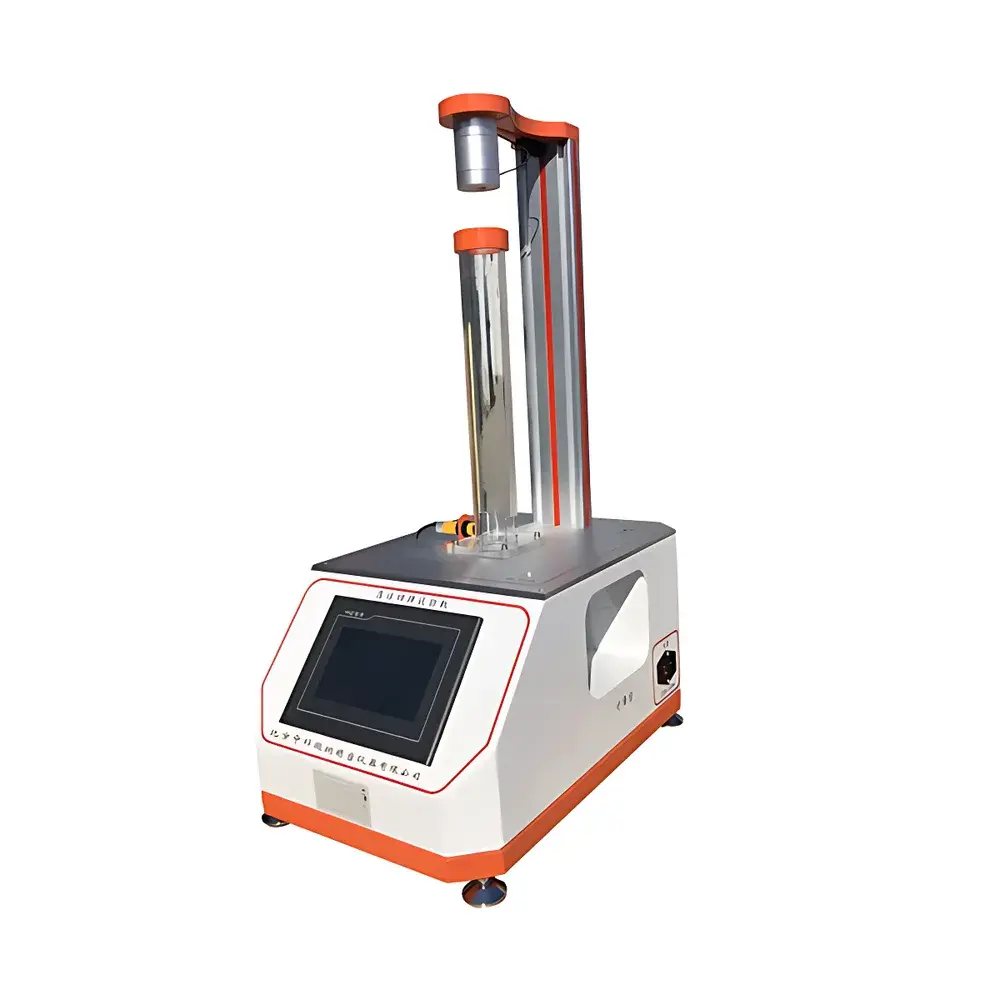
ZKWN ZKPMLQ-500C Foam Resilience Drop Tester
| Brand | ZKWN |
|---|---|
| Origin | Beijing, China |
| Manufacturer Type | Authorized Distributor |
| Country of Origin | China |
| Model | ZKPMLQ-500C |
| Drop Height | 460 mm |
| Max Sample Weight | 75 g |
| Max Sample Dimensions | 100 × 100 × 100 mm |
| Impact Surface Diameter | 50 mm |
| Compliance | GB/T 6670–2008, ISO 8307, ASTM D3574, GB/T 10652–2001 |
Overview
The ZKWN ZKPMLQ-500C Foam Resilience Drop Tester is a precision-engineered instrument designed for the quantitative evaluation of resilience (ball rebound) in flexible polymeric foam materials—primarily soft polyurethane (PU) foams used in seating, bedding, packaging, and automotive interiors. It operates on the principle of standardized free-fall impact: a calibrated steel sphere of defined mass and diameter is released from a fixed height (460 mm) onto a horizontally mounted foam specimen. The rebound height is measured optically or via high-speed displacement sensing, and resilience is expressed as the ratio of rebound height to drop height, reported as a percentage. This method directly correlates with energy absorption and recovery behavior under transient compressive loading, making it a critical quality control parameter for foam manufacturers, R&D labs, and third-party testing facilities adhering to international physical property standards.
Key Features
- Electromagnetic ball release mechanism ensures zero rotational deviation and precise axial alignment—fully compliant with ISO 8307 and ASTM D3574 requirements for centerline impact and non-rotating descent.
- Integrated 7-inch industrial-grade HMI touchscreen interface with Chinese/English language toggle; intuitive navigation for test setup, batch ID assignment, real-time data display, and result review.
- Programmable test protocol: supports automatic execution of 3 specimens × 3 drops per specimen, with embedded logic to identify and exclude outliers based on user-defined tolerance thresholds (e.g., ±5% deviation from median).
- Siemens S7-1200 PLC-based control architecture provides deterministic timing, I/O redundancy, and long-term operational stability under continuous laboratory use.
- Dual-mode height measurement: primary optical sensor array for automated rebound capture, supplemented by manual digital caliper input for verification and calibration cross-check—ensuring metrological traceability and audit readiness.
- Impact surface: hardened stainless steel anvil (Ø50 mm), flatness tolerance ≤±2 µm, mounted on vibration-damped base to isolate environmental interference.
Sample Compatibility & Compliance
The ZKPMLQ-500C accommodates standard test specimens conforming to GB/T 6670–2008 and ISO 8307: rectangular blocks up to 100 mm × 100 mm × 100 mm, with density range 10–120 kg/m³ and indentation load deflection (ILD) values typical of low-to-medium resilience foams. Specimens must be conditioned at 23 ± 2°C and 50 ± 5% RH for ≥16 h prior to testing per ISO 293 and ASTM D3574. The system meets essential requirements of ISO/IEC 17025 for test method validation and supports GLP-compliant documentation through timestamped, operator-ID-tagged data logs exportable via USB. Full traceability to national metrology institutes (e.g., NIM China) is maintained via factory calibration certificate (included), covering drop height repeatability (±0.3 mm), ball mass certification (±0.1 g), and rebound height resolution (0.1 mm).
Software & Data Management
Firmware v3.2 embeds structured data handling aligned with regulatory expectations for analytical instrumentation. Each test record stores: batch ID, specimen ID, ambient temperature/humidity, operator ID, timestamp, raw rebound heights (n=9), outlier flags, mean rebound height, and final resilience % with statistical confidence interval (95%). Data exports as CSV or PDF (with optional company header/footer) for integration into LIMS or ERP systems. Audit trail functionality logs all configuration changes, calibration events, and user logins—supporting FDA 21 CFR Part 11 readiness when deployed with network-authenticated access control and electronic signature modules (optional add-on). No cloud storage or remote telemetry is enabled by default; all data resides locally unless explicitly exported.
Applications
- Quality assurance in PU foam production lines: monitoring batch-to-batch consistency of resilience during formulation tuning or raw material substitution.
- R&D evaluation of novel elastomeric blends, bio-based polyols, or flame-retardant additives where resilience loss or gain indicates molecular network alterations.
- Supplier qualification testing per OEM specifications (e.g., automotive seat foam resilience ≥55% at 460 mm drop per Ford WSS-M99P1111-A2).
- Conformance verification for ISO 9001:2015 Clause 8.5.1 (control of production and service provision) and IATF 16949:2016 process capability studies (Cp/Cpk analysis of resilience distributions).
- Independent laboratory accreditation (CNAS, A2LA) for accredited testing to ISO 8307:2017, supporting certification reports issued to clients.
FAQ
What standards does the ZKPMLQ-500C fully support for foam resilience testing?
GB/T 6670–2008, ISO 8307:2017, ASTM D3574–2022 (Method B), and GB/T 10652–2001—all verified via interlaboratory round-robin testing with NIM-certified reference foams.
Is electromagnetic release mandatory for compliance?
Yes. Manual release introduces uncontrolled torque and lateral drift, violating ISO 8307 Section 6.2 and ASTM D3574 Section 7.3 requirements for “free-fall without rotation.” Electromagnetic release is the only method accepted for accredited testing.
How is data integrity ensured during long-term operation?
All measurements are time-stamped, operator-logged, and stored in non-volatile memory with cyclic redundancy check (CRC-32). Calibration history and firmware version are embedded in every export file.
Can the instrument be integrated into an existing LIMS environment?
Yes—via USB-host mode for batch data transfer or optional RS-232/Modbus RTU interface for real-time polling. API documentation and sample Python scripts are provided upon request.
What maintenance is required for sustained accuracy?
Quarterly verification of drop height using certified gauge blocks; annual recalibration of optical sensor and electromagnet timing circuit by authorized service center (certificate traceable to CNAS-accredited lab).



