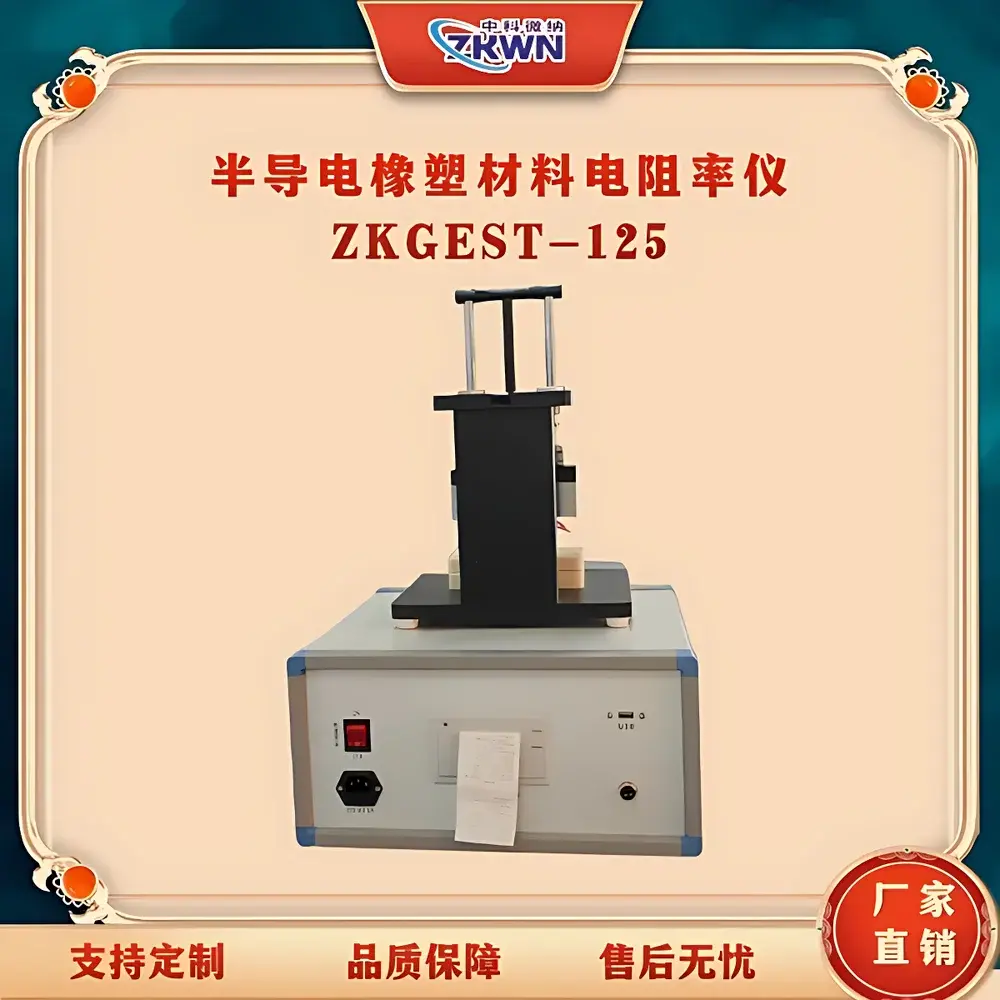
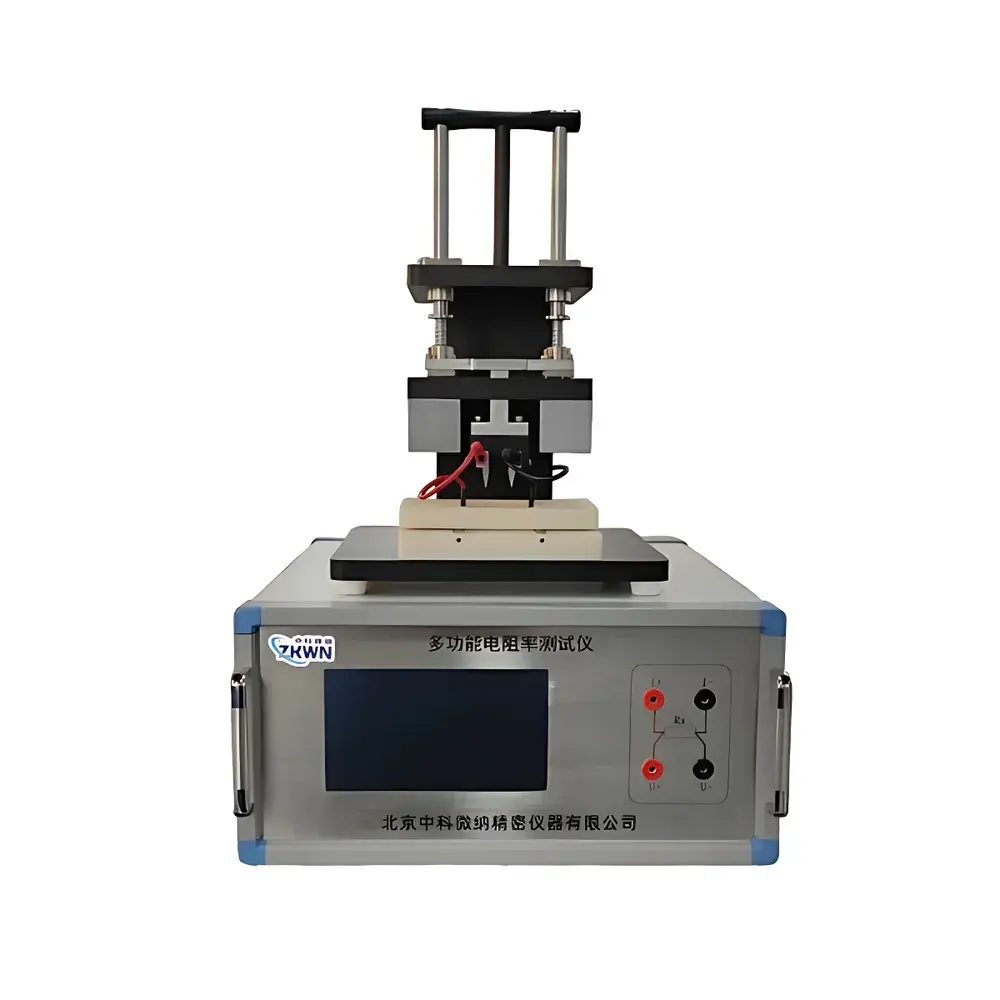
ZKWN ZKGEST-125 Semiconductor-Specific Volume Resistivity Tester for Elastomeric & Plastic Materials
| Brand | ZKWN |
|---|---|
| Model | ZKGEST-125 |
| Measurement Principle | Four-Terminal DC Voltage-Current Method (Constant Current Source + High-Impedance Voltmeter) |
| Resistivity Range | 10⁻⁴ – 10⁵ Ω·cm |
| Resolution | 10⁻⁶ Ω·cm |
| Resistance Range (two-terminal mode) | 10⁻⁴ – 2×10⁵ Ω |
| Resistance Resolution | 1 µΩ |
| Voltage Ranges | 2 mV / 20 mV / 200 mV / 2 V |
| Voltage Accuracy | ±(0.5% rdg + 8 digits) at 2 mA range |
| Constant Current Outputs | 10 µA, 100 µA, 1 mA, 10 mA, 100 mA |
| Current Accuracy | ±(0.5% rdg + 2 digits) |
| Electrode Contact Width | 5 mm |
| Electrode Contact Force | 0.6 N |
| Sample Dimensions | (10 ± 0.2) mm width × (70–150) mm length × (3–4) mm thickness (thickness variation ≤ 5% of mean) |
| Power Supply | 220 V ±10%, 50/60 Hz, <50 W |
Overview
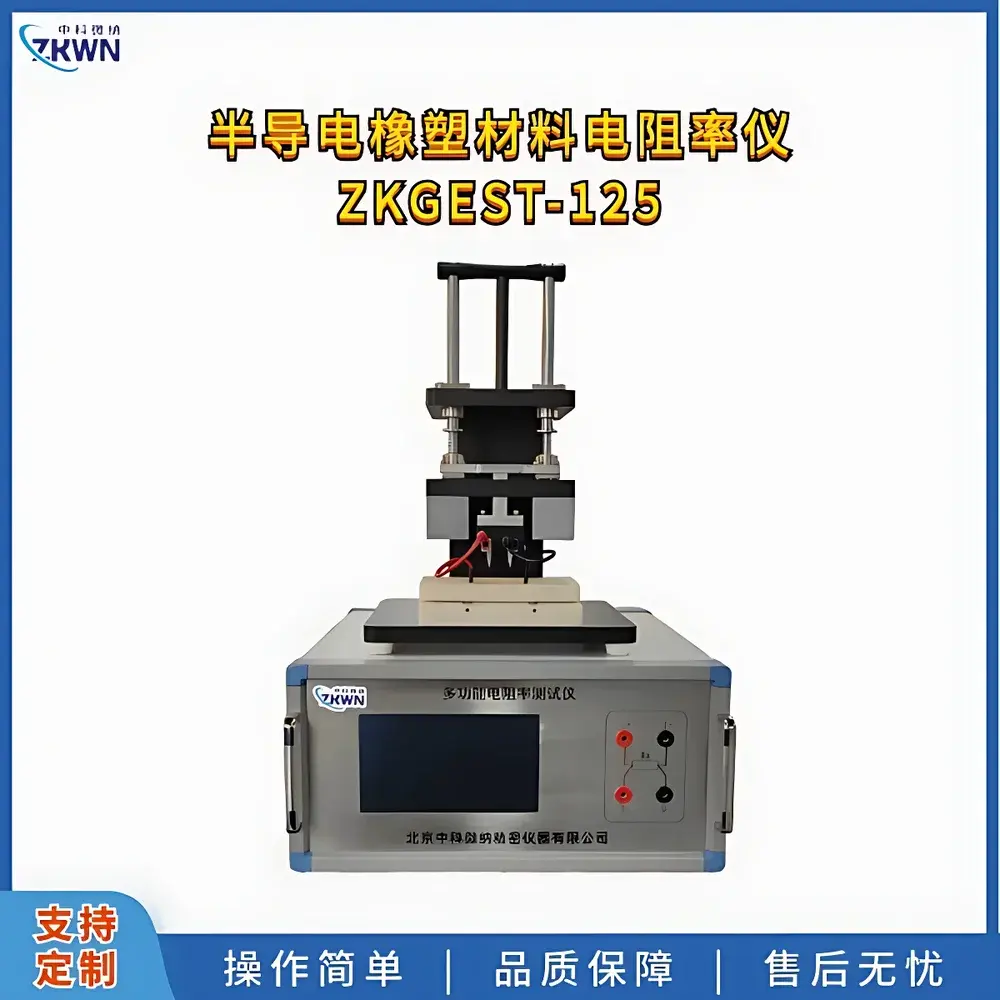
The ZKWN ZKGEST-125 Semiconductor-Specific Volume Resistivity Tester is a precision DC-based instrumentation system engineered for the quantitative characterization of bulk electrical resistivity in semiconductive elastomeric and polymeric materials—particularly those used in wire & cable insulation, ESD-safe components, conductive composites, and semiconductor packaging substrates. It operates on the four-terminal (Kelvin) measurement principle: a stable, calibrated constant current source applies excitation across outer electrodes while a high-input-impedance digital voltmeter measures the potential drop across inner sensing electrodes, eliminating lead and contact resistance errors. This architecture ensures traceable, repeatable volume resistivity (ρ) calculation per ASTM D257 and IEC 60093 conventions: ρ = (V/I) × (t/A), where t is sample thickness and A is electrode contact area. Designed explicitly for compliance with GB/T 3048.3–2007 (equivalent to IEC 60227-3), GB/T 15738–2008, GB/T 15662–1995, and GB/T 2439–2001, the ZKGEST-125 bridges the metrological requirements of QC laboratories in cable manufacturing, conductive polymer R&D, and semiconductor assembly facilities where controlled surface and bulk conductivity are critical to device reliability and EMI shielding integrity.
Key Features
- Four-terminal DC resistivity measurement architecture with independent current sourcing and voltage sensing paths for uncompromised accuracy in low- to medium-conductivity regimes (10⁻⁴ – 10⁵ Ω·cm)
- High-stability constant current source with five discrete output levels (10 µA to 100 mA), each calibrated to ±(0.5% rdg + 2 digits) and thermally stabilized for drift < 0.05%/hr
- 4½-digit LED digital display with simultaneous real-time readouts: applied voltage (2 mV–2 V range), user-input sample thickness (mm), and calculated volume resistivity (Ω·cm)
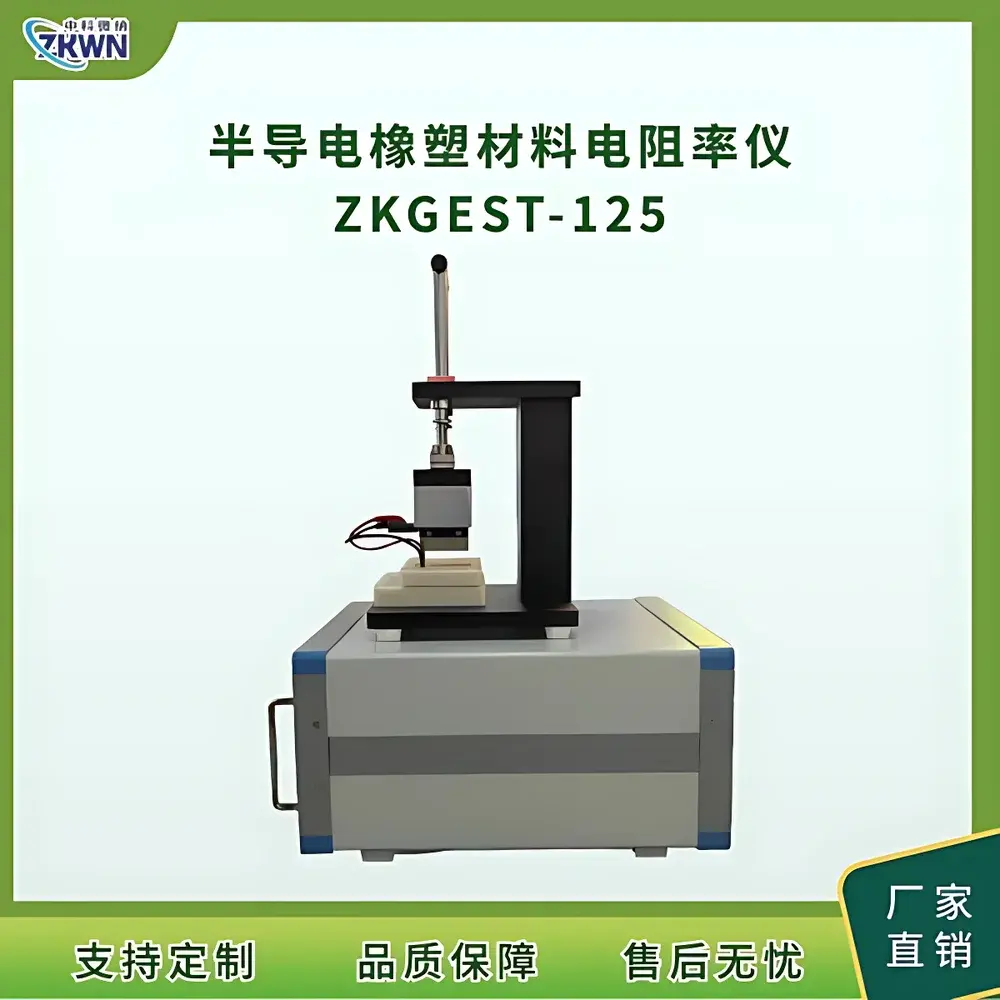
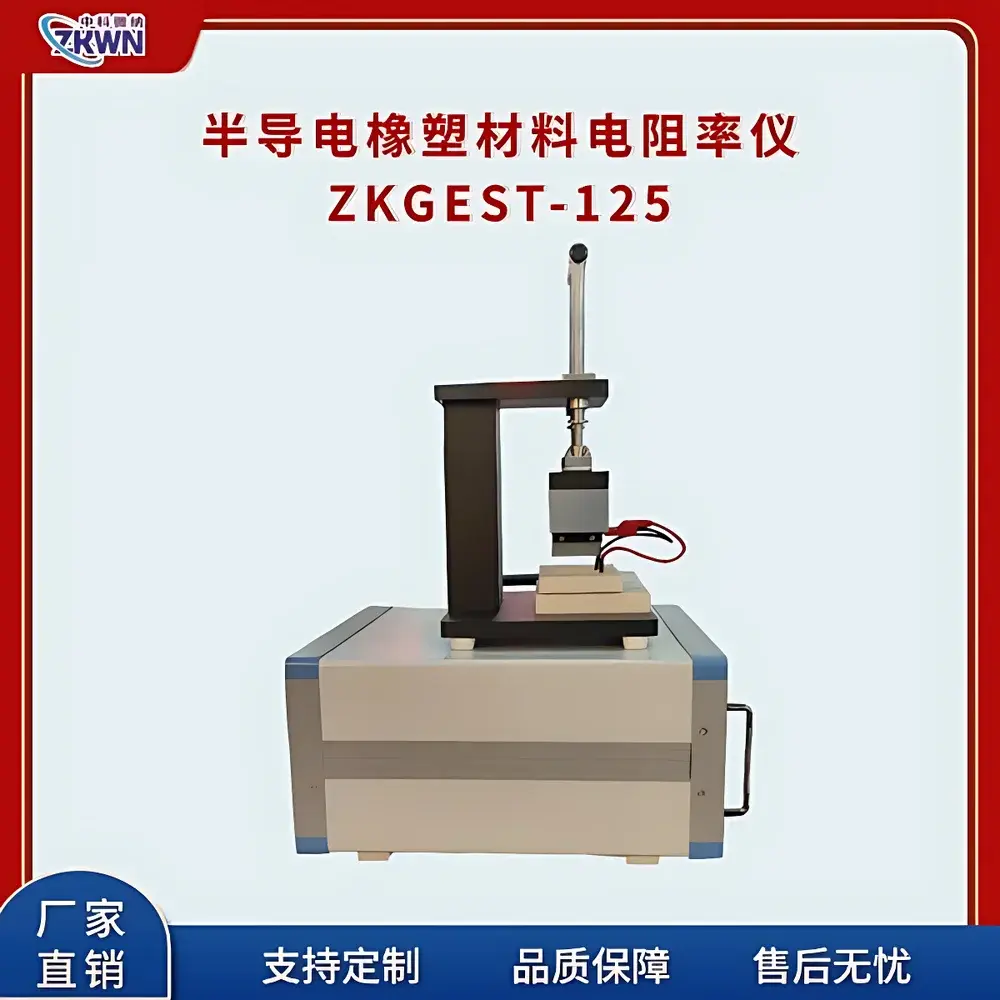
- Dedicated electrode assembly featuring brass measuring electrodes (5 mm contact width) mounted on stainless-steel support fixtures, applying consistent 0.6 N contact force to minimize interfacial variability
- Compact benchtop design (< 50 W power consumption) with robust EMI-shielded enclosure suitable for ISO/IEC 17025-accredited testing environments
- Full alignment with national and international standards for conductive polymer qualification, including GB/T 3048.3–2007, GB/T 2439–2001, and harmonized test protocols referenced in IPC-4101 and JEDEC JESD22-A118
Sample Compatibility & Compliance
The ZKGEST-125 is validated for standardized testing of flat, solid specimens conforming to dimensional tolerances defined in GB/T 3048.3–2007: width (10.0 ± 0.2) mm, length 70–150 mm, thickness 3–4 mm (with local deviation ≤ 5% of mean thickness). Three replicate samples are required per test series to establish statistical confidence in reported resistivity values. The instrument supports both volume resistivity determination (via guarded electrode configuration) and two-terminal low/mid-resistance measurements (e.g., for metallic interconnects or busbar segments) without hardware reconfiguration. All measurement procedures satisfy traceability requirements under ISO/IEC 17025:2017 Clause 7.7 (Uncertainty of Measurement) and support audit readiness for GLP-compliant semiconductor material qualification dossiers. Calibration certificates are issued against NIM-traceable DC resistance and voltage standards.
Software & Data Management
While the ZKGEST-125 operates as a standalone instrument with direct LED readout, its analog voltage and current outputs (0–2 V full scale) are compatible with external data acquisition systems supporting IEEE 488 (GPIB), RS-232, or USB-to-serial interfaces. Users may integrate measurement sequences into custom LabVIEW, Python (PyVISA), or MATLAB workflows for automated batch logging, statistical process control (SPC) charting, and export to CSV or Excel formats. The instrument’s deterministic response time (< 100 ms settling per reading) enables synchronized multi-point acquisition across production line test stations. For regulated environments (e.g., FDA-regulated semiconductor packaging lines), optional firmware upgrades support 21 CFR Part 11-compliant electronic signatures and audit trail generation when paired with validated third-party SCADA platforms.
Applications
- Volume resistivity verification of extruded semiconductor-grade silicone rubber and carbon-black-filled TPEs used in high-voltage cable shielding layers
- Process validation of antistatic polyamide (PA6/PA12) compounds for wafer carrier trays and cleanroom handling tools
- R&D screening of graphene- or CNT-doped thermoplastics targeting ESD-safe enclosures for photolithography equipment housings
- Quality conformance testing of conductive elastomer gaskets per MIL-DTL-83528 and IPC-CC-830B specifications
- Educational labs conducting fundamental semiconductor physics experiments on doped polymer films and organic charge transport layers
FAQ
What standards does the ZKGEST-125 directly support?
It is fully compliant with GB/T 3048.3–2007, GB/T 15738–2008, GB/T 15662–1995, and GB/T 2439–2001 — all of which align with IEC 60227-3, IEC 60093, and ASTM D257 for volume resistivity measurement.
Can it measure surface resistivity?
No — the ZKGEST-125 is configured exclusively for volume resistivity using the specified three-electrode or two-electrode volumetric geometry per GB/T 3048.3. Surface resistivity requires concentric ring electrode fixtures not included with this model.
Is calibration documentation provided with shipment?
Yes — each unit ships with a factory calibration report traceable to China National Institute of Metrology (NIM) standards, covering voltage, current, and resistivity verification points across the full operating range.
What sample preparation tools are recommended?
Users should employ precision micrometers (±0.001 mm resolution) for thickness verification and CNC-cutting jigs to ensure edge perpendicularity and dimensional repeatability per GB/T 3048.3 Annex A.
Does the instrument support temperature-controlled testing?
Not natively — the ZKGEST-125 is a room-temperature (23 ± 2 °C) benchtop system. For temperature-dependent resistivity studies, integration with external environmental chambers (e.g., ESPEC or Angelantoni) and external thermocouple feedback is required via analog I/O interfaces.