
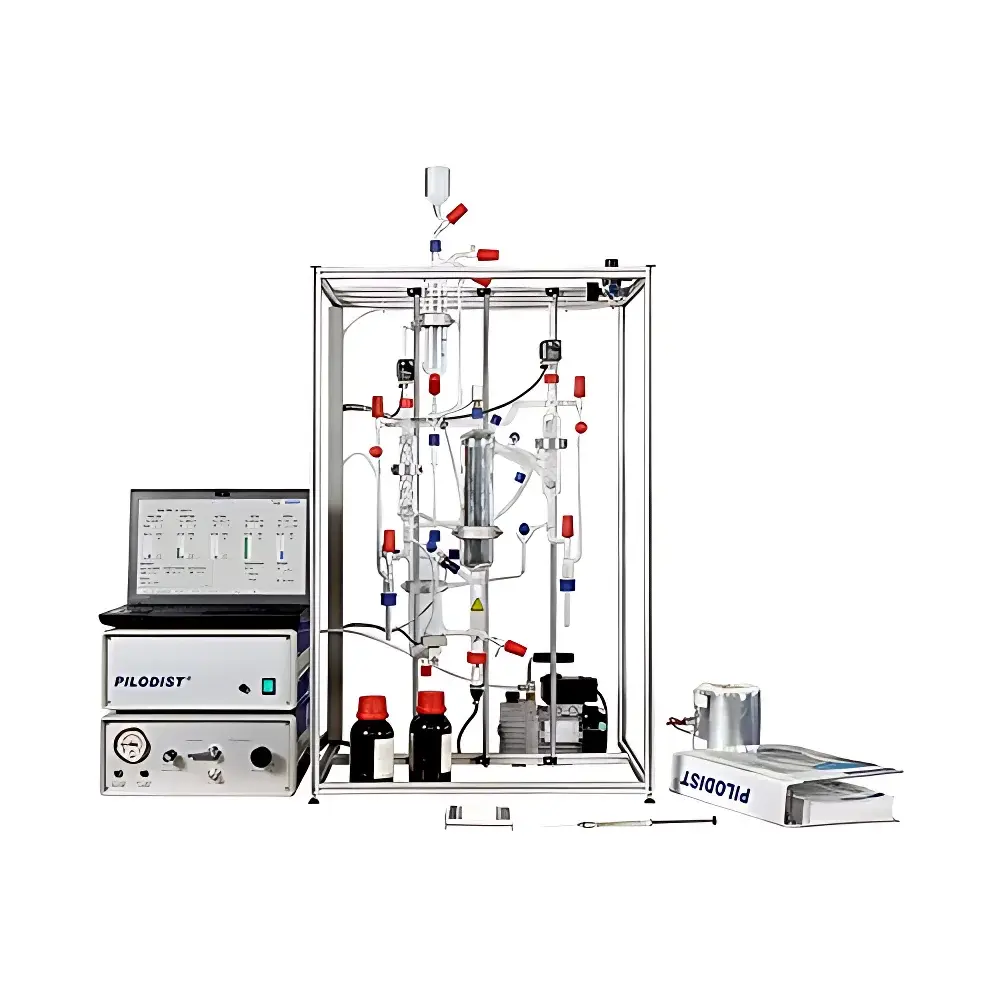
Pilodist VLE 110 Automated Vapor-Liquid Equilibrium Analyzer
| Brand | Pilodist |
|---|---|
| Origin | Germany |
| Model | VLE 110 |
| Operating Pressure Range | Vacuum to Overpressure (Configurable) |
| Temperature Range | Ambient to 250 °C |
| Temperature Accuracy | ±0.1 °C |
| Cold Bath Temperature Range | −20 °C to 100 °C |
| Distillation Rate | 30 drops/min |
| Sample Volume Capacity | 100 mL |
| Volume Resolution | 1 mL |
Overview
The Pilodist VLE 110 Automated Vapor-Liquid Equilibrium Analyzer is a precision-engineered laboratory instrument designed for the experimental determination of thermodynamic phase equilibrium data in multicomponent liquid mixtures. Based on the classical static–dynamic equilibrium method, the system establishes controlled isothermal and isobaric conditions within a sealed equilibrium cell, enabling simultaneous sampling and analysis of coexisting vapor and liquid phases. This principle—grounded in Raoult’s law extensions and activity coefficient modeling—provides foundational data for process simulation (e.g., Aspen Plus®, CHEMCAD®), distillation column design, solvent selection, and thermodynamic model parameter regression (NRTL, UNIQUAC, Wilson). Unlike empirical correlations or predictive methods, the VLE 110 delivers experimentally validated equilibrium compositions under reproducible, traceable conditions—critical for R&D validation, regulatory submission support, and plant-scale scale-up.
Key Features
- Microprocessor-controlled dual-zone temperature regulation with independent heating and cooling loops ensures stable isothermal equilibrium at ±0.1 °C accuracy across the full 20–250 °C operating range.
- Integrated cold bath unit (−20 °C to 100 °C) enables precise condensation control for vapor-phase sampling and supports low-boiling systems including light hydrocarbons and refrigerants.
- Automated distillation module maintains a consistent 30-drop-per-minute effluent rate, minimizing transient deviations and supporting steady-state equilibrium attainment.
- Full-pressure flexibility: configurable vacuum-to-overpressure operation (up to 10 bar(g) with optional upgrades), accommodating high-boiling, azeotropic, or pressure-sensitive systems.
- Modular equilibrium cell design (standard 100 mL capacity, 1 mL volume resolution) allows rapid sample loading, inert gas purging, and phase separation verification via integrated sight glasses and manual/automated sampling valves.
- Robust stainless-steel and borosilicate glass construction complies with ASME B31.3 process piping guidelines and meets material compatibility requirements for aggressive solvents (e.g., HCl, HF, aldehydes) when specified.
Sample Compatibility & Compliance
The VLE 110 accommodates binary and multicomponent organic, aqueous, and ionic liquid systems—including hydrocarbon blends, alcohol–water mixtures, amine-based CO₂ capture solvents, and pharmaceutical intermediates. All wetted parts are selected per ASTM G128 guidelines for chemical resistance assessment. The system supports GLP-compliant workflows through hardware-level audit trail logging (timestamped temperature, pressure, and volume events), and its mechanical design conforms to IEC 61000-6-2/6-4 EMC standards and PED 2014/68/EU for pressure equipment. Optional ATEX Zone 1 certification is available for hazardous area deployment.
Software & Data Management
The VLE 110 Control Unit is a Windows-based application built on .NET Framework 4.8, offering real-time monitoring of all process variables (T, P, volume, drop count), programmable ramp/soak profiles, and automated equilibrium detection algorithms. Data export adheres to ASTM E2575-22 formatting conventions for VLE datasets, generating CSV and XML files compatible with NIST ThermoData Engine (TDE) and DDBST GmbH tools. Full 21 CFR Part 11 compliance is achieved via optional electronic signature modules, role-based access control, and immutable audit logs—with revision history retained for ≥30 days by default. Raw sensor data is stored locally with SHA-256 checksum integrity verification.
Applications
- Determination of bubble-point and dew-point curves for refinery naphtha cuts and FCC gasoline fractions.
- Validation of thermodynamic models for acid gas removal solvents (e.g., MDEA–H₂O–CO₂).
- Measurement of activity coefficients in chiral separation systems (e.g., limonene–ethanol).
- Supporting QbD initiatives in API manufacturing by mapping solvent–impurity partitioning behavior.
- Generating benchmark datasets for machine learning–driven property prediction frameworks.
- Teaching advanced chemical engineering thermodynamics in university laboratories (ABET-accredited curricula).
FAQ
What types of samples can be analyzed on the VLE 110?
Binary and ternary liquid mixtures containing volatile organics, water, ionic liquids, or reactive species—provided they remain thermally stable below 250 °C and do not corrode 316SS or borosilicate components.
Is the system compatible with online GC or FTIR integration?
Yes—vapor and liquid sampling ports include standard Swagelok® 1/8″ VCR fittings, enabling direct coupling to gas chromatographs (per ASTM D2887) or transmission FTIR cells with heated transfer lines.
How is equilibrium confirmed during a test run?
Equilibrium is verified by monitoring temperature stability (<±0.05 °C over 10 min), pressure drift (<0.1 kPa/h), and repeat composition measurements from sequential vapor/liquid samples—meeting ISO 17935:2016 validation criteria.
Does the VLE 110 support unattended overnight operation?
Yes—fully automated sequences, thermal runaway protection, and UPS-compatible power management enable 72-hour continuous runs with minimal supervision.
Can the software generate reports compliant with regulatory submissions?
Yes—the report engine exports PDFs with embedded metadata (operator ID, calibration certificates, uncertainty budgets) aligned with ICH M4Q(R2) and USP analytical instrument qualification requirements.





