
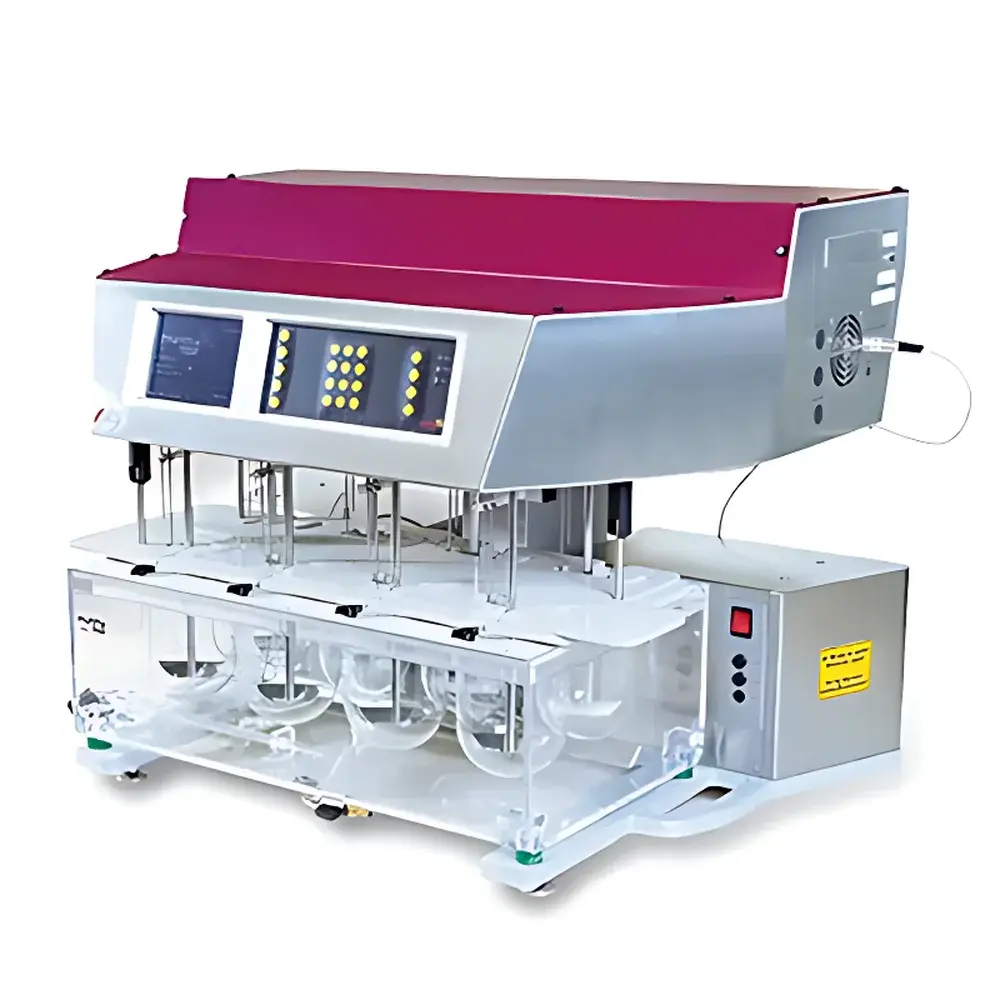
Pharma-test PTWS 820D Online Dissolution Tester
| Brand | Pharma-test |
|---|---|
| Origin | Germany |
| Model | PTWS 820D |
| Instrument Type | Online Dissolution Tester |
| Compliance | USP <711>, USP <724>, EP 2.9.3/2.9.4, ChP (Chinese Pharmacopoeia), JP |
| Vessel Options | 250 mL, 1 L, 2 L, 4 L |
| Construction | Stainless Steel (GLP-compliant) |
| Automation Level | Fully Automated Online System with Integrated Sampling |
| Sampling Mechanism | EPE Robotic Arm with Precise Z-axis Positioning |
| Stirring Stations | 8 Independent Vessels |
| Method Storage | Unlimited Methods via USB |
| Validation Support | IQ/OQ/PQ Documentation & Services Available |
| Temperature Uniformity | Optimized Water Bath with Diffuser & Low-Noise Circulation Pump |
| Connectivity | USB (Remote Control & Data Export), RS232 (Printer Interface) |
| User Management | Password-Protected Role-Based Access |
| System Diagnostics | Pre-run Self-Check Routine |
| Alert System | Visual (LED) and Audible Status Indication |
| Cleaning | Removable Bath Assembly & Dedicated System Rinse Kit |
Overview
The Pharma-test PTWS 820D is a fully automated, online dissolution testing system engineered for regulatory compliance and operational robustness in pharmaceutical quality control laboratories. Based on the principles of paddle and basket dissolution methodologies defined in USP and , the PTWS 820D implements precise hydrodynamic control within standardized vessels to quantify the rate and extent of drug release from solid oral dosage forms—including immediate-release and modified-release tablets, capsules, and multiparticulates. Its design adheres strictly to pharmacopoeial requirements across major global compendia: the United States Pharmacopeia (USP), European Pharmacopoeia (EP), Japanese Pharmacopoeia (JP), and the Chinese Pharmacopoeia (ChP). The system integrates real-time temperature regulation, programmable agitation profiles, and robotic sampling—all synchronized to predefined dissolution methods—ensuring high reproducibility across batches and operators. As an online instrument, it eliminates manual intervention during sampling, thereby reducing human error, contamination risk, and inter-operator variability.
Key Features
- Eight independent dissolution vessels with individual vessel identification and programmable agitation parameters (paddle/basket speed, immersion depth, centering accuracy)
- EPE (Electronic Positioning Equipment) robotic arm with vertical (Z-axis) precision positioning for compliant sampling at specified depths per ChP and USP guidelines
- Stainless steel mainframe construction meeting GLP infrastructure requirements for audit readiness and long-term durability
- Modular architecture supporting future expansion to integrated UV analysis, fractional collection, or multi-stage dissolution protocols
- Pre-operational system self-check verifying water bath temperature stability, motor function, sampling arm movement, and sensor calibration status
- Step-start agitation initiation to minimize tablet disruption during initial immersion
- Low-volatility vessel lids minimizing solvent evaporation over extended test durations (up to 24+ hours)
- Dedicated water bath diffuser and low-noise circulation pump ensuring ±0.1 °C temperature uniformity across all vessels (per USP requirement)
- USB-based method storage supporting unlimited protocol definitions, version control, and secure export for backup or audit submission
- Role-based user management with password protection, session logging, and configurable access levels for analysts, supervisors, and QA personnel
Sample Compatibility & Compliance
The PTWS 820D accommodates standard USP Apparatus 1 (basket) and Apparatus 2 (paddle) configurations across four vessel volumes: 250 mL (for small-volume or pediatric formulations), 1 L, 2 L, and 4 L (for extended-release or low-solubility compounds requiring larger media volumes). It supports both sink and non-sink conditions, and is compatible with common dissolution media including pH-adjusted buffers, surfactant-containing solutions, and biorelevant fluids (FaSSIF/FeSSIF). All mechanical components meet ISO 9001 manufacturing standards, and the system is validated against ASTM E2503–22 (Standard Guide for Validation of Dissolution Apparatus) and ICH Q5C (Stability Testing of Biotechnological/Biological Products). IQ/OQ/PQ documentation packages are provided, fully traceable to NIST-traceable standards, and include evidence of temperature mapping, rotational speed verification, sampling accuracy assessment, and volumetric delivery validation.
Software & Data Management
The embedded control software enables method creation, execution scheduling, real-time monitoring of temperature, rotation speed, and sampling events, and automatic timestamped data logging. All raw data—including vessel ID, timepoint, sample volume, and system status flags—are stored in ASCII-compatible .csv format for seamless integration with LIMS or statistical analysis platforms (e.g., JMP, Minitab). Audit trail functionality complies with FDA 21 CFR Part 11 requirements, recording user logins, method modifications, run initiations/terminations, and error alerts with immutable timestamps. OQ/PQ reminder prompts appear automatically based on configurable intervals, supporting routine requalification and lifecycle management. Remote operation via USB host connection allows centralized lab-wide control without direct HMI interaction.
Applications
The PTWS 820D serves as a core platform for formulation development, batch release testing, stability studies, and post-approval change evaluations. Typical use cases include comparative dissolution profiling for generic product equivalence (BCS-based waivers), evaluation of excipient effects on release kinetics, assessment of coating integrity under stress conditions (e.g., elevated temperature/humidity), and support for ANDA submissions requiring dissolution data aligned with ICH Q5A(R2) and Q5C. Its online architecture ensures continuity in multi-hour dissolution runs required for extended-release products, while its modular design facilitates adaptation to novel dosage forms such as orally disintegrating tablets (ODTs), buccal films, or nanosuspension-based capsules.
FAQ
Does the PTWS 820D support both basket and paddle apparatus configurations?
Yes—it accepts standard USP-compliant baskets and paddles with adjustable shaft height and centering mechanisms.
Is the system suitable for GMP-regulated environments?
Yes—the stainless steel construction, electronic audit trail, IQ/OQ/PQ documentation, and 21 CFR Part 11–compliant software meet current GMP expectations for dissolution equipment.
Can vessel temperature be mapped and validated?
Yes—temperature mapping procedures are included in the OQ protocol, using calibrated PT100 sensors placed at defined geometric positions within each vessel.
What maintenance routines are recommended for long-term reliability?
Daily rinsing of the water bath and sampling lines, weekly inspection of vessel centering and paddle wobble, and quarterly verification of rotational speed accuracy using a certified tachometer.
Is remote troubleshooting supported by Pharma-test?
Yes—through secure remote desktop access (with customer authorization), Pharma-test engineers provide technical support aligned with ISO/IEC 17025–accredited service protocols.




