
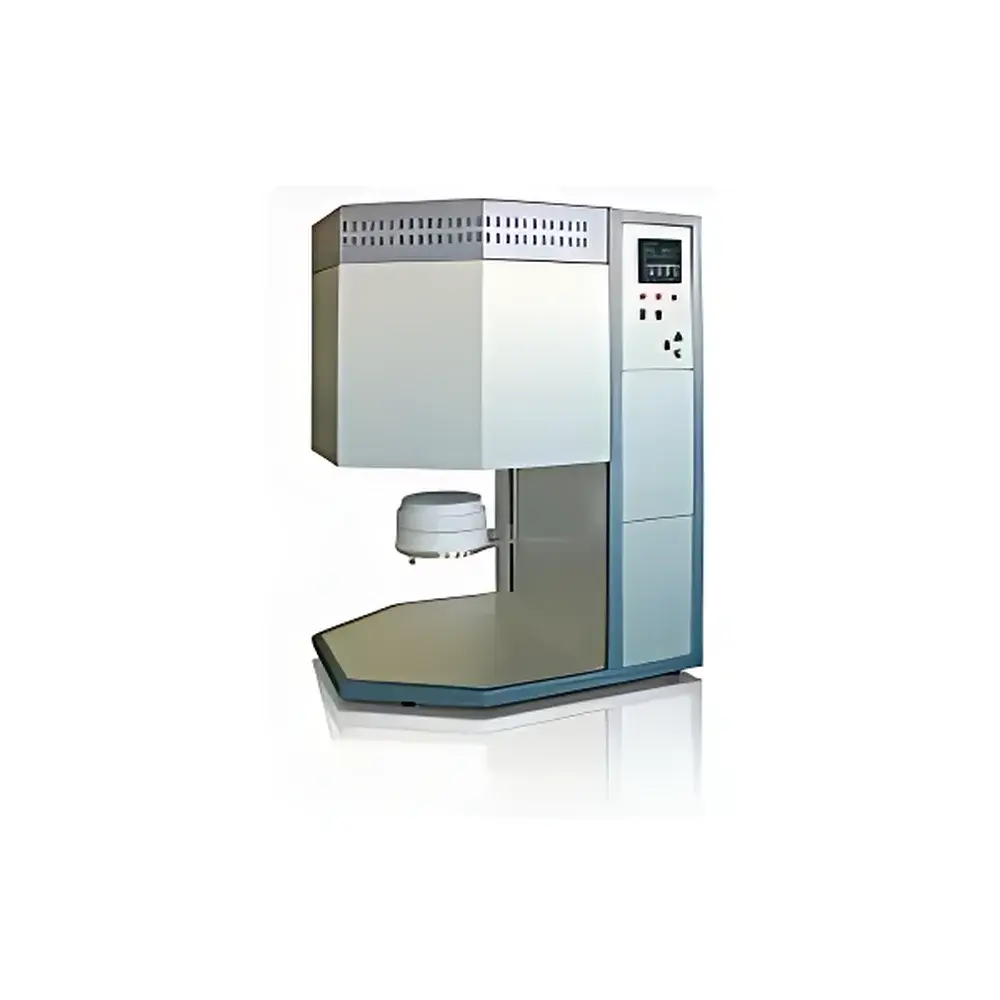
Thermconcept Germany Vertical-Lift Muffle Furnace
| Brand | Thermconcept |
|---|---|
| Origin | Germany |
| Model | Vertical-Lift Muffle Furnace |
| Max Operating Temperature | 1600 °C / 1750 °C / 1800 °C |
| Chamber Volume | 2 L (benchtop), 4 L (benchtop), up to 2000 L (industrial vertical) |
| Heating Element | MoSi₂ |
| Insulation | High-purity alumina fiber |
| Construction | Dual-wall stainless steel housing with rear ventilation |
| Lift Mechanism | Motorized base-lift or furnace-bottom lift configuration |
| Optional Features | Inert gas inlet, automatic exhaust flap, protective atmosphere port, reinforced load-bearing base |
| Compliance | Designed per IEC 61000-6-3, EN 60519-1, and applicable parts of ISO/IEC 17025 for laboratory thermal equipment |
Overview
The Thermconcept Germany Vertical-Lift Muffle Furnace is a precision-engineered high-temperature thermal processing system designed for controlled atmosphere sintering, ashing, calcination, heat treatment, and material synthesis in research laboratories and pilot-scale production environments. Utilizing a vertical-lift architecture—either motorized base elevation or furnace-bottom displacement—the system enables safe, repeatable, and ergonomic sample loading and unloading without manual handling at elevated temperatures. Its core thermal design relies on MoSi₂ (molybdenum disilicide) heating elements embedded within multi-layered high-purity alumina fiber insulation, delivering exceptional thermal homogeneity (±3 °C at 1600 °C), low external surface temperature (<60 °C under full load), and rapid thermal response (typical ramp rates up to 15 °C/min from ambient to 1600 °C). The dual-wall stainless steel enclosure incorporates forced rear ventilation, ensuring stable ambient interface conditions and structural integrity across repeated thermal cycles. All models conform to EN 60519-1 (safety requirements for industrial electroheating equipment) and support integration into GLP- and GMP-aligned workflows through configurable data logging and process documentation capabilities.
Key Features
- Motorized vertical lift mechanism: Selectable configurations—fixed base with ascending furnace chamber or stationary furnace with descending bottom plate—optimized for operator safety and process repeatability.
- High-temperature capability: Certified continuous operation at 1600 °C, 1750 °C, or 1800 °C depending on model; validated thermal stability over 500+ cycles at maximum setpoint.
- Energy-efficient insulation: Low-conductivity alumina fiber modules minimize standby heat loss (<1.2 kW/h at 1600 °C) and enable cooling rates of ~10 °C/min (forced air assist optional).
- Robust mechanical architecture: Reinforced load-bearing base rated for static loads up to 50 kg (benchtop) or 500 kg (industrial vertical units); polished AISI 304 stainless steel exterior with IP20-rated electrical compartment.
- Integrated process interface: Front-panel controller with programmable 16-segment ramp-soak profiles; optional RS485 Modbus RTU or Ethernet/IP connectivity for SCADA integration.
- Atmosphere management: Standard 1/4″ VCR-compatible inert gas inlet, spring-loaded automatic exhaust flap (actuated at preset pressure differential), and dedicated purge gas port for N₂, Ar, or forming gas applications.
Sample Compatibility & Compliance
The furnace accommodates crucibles, boats, and custom fixtures made from alumina, silicon carbide, molybdenum, tungsten, or graphite—compatible with ASTM C71, ISO 5659-2, and USP heavy metal residue testing protocols. Benchtop variants (2 L and 4 L) meet DIN 12880 Class II thermal uniformity specifications; industrial vertical systems (up to 2000 L) are engineered to ASME Section VIII Div. 1 pressure boundary standards when configured with sealed atmosphere chambers. All units include CE marking per Machinery Directive 2006/42/EC and Electromagnetic Compatibility Directive 2014/30/EU. Optional validation packages support IQ/OQ documentation per FDA 21 CFR Part 11 and ISO/IEC 17025 traceability requirements.
Software & Data Management
Thermconcept furnaces ship with the TC-Control Suite—a Windows-based application supporting real-time temperature monitoring, profile editing, alarm event logging, and CSV export of time-stamped thermocouple (Type S or B) and power consumption data. Audit trails record all parameter changes with user ID, timestamp, and reason-for-change fields—fully compliant with ALCOA+ principles. For automated lab environments, OPC UA server integration enables bidirectional communication with LIMS platforms such as LabWare or STARLIMS. Firmware updates are delivered via secure HTTPS endpoint with SHA-256 signature verification.
Applications
- Materials science: Sintering of advanced ceramics (ZrO₂, Si₃N₄), densification of metal powders (Ti-6Al-4V, Inconel), and phase transformation studies.
- Geochemistry & environmental analysis: Gravimetric determination of volatile solids (ASTM D2974), ash content in biomass (ISO 18122), and sulfate residue quantification (EPA Method 3050B).
- Pharmaceutical development: Thermal degradation profiling of active pharmaceutical ingredients (APIs), excipient compatibility screening, and residual solvent removal validation.
- Nuclear fuel cycle R&D: Uranium oxide pellet sintering, cerium-doped zirconia stability testing, and fission product volatility assessments under reducing atmospheres.
- Electronics manufacturing: Co-firing of LTCC (low-temperature co-fired ceramic) substrates and annealing of thick-film resistors.
FAQ
What temperature uniformity can be expected across the working zone?
At 1600 °C, radial and axial uniformity is ±3 °C within the central 60% of chamber volume, verified per DIN 12880 Annex A using nine-point thermocouple mapping.
Is the furnace suitable for hydrogen-atmosphere processing?
Yes—models equipped with welded gas-tight chambers, explosion-proof actuators, and H₂-compatible seals comply with EN 13463-1 for Group IIA non-mining applications.
Can the lift motion be synchronized with temperature program execution?
Yes—via digital I/O triggers or Modbus register commands, enabling fully automated “load → seal → heat → cool → unload” sequences.
What maintenance intervals are recommended for MoSi₂ elements?
Under standard air-atmosphere operation at ≤1750 °C, element service life exceeds 2000 hours; annual resistance verification and visual inspection are advised.
Does Thermconcept provide installation qualification (IQ) documentation?
Yes—factory-applied IQ templates include dimensional verification, electrical safety test records, and control system firmware version logs; site-specific OQ/PQ support available upon request.



