
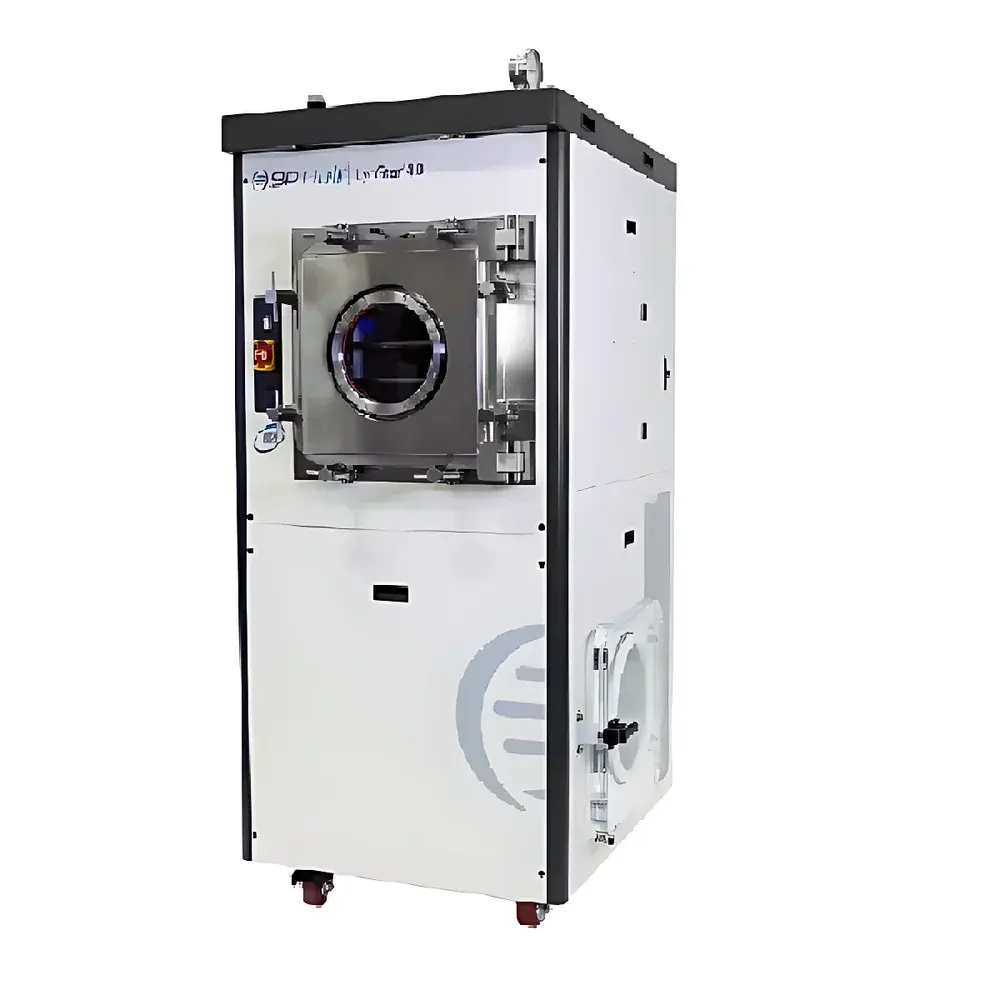
SP Scientific LyoStar 4.0 Pilot-Scale Freeze Dryer
| Brand | SP Scientific |
|---|---|
| Origin | USA |
| Model | LyoStar 4.0 |
| Instrument Type | Shelf-Type Freeze Dryer |
| Application Scale | Pilot-Scale |
| Shelf Area | 0.42 m² / 0.56 m² |
| Ultimate Vacuum | 13 µbar (10 mTorr) |
| Condensate Capacity (24 h) | 30 L |
| Cold Trap Temperature | −85 °C |
| Shelf Temperature Range | −70 °C to +60 °C |
| Dimensions (W×H×D) | 994 mm × 2137.6 mm × 1208.5 mm |
Overview
The SP Scientific LyoStar 4.0 Pilot-Scale Freeze Dryer is an engineered platform for robust, scalable lyophilization process development in biopharmaceutical R&D and early-stage manufacturing. Designed with direct lineage to full-scale production freeze dryers, it bridges the critical gap between laboratory feasibility studies and commercial validation—enabling rapid technology transfer while preserving thermodynamic fidelity across scales. Its core architecture implements primary drying based on heat and mass transfer principles under controlled sublimation conditions, where product temperature, shelf thermal dynamics, chamber pressure, and vapor flow are simultaneously monitored and regulated. The system operates under high-vacuum conditions (≤13 µbar), ensuring efficient water vapor removal while maintaining low thermal load on sensitive biologics. Built in the USA and compliant with ASME BPVC Section VIII Div. 1 for pressure vessel safety, the LyoStar 4.0 supports GLP- and GMP-aligned workflows from formulation screening through Phase II/III clinical supply.
Key Features
- Shelf temperature control with ±0.5 °C uniformity across full shelf area, enabled by dual-zone silicone oil circulation and real-time PID feedback
- Integrated ControLyo® controlled nucleation technology—induces consistent ice crystal formation via precise pressure modulation, reducing batch variability and improving cake structure homogeneity
- AutoMTM/SMART™ dynamic primary drying optimization—automatically adjusts shelf temperature ramp rates and hold times based on real-time resistance-to-mass-transfer (Rp) calculations derived from chamber pressure rise tests (PRT)
- LyoFlux® TDLAS (Tunable Diode Laser Absorption Spectroscopy) sensor for non-intrusive, continuous measurement of vapor mass flow rate and dryness endpoint detection
- Tempris® wireless product temperature sensors—sterilizable, battery-free RF-based probes providing spatially resolved, drift-free monitoring at multiple vial locations without feedthroughs or wiring constraints
- −85 °C cold trap with 30 L condensate capacity, optimized for high-water-load formulations and extended cycle durations without defrost interruption
- Modular design compatible with ISO Class 5 cleanroom integration or isolator coupling via standardized flange interfaces and HEPA-filtered utility connections
Sample Compatibility & Compliance
The LyoStar 4.0 accommodates a broad range of primary packaging formats including serum vials (2–50 mL), 96-well microplates, and diagnostic cartridges. Its shelf configuration supports both standard and custom tray systems, enabling parallel processing of heterogeneous sample sets. All wetted surfaces are electropolished 316L stainless steel, meeting USP and ASTM A967 standards for corrosion resistance and extractables profile. The system’s software architecture complies with FDA 21 CFR Part 11 requirements—including electronic signatures, audit trails, role-based access control, and immutable data archiving—supporting regulatory submissions under ICH Q5C, Q5A(R2), and Annex 1 (EU GMP). Validation documentation packages (IQ/OQ/PQ) are available per client-specific protocols aligned with ASTM F2476 and ISO 20957.
Software & Data Management
Control and data acquisition are managed via LyoLogic® 4.0 software—a validated, Windows-based platform featuring synchronized multi-sensor time-series logging at up to 10 Hz sampling resolution. All PAT data streams (shelf temp, chamber pressure, vapor flow, product temp, condenser load) are time-stamped and correlated using a common epoch reference. Raw datasets export in CSV and HDF5 formats; trend analysis, Rp modeling, and drying rate profiling are performed within built-in analytical modules compliant with ASTM E2500-13 guidelines. Cybersecurity is maintained through TLS 1.2 encryption, Windows Defender Application Control policies, and optional integration with enterprise LIMS via OPC UA or RESTful API endpoints.
Applications
- Formulation development and stability assessment of monoclonal antibodies, vaccines, and gene therapies under varied freezing protocols (quench vs. controlled-rate)
- Lyophilization cycle development and optimization—including determination of collapse temperature (Tc), eutectic melt onset, and critical product temperature thresholds
- Scale-up studies supporting tech transfer to commercial freeze dryers, leveraging Line of Sight™ predictive modeling for shelf heat transfer coefficient (U-value) and product resistance (Rp) correlation
- Process characterization for Quality-by-Design (QbD) initiatives, generating design space boundaries per ICH Q8(R2)
- Diagnostic reagent lyophilization requiring high sterility assurance and minimal residual moisture (<1.0 % w/w)
- Accelerated stability testing under ICH Q1A(R3) conditions using programmable shelf temperature ramps and humidity-controlled storage post-lyo
FAQ
What is the maximum allowable shelf load for validated operation?
The LyoStar 4.0 is validated for full-shelf loading up to 0.56 m² at ≤20 g/L vial fill density, with thermal uniformity maintained per ASTM F2476 Annex A.
Does the system support remote monitoring and alarm notification?
Yes—via LyoLogic® 4.0’s embedded web server and SMTP/OPC UA interfaces, enabling secure off-site supervision, SMS/email alerts for critical deviations, and integration into centralized MES platforms.
Can Tempris® sensors be used with stoppered vials during secondary drying?
Yes—the RF-powered sensors operate continuously through aluminum crimp seals and lyophilized cake matrices, delivering stable readings up to 60 °C shelf temperature during desorption phases.
Is the cold trap designed for solvent-laden vapors (e.g., tert-butanol, ethanol)?
The −85 °C trap is compatible with aqueous and partially organic systems; for >15 % v/v solvent content, optional cryo-cooler derating and condensate management protocols are recommended per application review.
How is calibration traceability maintained across PAT sensors?
All sensors ship with NIST-traceable calibration certificates; field recalibration intervals follow ASTM E2919-22 guidelines, with automated verification routines embedded in LyoLogic® software.



