
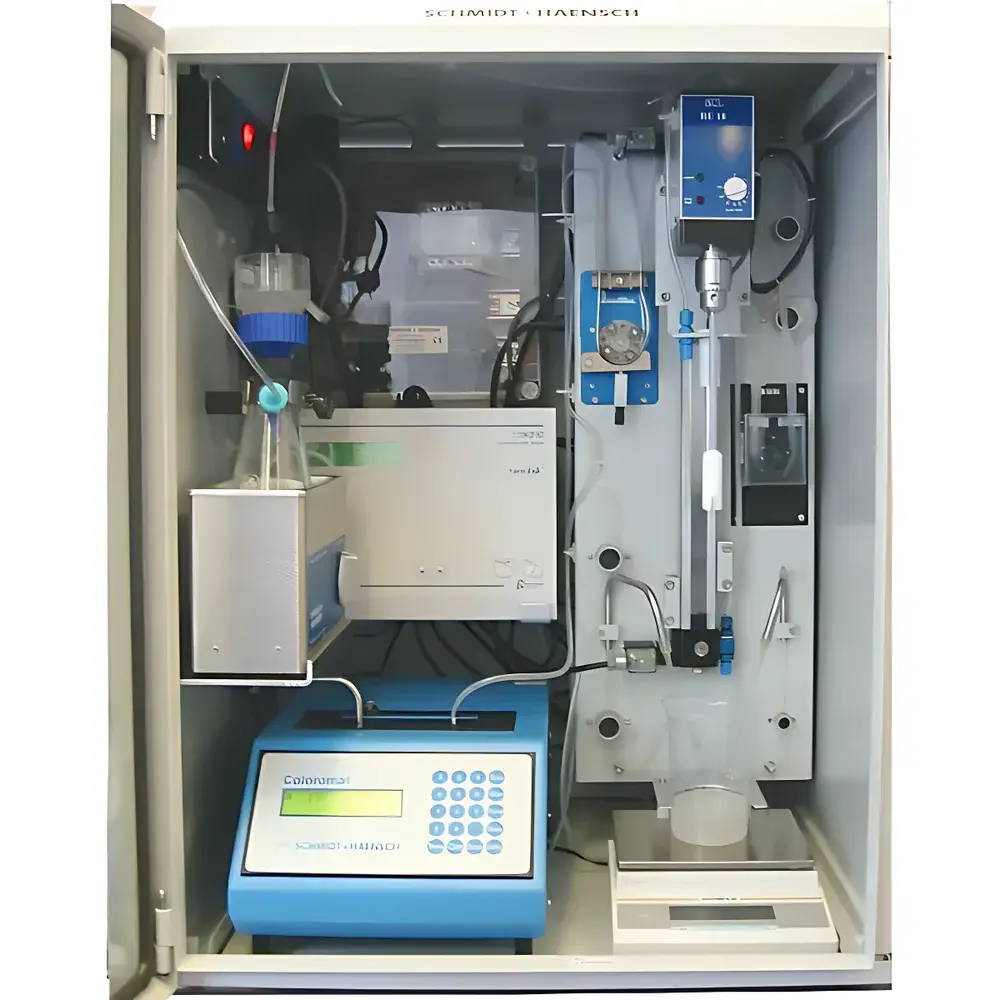
Schmidt + Haensch S+H AutoAnalyzer for Ash, Color, and Turbidity
| Brand | Schmidt + Haensch (S+H) |
|---|---|
| Country of Origin | Germany |
| Instrument Type | Benchtop Laboratory Analyzer |
| Measurement Principles | Conductivity-based Ash Determination, Photometric Colorimetry at 420 nm (ICUMSA), Nephelometric Turbidity |
| Accuracy | ±1 IU (Color, ≤30 IU), ±10% (Turbidity), ±0.001% (Ash), ±0.1 °Brix (Brix) |
| Compliance | ICUMSA Method GS5/8/9-1, ASTM D1209, ISO 7027, USP <731> |
| Automation Level | Fully Automated Sample Handling, Dilution, Filtration, Measurement, and System Rinse |
| Software Integration | LIMS-ready with audit-trail-capable data acquisition, FDA 21 CFR Part 11–compliant optional module |
| Sample Throughput | ~3 samples/hour |
| Sample Format | Pre-weighed white sugar solids (barcoded) |
Overview
The Schmidt + Haensch S+H AutoAnalyzer for Ash, Color, and Turbidity is a fully integrated, benchtop laboratory system engineered for high-throughput, standardized quality control in sugar refining laboratories. It implements three orthogonal optical and electrochemical measurement principles within a single automated workflow: (1) nephelometric turbidity assessment per ISO 7027 and USP , (2) photometric colorimetry at 420 nm under strict adherence to ICUMSA GS5/8/9-1 methodology for raw and refined sugar, and (3) conductivity-based ash determination calibrated against ICUMSA GS7-1 and ASTM D1209. Unlike standalone turbidimeters or colorimeters, this analyzer eliminates manual dilution, filtration, cuvette handling, and instrument reconfiguration—replacing them with a closed-loop fluidic architecture, precision peristaltic pumping, and gravimetrically verified dilution steps. The system is designed for unattended operation across multi-shift environments and delivers metrologically traceable results aligned with international sugar industry specifications.
Key Features
- Fully automated end-to-end analysis: barcode-driven sample identification, auto-weighing interface readiness (via optional balance integration), programmable dilution to 50 °Brix (for color) and 28 °Brix (for ash), membrane filtration (0.45 µm), and sequential spectrophotometric and conductometric measurement.
- Dual-path optical architecture: dedicated COLOROMAT spectrophotometer with thermally stabilized tungsten-halogen source and interference filter set centered at 420 nm (FWHM ≤5 nm), coupled with a calibrated nephelometric detector optimized for 90° scattering geometry.
- Conductivity cell with temperature compensation (±0.1 °C) and automatic electrode polarization correction, enabling precise ash quantification from specific conductance of clarified sugar solutions.
- Self-cleaning fluidic pathway: post-analysis rinse cycle using deionized water and ethanol, validated via conductivity and absorbance baseline recovery; full system flush protocol configurable per batch.
- Modular expandability: supports optional integration of pH probes, analytical balances, bar code scanners, and robotic sample loaders—enabling seamless upgrade to full GLP/GMP-compliant production-line QC stations.
Sample Compatibility & Compliance
The analyzer is validated for white granulated sugar (ICUMSA RS), raw sugar (ICUMSA LS), and liquid sugar syrups (up to 65 °Brix pre-dilution). All measurements conform to mandatory sugar industry standards: color values reported in ICUMSA Units (IU), turbidity in Formazin Nephelometric Units (FNU), ash content as % w/w, and Brix via inline refractometric verification. System validation documentation includes IQ/OQ protocols aligned with ISO/IEC 17025 requirements. Data integrity meets FDA 21 CFR Part 11 criteria when operated with the optional electronic signature and audit trail software module. Routine calibration verification uses NIST-traceable sucrose reference materials and formazin standards certified to ISO 7027.
Software & Data Management
Control and data acquisition are managed through S+H AnalyzeSuite™ v4.x—a Windows-based application supporting real-time monitoring, method parameterization (dilution factors, measurement dwell times, filter selection), and automated report generation in PDF/XLSX. Raw spectral scans, conductivity transients, and turbidity decay curves are stored with full metadata (operator ID, timestamp, instrument serial, environmental temperature/humidity). The software provides built-in statistical process control (SPC) charts, outlier detection per Grubbs’ test, and direct export to LIMS via ASTM E1394 or HL7 ADT interfaces. Audit trails record all user actions—including method edits, result overrides, and calibration events—with immutable timestamps and digital signatures.
Applications
- Refinery QC labs performing daily compliance testing against ICUMSA specifications for refined sugar shipments.
- R&D departments evaluating bleaching efficiency, carbonatation performance, or ion-exchange resin exhaustion via longitudinal ash and color trend analysis.
- Contract testing laboratories requiring ISO/IEC 17025-accredited reporting for third-party certification (e.g., BRCGS, FSSC 22000).
- Process engineers correlating online turbidity spikes in clarifiers with offline ash/color deviations to diagnose filter cloth fouling or lime dosage drift.
- Regulatory submissions requiring fully documented, reproducible measurement chains traceable to primary standards.
FAQ
What standards does the system comply with for color measurement?
ICUMSA GS5/8/9-1 (2022), ASTM D1209, and ISO 6685–all verified using certified ICUMSA reference solutions.
Can the system analyze molasses or brown sugars?
No—it is optimized for clarified, low-turbidity solutions of white and raw sugars; high-color, viscous matrices require pretreatment outside the automated workflow.
Is method validation support provided?
Yes: S+H supplies full IQ/OQ documentation templates, calibration checklists, and uncertainty budget worksheets compliant with EURACHEM/CITAC guidelines.
How is carryover between samples prevented?
Through triple-rinse cycles (DI water → ethanol → DI water), pressure-monitored line purging, and real-time absorbance baseline verification prior to each measurement.
What maintenance intervals are recommended?
Filter cartridge replacement every 200 runs; conductivity cell polishing quarterly; optical path inspection semiannually—schedule tracked automatically in AnalyzeSuite™.




