
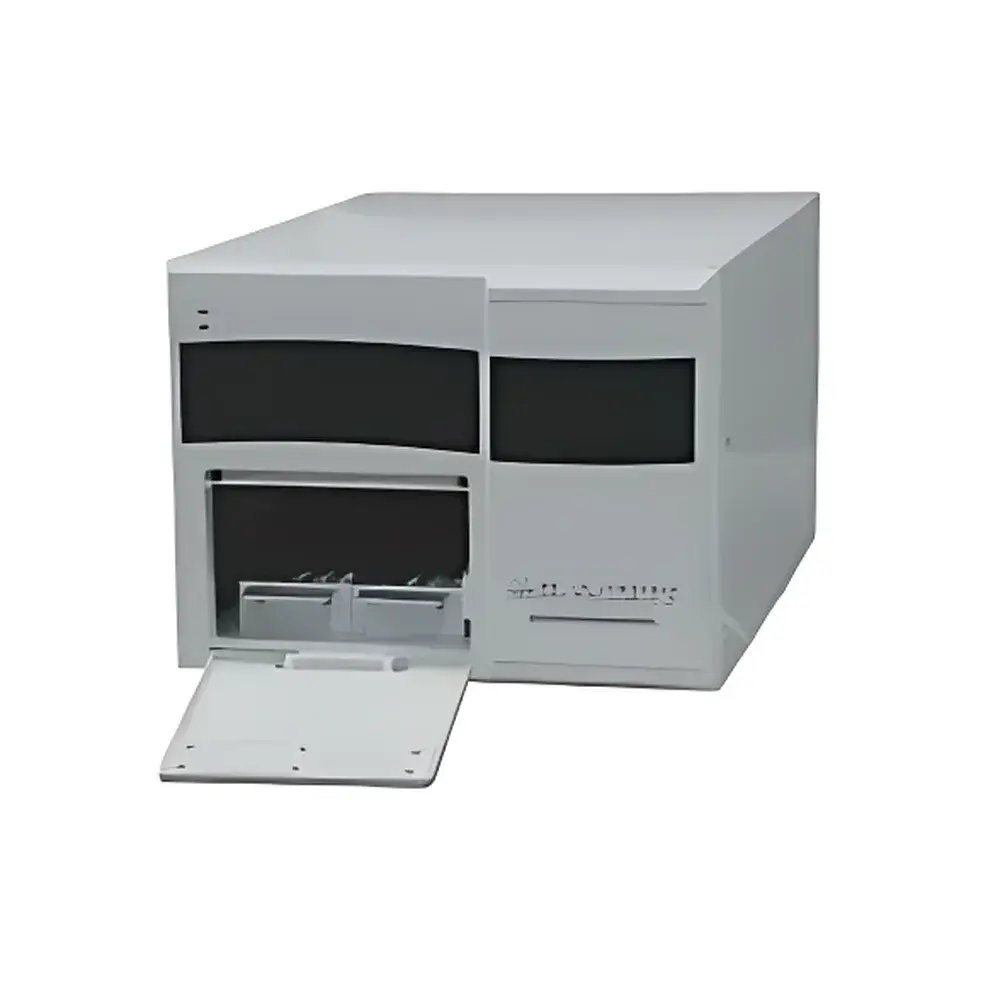
Unimicro Technologies AS1020 Multifunctional Liquid Chromatography Autosampler
| Brand | Unimicro Technologies |
|---|---|
| Origin | Shanghai, China |
| Manufacturer Type | Original Equipment Manufacturer (OEM) |
| Regional Classification | Domestic (China) |
| Model | AS1020 |
| Instrument Type | HPLC Autosampler |
| Sample Capacity | 120 × 1.8 mL vials (2 × 60-position racks) |
| Injection Modes | Full-loop, Partial-loop, and Needle-Over-Loop (NOL) / Zero-dead-volume injection |
| Minimum Injection Volume | 0.1 µL (with 250 µL syringe pump) |
| Syringe Pump Volume | 250 µL (standard) |
| Loop Volume | 100 µL (standard) |
| Injection Valve Switching Time | <100 ms |
| Positioning Accuracy | <0.3 mm |
| Motion Architecture | XYZ three-axis Cartesian coordinate system |
| Needle Wash | Dual internal/external wash with programmable unlimited rinse cycles |
| Carryover | <0.01% |
| Precision (RSD) | <0.5% |
| Linearity (r²) | >0.999 |
| Dimensions (W×D×H) | 300 × 505 × 230 mm |
| Power Supply | AC 220 V, 50 Hz |
| Operating Temperature Range | 10–40 °C |
Overview
The Unimicro Technologies AS1020 is a high-precision, multifunctional autosampler engineered for integration with high-performance liquid chromatography (HPLC) and ultra-high-performance liquid chromatography (UHPLC) systems. It operates on a robust XYZ Cartesian motion architecture, enabling deterministic positioning of the sampling needle across dual 60-position racks—supporting up to 120 samples per unattended run. The instrument employs a dual-stage fluidic path design incorporating a 250 µL precision syringe pump and a standard 100 µL quantitative loop, allowing flexible implementation of full-loop, partial-loop, and needle-over-loop (NOL) injection modes. This architecture ensures minimal sample waste, sub-microliter accuracy, and exceptional reproducibility—critical for regulated QC/QA environments where trace-level quantitation and method transferability are essential.
Key Features
- Triple-injection mode support: full-loop, partial-loop, and zero-dead-volume (NOL) injection—enabling optimal method compatibility across diverse analyte concentrations and matrix complexities.
- Sub-0.3 mm XYZ positioning accuracy and <100 ms valve actuation time ensure tight retention time alignment and inter-run consistency in gradient and isocratic separations.
- Dual internal/external needle wash system with user-defined, unlimited rinse cycles—significantly reducing carryover to <0.01%, validated per ICH Q2(R2) carryover assessment guidelines.
- Programmable injection volume from 0.1 µL to full loop capacity, calibrated against NIST-traceable standards; RSD <0.5% at 1 µL and <0.3% at ≥5 µL (n = 6, 10 µg/mL caffeine in methanol).
- Linear response (r² > 0.999) verified over 3 orders of magnitude (0.1–100 µg/mL), supporting both trace impurity profiling and major component quantification within a single sequence.
- Intelligent rack recognition and auto-detection of vial presence prevent missed injections and mechanical collision during unattended operation.
Sample Compatibility & Compliance
The AS1020 accommodates standard 1.8 mL screw-thread or crimp-top vials (12 × 32 mm), compatible with widely adopted HPLC vial formats including Waters, Agilent, and Thermo Fisher consumables. Its sealed sample compartment maintains thermal stability between 10–40 °C, minimizing analyte degradation or precipitation during extended runs. The system is designed to meet core requirements of ISO/IEC 17025:2017 for testing laboratories and supports GLP/GMP workflows through audit-trail-capable method storage and execution logging. While not pre-certified to FDA 21 CFR Part 11, its firmware architecture permits integration with compliant LIMS or CDS platforms that enforce electronic signature, change control, and data integrity protocols.
Software & Data Management
Controlled via Unimicro’s AS-Control Suite (v3.2+), the AS1020 supports method-driven scheduling—including variable injection volumes, dynamic wash protocols, and conditional re-injection logic. All method parameters, run logs, and maintenance events are timestamped and stored locally with optional network backup. Raw positional and timing metadata are exportable in CSV format for third-party statistical process control (SPC) analysis. The software interface complies with IEEE 11073-10201 for medical device interoperability frameworks and includes built-in diagnostics for syringe wear detection, valve leakage monitoring, and wash solvent level alerts.
Applications
- Routine pharmaceutical QC testing: assay, dissolution, and stability-indicating methods per USP and EP 2.2.46.
- Environmental analysis of polar pesticides and pharmaceutical residues in wastewater using LC-MS/MS workflows.
- Biopharmaceutical characterization: peptide mapping, residual host-cell protein quantitation, and monoclonal antibody subunit analysis.
- Food safety screening: mycotoxins, veterinary drug residues, and synthetic food dyes under EU Regulation (EC) No 401/2006.
- Academic and contract research labs requiring flexible, low-maintenance autosampling for method development and validation studies.
FAQ
What injection modes does the AS1020 support, and how do they differ in application?
It supports full-loop (maximum precision for fixed-volume injections), partial-loop (variable volume without loop overfill), and needle-over-loop (NOL) injection—ideal for precious or volume-limited samples where zero dead-volume transfer is required.
Can the AS1020 be integrated with third-party CDS platforms such as Empower or Chromeleon?
Yes—via industry-standard ASCII-based RS-232/485 or TCP/IP command sets; driver packages are available for Waters Empower 3+, Thermo Chromeleon 7.3+, and Agilent OpenLab CDS.
Is temperature-controlled sample storage available as an option?
No—the AS1020 does not include active Peltier cooling; however, it is compatible with external refrigerated racks (e.g., Unimicro CR-60) for ambient-sensitive applications.
How is carryover performance validated, and what solvents are recommended for needle wash?
Carryover is assessed per ICH Q2(R2) using a high-concentration standard followed by blank injections; recommended wash solvents include 50:50 water:acetonitrile or 0.1% formic acid in water/methanol, depending on analyte polarity.
Does the system support scheduled maintenance alerts or predictive diagnostics?
Yes—firmware monitors syringe plunger cycle count, valve actuation latency, and wash fluid consumption to trigger configurable service alerts prior to performance drift.





