
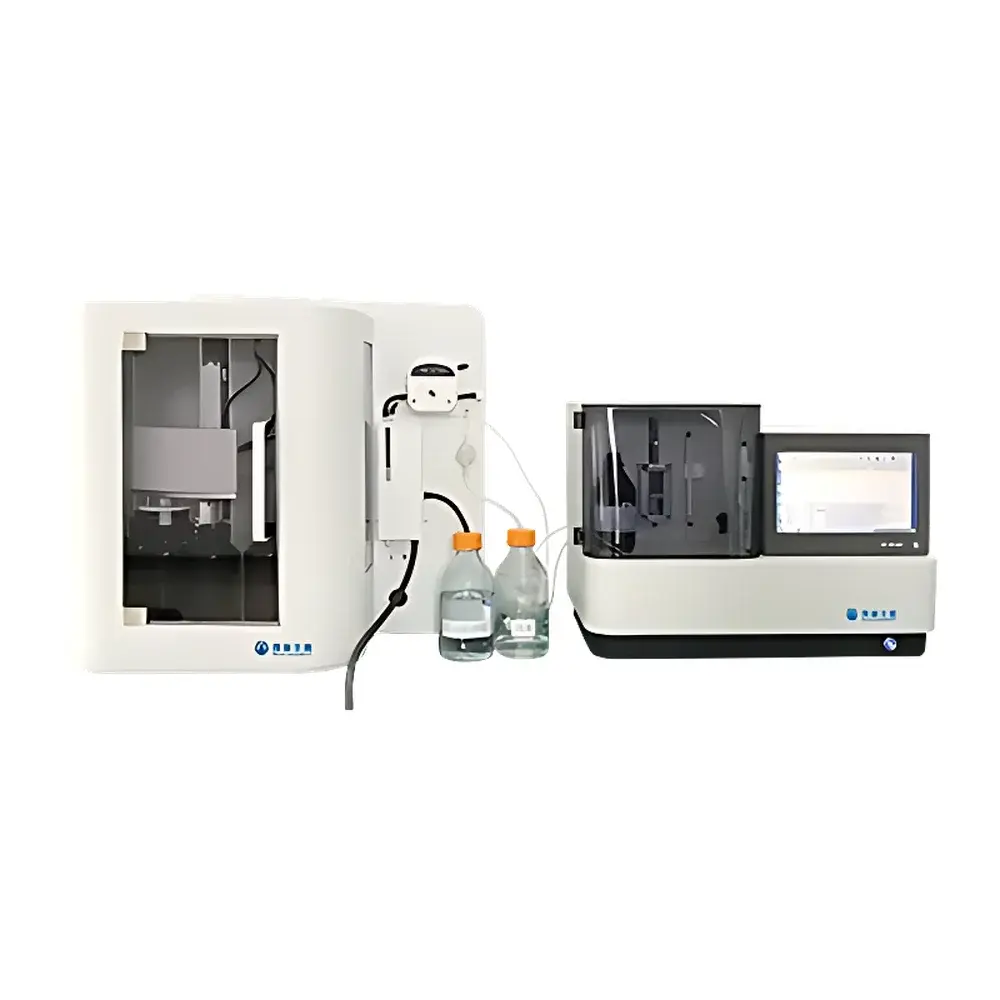
Online Instrument OL1040 Fully Automated UV Oil Content Analyzer
| Brand | Online Instrument |
|---|---|
| Origin | Shanghai, China |
| Manufacturer Type | Manufacturer |
| Product Category | Domestic |
| Model | OL1040 |
| Instrument Type | Laboratory-Based |
| Measurement Principle | Ultraviolet Spectrophotometry |
| Measurement Range | 0–16 mg/L (with automatic dilution beyond range) |
| Detection Limit | 0.005 mg/L |
| Accuracy | ±2% |
| Resolution | 0.001 mg/L |
| Analysis Time | <6 minutes per sample |
Overview
The Online Instrument OL1040 Fully Automated UV Oil Content Analyzer is a laboratory-grade, regulatory-compliant instrument engineered for precise quantification of petroleum hydrocarbons in aqueous environmental matrices. It operates on the established principle of ultraviolet spectrophotometry (UV-Vis), leveraging the characteristic absorbance of aliphatic and aromatic hydrocarbons in the 225 nm spectral region—aligned with standardized methodologies including HJ 970–2018 (China) and EPA Method 1664A (US). The system integrates fully automated liquid handling, solvent extraction, phase separation, and optical measurement into a single closed-loop workflow. Designed for routine compliance monitoring and research-grade water quality analysis, it eliminates manual intervention in critical steps such as volumetric sampling, reagent addition, emulsion breaking, and solvent recovery—thereby minimizing analyst exposure, operator-induced variability, and cross-contamination risk.
Key Features
- Fully automated sample processing: Accepts standard wide-mouth sampling bottles (per HJ/T 91–2002) directly; non-contact volume recognition ensures <2% volumetric error and auto-populates sample volume into the analysis sequence.
- Integrated solvent-based extraction: Uses n-hexane or petroleum ether as extractant; programmable dosing ensures stoichiometric consistency across batches.
- Triple-stage phase separation: Combines centrifugal extraction, membrane-based water removal (hydrophobic PTFE membrane), and anhydrous Na₂SO₄ drying—ensuring >99.5% organic phase purity prior to UV measurement.
- Self-monitoring adsorption column: Silicon magnesium adsorbent column for selective removal of polar compounds (e.g., vegetal/animal oils); real-time capacity tracking via integrated pressure sensing and software alerting.
- Closed-system architecture: All fluidic pathways remain sealed during operation; volatile organic compound (VOC) emissions are routed through activated carbon filtration, eliminating requirement for external fume hoods.
- Automated solvent recovery: N-hexane is separated from aqueous waste via density-driven phase partitioning and collected in dedicated reservoirs for reuse or safe disposal.
- Remote operation capability: Web-enabled interface supports real-time status monitoring, method execution, and data retrieval via desktop or mobile devices—compatible with enterprise LIMS integration via secure HTTPS API.
Sample Compatibility & Compliance
The OL1040 is validated for use with surface water, groundwater, seawater, estuarine, and harbor samples containing petroleum hydrocarbons—including crude oil, diesel, lubricants, and weathered hydrocarbon mixtures. Its measurement range (0–16 mg/L) and sub-ppb detection limit (0.005 mg/L) meet the sensitivity requirements of national and international regulatory frameworks, including China’s HJ 970–2018, ISO 9377-2:2000 (Water quality — Determination of hydrocarbon oil index — Part 2: Infrared spectrometric method), and ASTM D7066–19 (Standard Test Method for Determination of Oil and Grease and Selected Petroleum Hydrocarbons in Water by Direct Aqueous Injection Capillary Gas Chromatography). While primarily configured for UV-based petroleum index determination, its optical engine supports full-spectrum scanning (190–1100 nm), enabling supplementary applications such as TOC surrogate estimation, nitrate/nitrite analysis, and general UV-Vis qualitative/quantitative assays in academic and industrial labs.
Software & Data Management
The embedded Windows-based control software provides intuitive touchscreen navigation, method library management, and audit-trail-enabled data recording compliant with GLP and GMP principles. Each analysis generates a timestamped digital record containing raw absorbance spectra, calibration curve parameters, dilution factors, separation efficiency metrics, and column saturation status. Data export supports CSV, PDF, and XML formats; optional 21 CFR Part 11 compliance package includes electronic signatures, role-based access control, and immutable audit logs. Instrument diagnostics—such as pump priming status, solvent level thresholds, membrane integrity checks, and detector baseline stability—are continuously monitored and logged.
Applications
- Regulatory monitoring of petroleum hydrocarbons in municipal wastewater effluents and receiving waters.
- Environmental impact assessment at offshore drilling sites, refineries, and petrochemical terminals.
- Leak detection and source identification in groundwater plumes using spatially resolved oil concentration profiling.
- Method validation and inter-laboratory comparison studies requiring high reproducibility (RSD <3% intra-day, <5% inter-day).
- Teaching laboratories requiring robust, low-maintenance UV-Vis instrumentation for analytical chemistry curricula.
- Industrial QC for cooling tower water, boiler feedwater, and process rinse streams where hydrocarbon ingress must be controlled below 0.1 mg/L.
FAQ
What extraction solvents are compatible with the OL1040?
n-Hexane and petroleum ether (boiling point range 60–90 °C) are validated and pre-programmed; alternative solvents require method revalidation and may affect separation efficiency and detection sensitivity.
Does the system support unattended overnight operation?
Yes—the OL1040 supports continuous batch processing of up to 14 samples per run, with automatic initiation of subsequent cycles upon completion; solvent and waste reservoirs are sized for ≥24-hour operation under typical lab throughput.
How is cross-contamination prevented between samples?
The system employs reverse-pressure solvent flush of all wetted components (extraction lines, separation membranes, cuvettes) between analyses, combined with real-time pressure monitoring to confirm pathway clearance.
Is third-party calibration verification supported?
Yes—calibration standards traceable to NIST SRM 2781 (Mineral Oil in Water) or equivalent certified reference materials can be loaded manually or via autosampler; calibration verification reports include linearity, LOD/LOQ confirmation, and spike recovery data.
Can the instrument be integrated into an existing LIMS environment?
Yes—via RESTful API or OPC UA protocol; raw spectral data, quantitative results, and instrument metadata are transmitted in structured JSON format with configurable polling intervals and authentication tokens.
Related Products







