
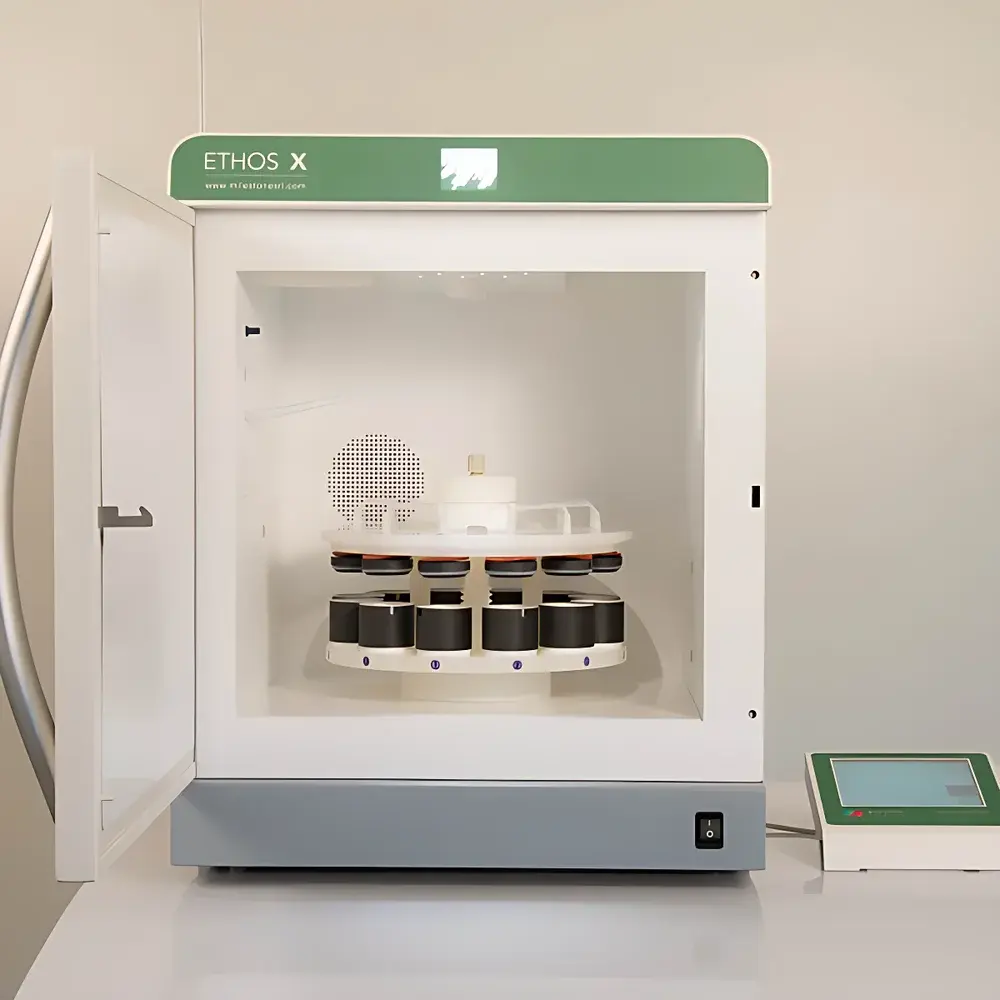
ETHOS X Microwave-Assisted Fat Analyzer by Milestone
| Brand | Milestone |
|---|---|
| Origin | Italy |
| Model | ETHOS X |
| Application | Rapid total fat determination in food and feed samples |
| Sample throughput | 15 positions |
| Sample mass range | 3–15 g |
| Total process time | ≤ 3 hours |
| Temperature control | Full-vessel infrared temperature monitoring |
| Automation | Integrated balance interface for automatic mass data import and calculation |
| Extraction methodology | Microwave-assisted acid hydrolysis coupled with solvent extraction |
| Stirring | Built-in magnetic stirring system |
| Compliance context | Designed to support AOAC 991.36, ISO 1443, and USP <467> workflows |
Overview
The ETHOS X Microwave-Assisted Fat Analyzer is an integrated, high-throughput laboratory system engineered by Milestone (Italy) for the precise and standardized quantification of total fat content in food, animal feed, and agricultural commodities. Unlike conventional gravimetric methods—such as AOAC 991.36 or ISO 1443—which rely on sequential acid hydrolysis, filtration, solvent extraction (e.g., petroleum ether via Soxhlet), and multi-cycle drying/cooling/weighing steps, the ETHOS X consolidates hydrolysis and solvent extraction into a single, microwave-driven thermal-chemical process. This approach leverages controlled microwave energy to accelerate acid-catalyzed cleavage of lipid-protein and lipid-carbohydrate bonds, followed immediately by targeted solvent mobilization and recovery under inert atmosphere. The system operates on a closed-vessel platform with real-time, full-vessel infrared temperature sensing—ensuring reproducible thermal profiles across all 15 sample positions without reliance on external probes or averaged readings.
Key Features
- Simultaneous microwave-assisted acid hydrolysis and solvent extraction in sealed quartz or borosilicate vessels, eliminating manual transfer between unit operations.
- 15-position rotor accommodates sample masses from 3 g to 15 g—compatible with heterogeneous matrices including meat, dairy powders, cereals, and pelleted feed.
- Full-vessel infrared temperature monitoring provides per-vessel thermal feedback, enabling dynamic power modulation to maintain ±1.5 °C stability during ramp-and-hold protocols.
- Integrated magnetic stirring mechanism ensures homogeneous suspension of solid matrix throughout hydrolysis, minimizing charring and incomplete lipid liberation.
- Automated post-extraction solvent removal via vacuum-assisted rotary drying module—designed to prevent bumping, foaming, or oxidative degradation of unsaturated lipids.
- Digital balance interface (RS232/USB) enables direct acquisition of tare, pre-extraction, and post-drying masses—feeding raw values into embedded calculation engine compliant with AOAC-defined fat mass equations.
Sample Compatibility & Compliance
The ETHOS X supports a broad spectrum of natural and processed matrices requiring regulatory-grade fat analysis, including infant formula, baked goods, rendered fats, fishmeal, and botanical extracts. Its operational parameters align with internationally recognized standard methods: AOAC Official Method 991.36 (for total fat in foods), ISO 1443:2021 (milk and milk products), and USP residual solvents guidance for method validation traceability. While not inherently GLP-certified as a standalone instrument, the ETHOS X’s deterministic process sequencing, audit-ready log export (CSV/TXT), and timestamped event recording—including vessel ID, power profile, temperature history, and mass inputs—facilitate integration into GMP-compliant QC environments subject to FDA 21 CFR Part 11 requirements when paired with validated LIMS or ELN platforms.
Software & Data Management
The ETHOS X operates via Milestone’s dedicated PC-based control software, which provides protocol library management, customizable method templates (e.g., low-fat dairy vs. high-oil seed protocols), and real-time graphical display of temperature and pressure trajectories per vessel. All analytical events—including balance communication timestamps, drying cycle termination criteria (e.g., mass delta <0.5 mg over 60 s), and final fat percentage derivation—are logged with immutable metadata. Export functions support CSV, PDF report generation, and XML schema for downstream ingestion into enterprise quality systems. No cloud connectivity or remote access capabilities are embedded; data residency remains fully on-site per institutional IT policy requirements.
Applications
This instrument is routinely deployed in food safety laboratories, contract testing facilities, and R&D centers where rapid turnaround of nutritional labeling data is critical. Typical use cases include batch release testing of plant-based meat analogs (where traditional methods underestimate bound lipids), verification of fat content claims in organic dairy products, and screening of mycotoxin-contaminated grains (where lipid co-extraction impacts subsequent LC-MS cleanup efficiency). Its ability to handle variable moisture and fiber content—without pre-drying artifacts—makes it particularly suitable for high-water-content samples such as fresh cheese curds or silage.
FAQ
Does the ETHOS X replace Soxhlet extraction entirely?
Yes—for total fat determination in most food and feed matrices—as confirmed by interlaboratory validation studies demonstrating ≥95% method equivalence to AOAC 991.36 under defined operating conditions.
What solvents are compatible with the system?
Petroleum ether (40–60 °C fraction), diethyl ether, and chloroform/methanol (2:1 v/v) have been validated; solvent selection must comply with local EHS regulations and instrument material compatibility charts.
Is method validation support provided by Milestone?
Milestone supplies application notes, reference material test data (e.g., NIST SRM 1546), and IQ/OQ documentation templates—but final PQ and regulatory submission packages remain the responsibility of the end-user laboratory.
Can the ETHOS X be used for crude fiber or ash analysis?
No—it is purpose-built for fat quantification only; complementary instrumentation (e.g., fiber analyzers or muffle furnaces) is required for proximate analysis suites.
What maintenance intervals are recommended?
Quarterly inspection of IR sensor calibration, annual torque verification of rotor lid seals, and biannual cleaning of vacuum pump oil and condenser coils—per Milestone Maintenance Schedule M-ETHOSX-REV4.



