
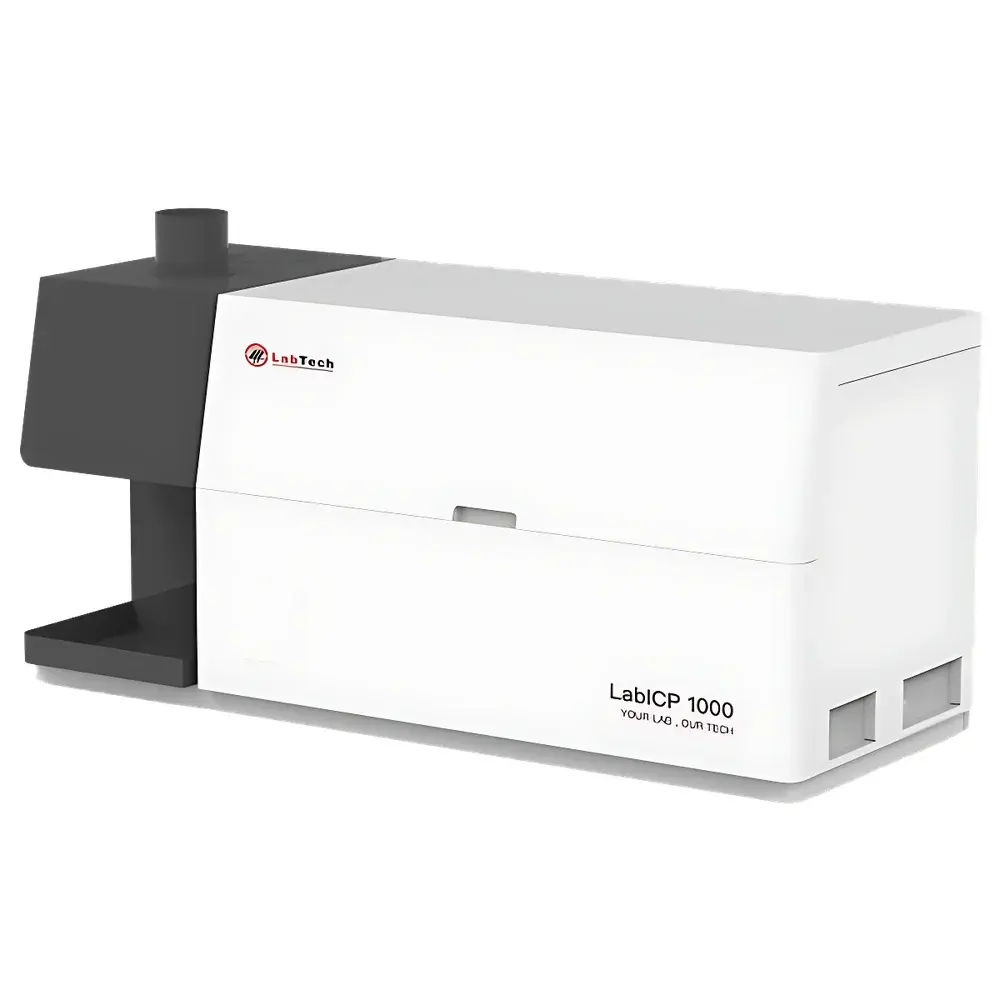
LabTech LabICP 1000 Inductively Coupled Plasma Optical Emission Spectrometer
| Brand | LabTech |
|---|---|
| Origin | Beijing, China |
| Manufacturer Type | Direct Manufacturer |
| Instrument Type | Sequential Scanning ICP-OES |
| Detection Limit | <1 ppb (typ. for key elements) |
| Precision (RSD) | ≤1% |
| Stability (RSD, 4h) | ≤2% |
| Wavelength Range | 165–900 nm |
| Optical Resolution | 6 pm / 7 pm / 10 pm @ 257.610 nm (Mn line, measured) |
Overview
The LabTech LabICP 1000 is a high-performance sequential scanning inductively coupled plasma optical emission spectrometer (ICP-OES) engineered for trace-to-major elemental analysis across diverse sample matrices. It operates on the fundamental principle of atomization and excitation of analyte elements in a high-temperature (~6,000–10,000 K) argon plasma, followed by detection of element-specific atomic emission lines across the ultraviolet–visible–near-infrared spectrum (165–900 nm). Its core design emphasizes spectral fidelity and measurement robustness—particularly critical for complex multi-element analyses where spectral overlap poses significant interference risks. The instrument’s high optical resolution—validated at 6 pm, 7 pm, and 10 pm at the Mn 257.610 nm reference line—enables reliable separation of adjacent emission lines, making it especially suited for high-accuracy quantification of rare earth elements (REEs), including Y, La–Lu, Sc, and Yb, in challenging matrices such as sintered NdFeB magnets, geological digests, and high-purity metal alloys.
Key Features
- High-resolution reflective monochromator with long focal length optical path, minimizing chromatic aberration and maximizing signal-to-noise ratio (SNR) and spectral peak definition.
- Closed-loop RF generator with digitally controlled high-voltage power supply—replacing conventional transformer/choke-based systems—achieving RF power stability better than ±0.1% under dynamic load conditions.
- Thermostatically controlled optical chamber maintained at constant temperature to eliminate thermal drift; purged with high-purity argon to enable stable, low-noise detection down to 180 nm (e.g., S I 180.731 nm) and 190 nm (Sn I 190.123 nm).
- Wide linear dynamic range spanning five to six orders of magnitude (typically 10⁵–10⁶), supporting simultaneous quantification of trace impurities (sub-ppb) and major constituents (wt%) without dilution or reconfiguration.
- Comprehensive hardware-level safety architecture including real-time monitoring and interlock protocols for cooling water flow, argon gas pressure, RF overvoltage/overcurrent, and arc suppression.
Sample Compatibility & Compliance
The LabICP 1000 accommodates liquid samples introduced via standard concentric nebulizers and cyclonic or Scott-type spray chambers. It supports acid-digested environmental soils, aqua regia–digested ores, microwave-assisted digests of food and biological tissues, and diluted metallurgical leachates. Its performance meets routine requirements for regulatory compliance testing under EPA Methods 200.7 and 6010D, ISO 11885, ASTM D1976, and GB/T 20125–2006. While not pre-certified for GLP/GMP environments out-of-the-box, its hardware design—including stable plasma control, audit-ready parameter logging, and deterministic wavelength calibration—facilitates validation per 21 CFR Part 11 when integrated with compliant LIMS or data acquisition software.
Software & Data Management
Instrument control, method development, calibration, and quantitative reporting are managed through LabTech’s proprietary ICP-Analyzer software. The platform supports multi-point calibration curves (linear, quadratic, or cubic), internal standard correction (e.g., Y, Sc, or In), background correction using adjacent pixel interpolation or multi-point polynomial fitting, and automatic spectral interference correction based on user-defined line overlap libraries. All acquisition parameters—including integration time, replicate count, viewing height, and plasma power—are stored with metadata (operator ID, timestamp, instrument serial number) to support traceability. Raw spectral data and processed results are exportable in ASCII, CSV, and XML formats compatible with third-party statistical packages and enterprise laboratory informatics systems.
Applications
- Rare earth element profiling in permanent magnet materials (e.g., NdFeB, SmCo), including precise stoichiometric verification and contamination screening for Dy, Tb, and Ce.
- Multi-element monitoring in environmental waters and wastewater per national discharge standards, with validated detection of As, Cd, Cr, Pb, Hg, and Se at sub-ppb levels.
- Quality control of high-purity metals and alloys in semiconductor-grade copper, aluminum, and nickel production.
- Geochemical mapping of exploration samples, including REE pattern normalization and chondrite-normalized distribution plots.
- Nutritional and contaminant analysis in agricultural products and dietary supplements, aligned with Codex Alimentarius and EU Commission Regulation (EC) No 1881/2006 limits.
FAQ
What plasma gas configuration does the LabICP 1000 require?
It operates with high-purity argon (≥99.996%) for both plasma generation and optical chamber purging. Optional auxiliary gas (e.g., nitrogen or oxygen) is not supported.
Is the instrument capable of axial or radial view selection?
The LabICP 1000 employs a fixed radial-view configuration optimized for robustness and long-term stability in routine QC environments.
Can it perform simultaneous multi-element analysis?
No—it is a sequential scanning system; elements are measured one at a time in user-defined order, balancing precision, sensitivity, and spectral resolution.
What maintenance intervals are recommended for the RF torch and nebulizer?
Typical torch lifetime exceeds 1,000 hours under standard operating conditions; nebulizer cleaning is advised after every 10–20 samples when analyzing high-TDS or hydrofluoric acid–digested matrices.
Does the system support external trigger input for synchronized sampling?
Yes—TTL-compatible external trigger input is provided for coordination with autosamplers or process analyzers in automated workflows.





