
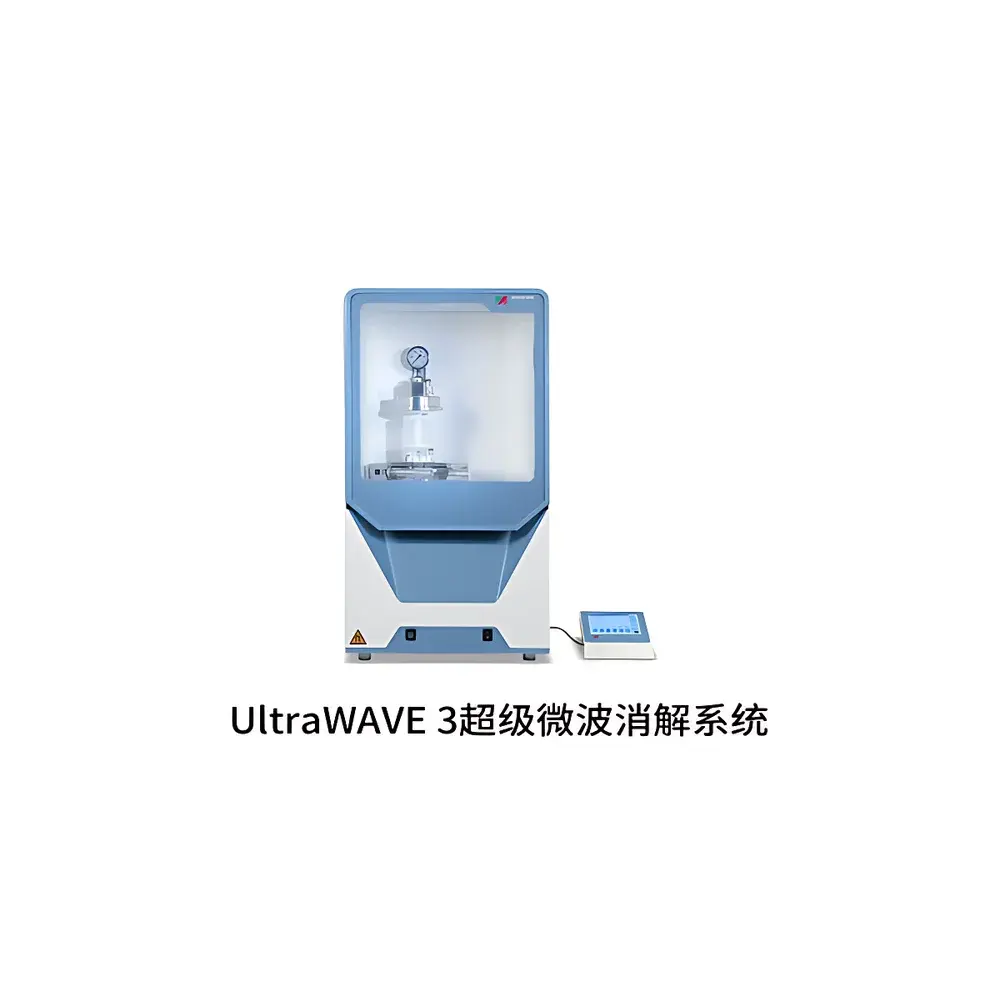
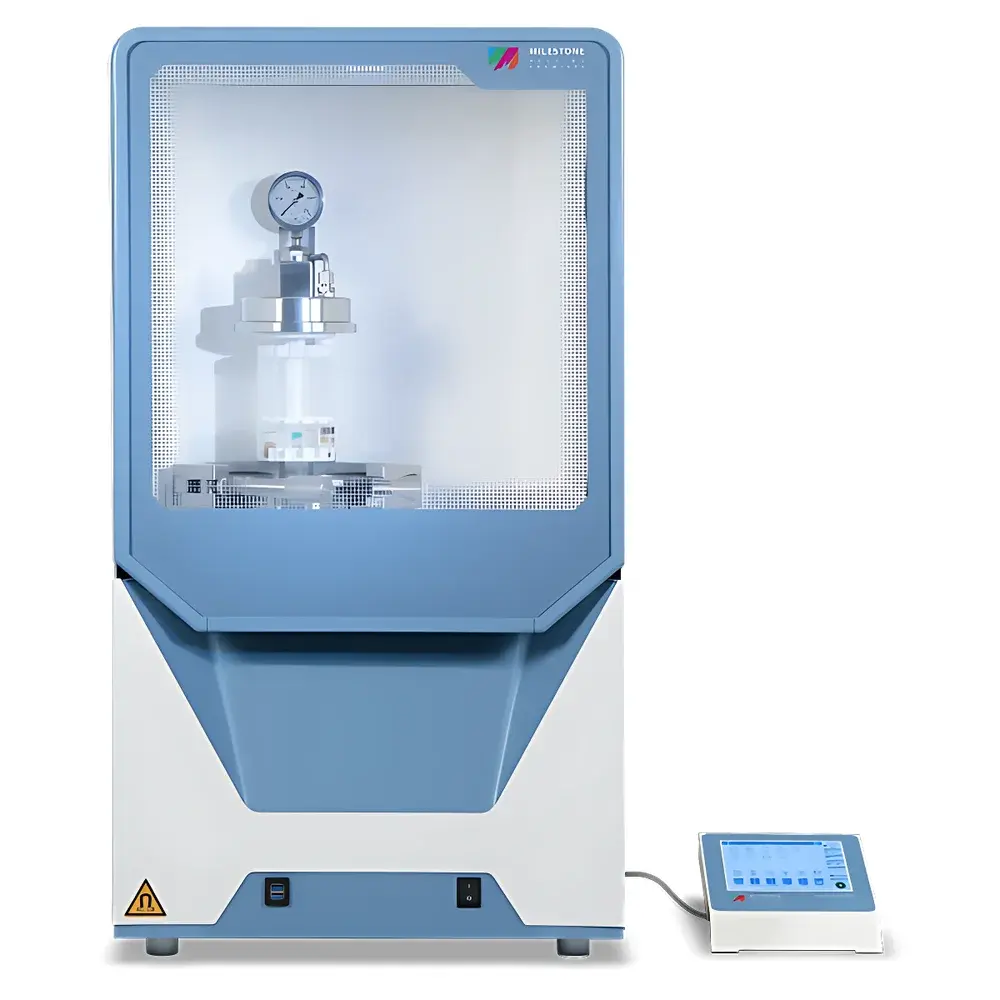
MILESTONE ultraWAVE 3 Superwave Microwave Digestion System
| Brand | MILESTONE |
|---|---|
| Origin | Italy |
| Model | ultraWAVE 3 |
| Cavity Class | Industrial-grade |
| Sample Capacity | 1–22 samples per batch |
| Microwave Source | Single Magnetron |
| Max Temperature | 320 °C |
| Max Pressure | 3000 psi (207 bar) |
| Reaction Chamber Volume | 4.2 L |
| Sample Mass Capacity | ≥25 g per vessel |
| Acid Consumption | 2–3 mL per sample |
| Vessel Compatibility | Standard quartz, borosilicate glass, or TFM-lined tubes |
Overview
The MILESTONE ultraWAVE 3 Superwave Microwave Digestion System represents a paradigm shift in closed-vessel sample preparation for elemental analysis. Engineered around the proprietary Pre-Pressurized Single Reaction Chamber (SPRC) technology—first introduced by MILESTONE over two decades ago—the ultraWAVE 3 eliminates the need for individual sealed vessels while enabling sustained operation at extreme thermobaric conditions: up to 320 °C and 3000 psi (207 bar). Unlike conventional multi-vessel microwave systems that rely on distributed energy coupling and pressure containment per tube, the ultraWAVE 3 applies uniform microwave irradiation to a single, large-volume (4.2 L), actively pressurized reaction chamber. This architecture enables rapid, homogeneous thermal transfer and eliminates inter-vessel variability in digestion kinetics—a critical factor in achieving high reproducibility for heterogeneous matrices such as soils, ores, polymers, biological tissues, and metal alloys.
Key Features
- Industrial-grade stainless-steel cavity with reinforced pressure containment, certified for continuous operation at 3000 psi and 320 °C
- Single-magnetron 1800 W microwave generator with dynamic power modulation for precise thermal ramping and hold control
- Automated pneumatic sealing and venting mechanism: full chamber closure/opening completed in ≤10 seconds, eliminating manual torque-based vessel handling
- No dedicated high-pressure digestion vessels required—compatible with standard laboratory-grade quartz, borosilicate glass, or TFM-coated tubes (10–50 mL capacity)
- Integrated real-time temperature monitoring via dual fiber-optic probes (one in chamber headspace, one immersed in liquid phase), with accuracy traceable to NIST standards
- Pre-pressurization sequence initiates prior to microwave activation, ensuring stable baseline pressure and minimizing thermal shock during ramp-up
Sample Compatibility & Compliance
The ultraWAVE 3 supports digestion of challenging, high-matrix samples—including silicates, refractory oxides, carbon-rich organics, and halogenated polymers—without pre-ashing or extended acid reflux. Its ability to sustain >200 bar for >60 minutes allows complete mineralization of recalcitrant materials using only 2–3 mL of HNO₃/HF/HCl mixtures—reducing acid consumption by ≥70% versus conventional microwave systems. The absence of specialized disposable vessels significantly lowers consumables cost and waste generation. Methodologically, the system aligns with ASTM D5681 (determination of metals in waste oils), ISO 11885 (water quality—determination of selected elements by ICP techniques), and USP (heavy metals testing), and supports GLP/GMP-compliant workflows when paired with audit-trail-enabled software (see Software & Data Management section).
Software & Data Management
Control and monitoring are executed via MILESTONE’s EASYwave™ v5.2 software, running on an integrated industrial PC with touchscreen interface. The platform provides full method programming (ramp/hold profiles, pressure limits, power curves), real-time graphing of temperature/pressure/power trajectories, and automatic data logging compliant with FDA 21 CFR Part 11 requirements—including electronic signatures, user access levels, and immutable audit trails. All raw sensor data (time-stamped at 100 Hz resolution) is exported in .csv and .xml formats for LIMS integration. Remote diagnostics and firmware updates are supported via secure HTTPS protocol without requiring local IT intervention.
Applications
- Environmental labs: Total digestion of EPA SW-846 Methods 3051A, 3052, and 3015A-compliant soils, sediments, and sludges
- Geochemical analysis: Complete dissolution of silicate rocks and mineral concentrates for ICP-MS/OES quantification
- Food safety: Rapid mineralization of fortified cereals, dairy powders, and seafood for Cd, Pb, As, and Hg screening
- Pharmaceutical QC: Residual catalyst (e.g., Pd, Pt) recovery from API intermediates per ICH Q2(R2) validation guidelines
- Recycling & metallurgy: Direct digestion of battery cathode materials (NMC, LFP), scrap alloys, and electronic waste fractions
FAQ
What distinguishes the ultraWAVE 3’s SPRC technology from conventional multi-vessel microwave digesters?
The Single Reaction Chamber architecture eliminates per-vessel pressure differentials and thermal gradients, enabling uniform energy absorption and consistent digestion efficiency across all sample types in a single run—without vessel-to-vessel calibration or pressure balancing.
Can the ultraWAVE 3 be validated for regulated pharmaceutical or clinical testing?
Yes. When operated with EASYwave™ software in 21 CFR Part 11 mode—including role-based access control, electronic signatures, and tamper-proof audit logs—the system meets ALCOA+ data integrity principles required for GxP environments.
Is HF acid compatible with standard quartz or glass tubes in the ultraWAVE 3?
Quartz tubes are recommended for HF-containing protocols; borosilicate glass is not suitable. TFM-lined tubes provide enhanced chemical resistance for mixed-acid applications involving HF, HClO₄, or aqua regia.
Does the system require external cooling or ventilation infrastructure?
The ultraWAVE 3 incorporates an integrated air-cooled condenser and catalytic converter for acid vapor management. No external fume hood connection is required, though ambient lab ventilation must meet OSHA PEL limits for NOₓ and HF.
How is method transfer performed from legacy microwave platforms?
MILESTONE provides documented equivalency studies comparing ultraWAVE 3 digestion yields against reference methods (e.g., hot-block + open-vessel, or multi-vessel microwave), including spike recovery data and RSD comparisons across ≥10 replicate batches.



