
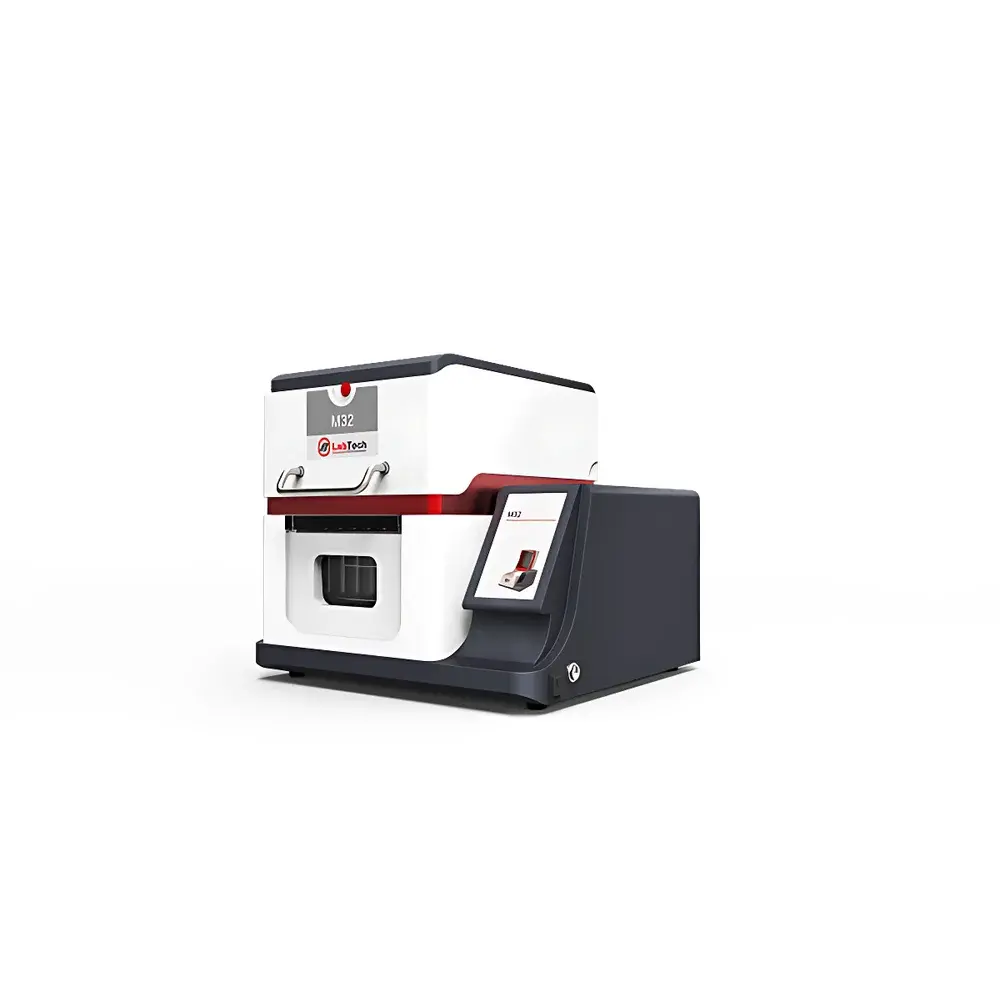
LabTech M32 Automated High-Throughput Parallel Concentrator
| Brand | LabTech |
|---|---|
| Origin | Beijing, China |
| Manufacturer Type | Direct Manufacturer |
| Instrument Type | Automated Quantitative Concentrator |
| Channels | 32 parallel |
| Heating Method | Precision Water Bath |
| Gas Delivery | Motorized Auto-Positioning Nitrogen Needles with Liquid-Level Tracking |
| Control Interface | Color Touchscreen GUI |
| Safety | Interlocked Lid with Auto-Pause/Resume |
| Visibility | Front-Access Illuminated Viewing Window |
| Software Capability | Real-Time Method Editing & Legacy Method Archiving |
| Compliance Framework | Designed for GLP/GMP-aligned workflows (21 CFR Part 11-ready audit trail optional) |
Overview
The LabTech M32 Automated High-Throughput Parallel Concentrator is an engineered solution for quantitative solvent removal in analytical laboratories requiring reproducible, unattended concentration of multiple samples under controlled thermal and gaseous conditions. It operates on the principle of combined conductive heating (via thermostatically regulated water bath) and inert gas displacement (nitrogen), enabling rapid, gentle evaporation of volatile solvents from biological, environmental, pharmaceutical, and food safety samples. Unlike single-channel or semi-automated systems, the M32 delivers true parallel processing across up to 32 independent sample positions—each equipped with a motor-driven nitrogen needle that dynamically tracks liquid meniscus height during evaporation. This active level-sensing mechanism maintains optimal gas-to-surface distance throughout the entire concentration cycle, minimizing nitrogen consumption while maximizing evaporation rate consistency across all channels.
Key Features
- 32-channel parallel architecture with individually addressable nitrogen delivery and thermal control per position
- Motorized auto-descending nitrogen needles synchronized to real-time liquid level detection—eliminates manual repositioning and ensures uniform gas flow dynamics
- Programmable nitrogen pressure regulation independent of active channel count—maintains stable flow profiles regardless of load configuration
- Integrated water bath with precise temperature setpoint control (range and accuracy specified per configuration; consult technical datasheet)
- Interlocked hinged lid with magnetic safety switch: automatic suspension of gas flow and heating upon opening; seamless resumption after closure
- Illuminated front-access viewing window enables continuous visual monitoring without interrupting operation or compromising containment integrity
- 7-inch color touchscreen interface supporting intuitive method creation, real-time parameter adjustment, and full method history logging
- Built-in method versioning: original protocols are preserved upon modification, ensuring traceability and compliance with documentation requirements
Sample Compatibility & Compliance
The M32 accommodates standard 13–18 mm OD test tubes, culture tubes, and vials compatible with common autosampler racks (e.g., 16 × 100 mm, 18 × 150 mm). Its design supports aqueous, organic, and mixed-solvent matrices—including acetonitrile, methanol, ethyl acetate, hexane, and dichloromethane—without cross-contamination risk due to isolated gas pathways and non-contact heating. From a regulatory standpoint, the system’s architecture aligns with Good Laboratory Practice (GLP) and Good Manufacturing Practice (GMP) expectations: electronic logs capture user ID, timestamp, method name, setpoints, and event flags (e.g., lid open/close, error conditions). When paired with LabTech’s optional software package, it supports 21 CFR Part 11-compliant audit trails, electronic signatures, and role-based access control—facilitating FDA, EMA, and ISO/IEC 17025 audits.
Software & Data Management
The embedded operating system provides local method storage (≥100 protocols), multi-user login support, and exportable CSV-formatted run reports containing start/end times, temperature profiles, nitrogen pressure logs, and status events. No external PC is required for routine operation, though optional Ethernet/Wi-Fi connectivity enables remote status monitoring and centralized fleet management via LabTech’s LabManager Suite. All method edits are time-stamped and attributed; previous versions remain accessible for comparison or rollback. Data integrity safeguards include write-protection for archived methods and cyclic redundancy checking (CRC) on stored files.
Applications
The M32 serves critical pre-analytical roles in LC-MS/MS, GC-MS, ICP-MS, and ELISA workflows—particularly where high-volume sample preparation is routine. Typical use cases include: post-extraction cleanup of pesticide residues in fruits and vegetables (per EN 15662); concentration of urinary metabolites prior to steroid profiling; reduction of large-volume environmental water extracts (e.g., EPA Method 525.3); preparation of forensic toxicology specimens; and parallel processing of stability-indicating assay samples in pharmaceutical development. Its ability to maintain consistent endpoint volumes across 32 samples significantly improves inter-batch precision in quantitation workflows.
FAQ
What is the maximum recommended sample volume per tube?
Maximum capacity depends on tube geometry and solvent volatility; typical operational range is 0.5–15 mL per channel. Optimal performance is achieved when initial volume does not exceed 70% of tube height.
Does the M32 support programmable endpoint detection (e.g., optical or weight-based)?
No—endpoint determination is method-defined by time or user-observed volume. The system does not integrate optical sensors or balance feedback loops.
Can nitrogen pressure be individually tuned per channel?
No—pressure is uniformly regulated across all active channels via a single proportional valve; however, flow distribution remains balanced due to calibrated orifice design and closed-loop pressure sensing.
Is validation documentation (IQ/OQ/PQ) available?
Yes—LabTech provides customizable qualification protocols and templates aligned with ASTM E2500 and EU Annex 15 guidelines, including temperature mapping, gas flow verification, and repeatability testing procedures.
What maintenance intervals are recommended?
Water bath fluid should be replaced quarterly; nitrogen filter cartridges require replacement every 6 months under continuous use; needle alignment verification is advised biannually using LabTech’s calibration jig kit.



