
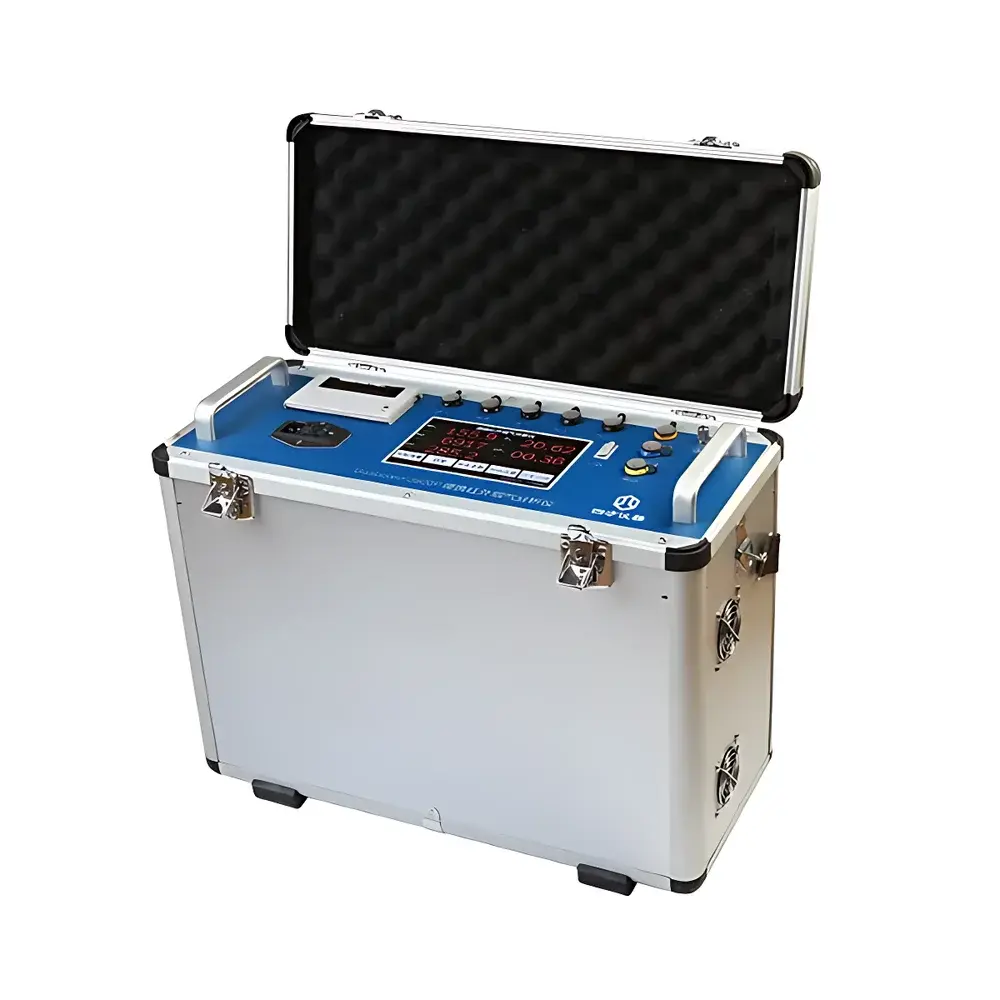
CUBIC INSTRUMENTS Gasboard-3800P Portable NDIR Flue Gas Analyzer
| Brand | CUBIC INSTRUMENTS |
|---|---|
| Origin | Hubei, China |
| Model | Gasboard-3800P |
| Instrument Type | Portable Flue Gas Analyzer |
| Measurement Accuracy | ±2% F.S. (SO₂, NO, CO, CO₂, O₂) |
| Repeatability | ≤2% |
| Response Time | T₉₀ < 15 s (NDIR) |
| Measured Gases | SO₂, NO, CO, CO₂, O₂ |
| Detection Principle | NDIR (SO₂/NO/CO/CO₂), Electrochemical (O₂) |
| Temperature Range | 0–800 °C |
| Flow Velocity Range | 3–40 m/s |
| Sample Flow Rate | 0.7–1.2 L/min |
| Inlet Pressure | 2–50 kPa |
| Power Supply | 100–240 VAC, 150 W |
Overview
The CUBIC INSTRUMENTS Gasboard-3800P is a field-deployable, multi-parameter flue gas analyzer engineered for regulatory-grade emissions monitoring and combustion performance evaluation in stationary sources. It employs dual-sensing architecture: non-dispersive infrared (NDIR) spectroscopy for quantitative detection of SO₂, NO, CO, and CO₂—each with inherent spectral selectivity and immunity to cross-interference—and an electrochemical cell (ECD) for high-stability O₂ measurement. The system integrates thermally controlled sampling hardware—including a 180 °C self-regulating heated probe, corrosion-resistant stainless steel sampling lance (modular length up to 2 m), and an imported aluminum-alloy portable pretreatment unit with integrated condensate removal (via Peltier-cooled condenser and peristaltic pump)—to maintain sample integrity under high-moisture, low-temperature, or particulate-laden conditions typical of industrial stack environments. Designed for compliance with ISO 12039, EN 14792, and EPA Method 6C/7E, the Gasboard-3800P delivers traceable, repeatable volumetric concentration data (ppm or % vol), while simultaneously capturing auxiliary parameters including flue gas temperature (0–800 °C), velocity (3–40 m/s), static pressure, ambient temperature, and barometric pressure—enabling real-time calculation of excess air ratio, combustion efficiency, and mass emission rates (kg/h) per EN 13284-1.
Key Features
- Multi-gas NDIR platform with proprietary optical design ensuring <2% F.S. linearity error across full dynamic range (SO₂/NO: 0–2000 ppm; CO: 0–5000 ppm; CO₂/O₂: 0–25% vol)
- Electrochemical O₂ sensor with >2-year operational lifetime and thermal compensation for stable output across ambient temperature gradients
- Heated sampling train: 180 °C constant-temperature heated probe + 180 °C self-regulating heated transfer line, eliminating condensation-induced bias in wet gas streams
- Integrated pretreatment module featuring Peltier-based cooling (dew point ≤5 °C), dual-stage filtration (stainless mesh + hydrophobic membrane), and auto-drain peristaltic pump
- Onboard data processing engine supporting automatic stoichiometric calculations: excess air coefficient (λ), thermal efficiency (ηth), and normalized emission concentrations at 3% O₂ (dry basis)
- Dual-output connectivity: USB 2.0 host interface for direct PC data logging and embedded thermal dot-matrix printer for on-site report generation (real-time or historical datasets)
Sample Compatibility & Compliance
The Gasboard-3800P is validated for use with flue gases from coal-fired boilers, cement kilns, waste incinerators, and gas turbines—covering gas matrices with up to 20% water vapor, particulate loadings <100 mg/m³, and acid gas concentrations within specified ranges. Its heated sampling configuration meets ISO 16911-1 requirements for representative sampling of moisture-sensitive analytes. All measurement algorithms adhere to EN 15267-3 (QAL1 certification framework), and raw data storage includes full audit trail metadata (timestamp, sensor ID, calibration status, ambient conditions). The device supports GLP-compliant operation through password-protected user roles, electronic signature capability, and immutable event logging—fully compatible with FDA 21 CFR Part 11 when deployed with validated software configuration.
Software & Data Management
Embedded firmware provides intuitive menu navigation via backlit graphical LCD and tactile keypad. All measurements are time-stamped and stored internally (≥10,000 records) with automatic backup to removable USB flash drives. The companion PC software (Gasboard Data Manager v3.x) enables post-processing of emission trends, compliance reporting against EU IED BAT conclusions or China’s GB 13223–2011 limits, and export to CSV, PDF, or XML formats compliant with national environmental monitoring platforms (e.g., China MEP’s EMIS). Audit logs record every calibration event, zero/span verification, sensor fault alert, and parameter modification—supporting traceability during third-party inspections or accreditation audits (CNAS, CMA).
Applications
- Regulatory stack testing for SO₂, NOx, CO, and CO₂ under national emissions standards (e.g., US EPA PS-12, China HJ/T 76–2017)
- Combustion optimization in power plants and industrial furnaces via real-time λ and efficiency feedback
- Performance verification of FGD (flue gas desulfurization) and SCR/SNCR (selective/non-selective catalytic reduction) systems
- Pre-commissioning and periodic maintenance checks of boiler safety interlocks (e.g., CO alarm thresholds in pulverized coal mills)
- Mobile source testing support, including temporary monitoring at construction-site generators or emergency diesel units
- Academic and governmental research on pollutant formation mechanisms and abatement technology validation
FAQ
What gas detection principles does the Gasboard-3800P employ?
It uses NDIR spectroscopy for SO₂, NO, CO, and CO₂, and electrochemical detection for O₂—ensuring orthogonal selectivity and minimal cross-sensitivity.
Is the instrument certified for use in hazardous areas?
No; it is rated for general industrial environments (IP54 enclosure) and requires external explosion-proof housing for Zone 1/2 deployment.
Can the device perform continuous unattended monitoring?
It is designed for periodic grab sampling and short-term surveys—not for 24/7 continuous emission monitoring (CEMS); however, optional AC-powered extended runtime kits enable 8–12 hour field deployments.
How often must the NDIR sensors be calibrated?
Zero and span calibration is recommended before each measurement campaign; annual factory recalibration is advised for metrological traceability.
Does the system support remote data transmission?
Not natively; but USB-exported datasets can be ingested into SCADA or cloud-based EMS platforms via third-party middleware integration.
Related Products







