
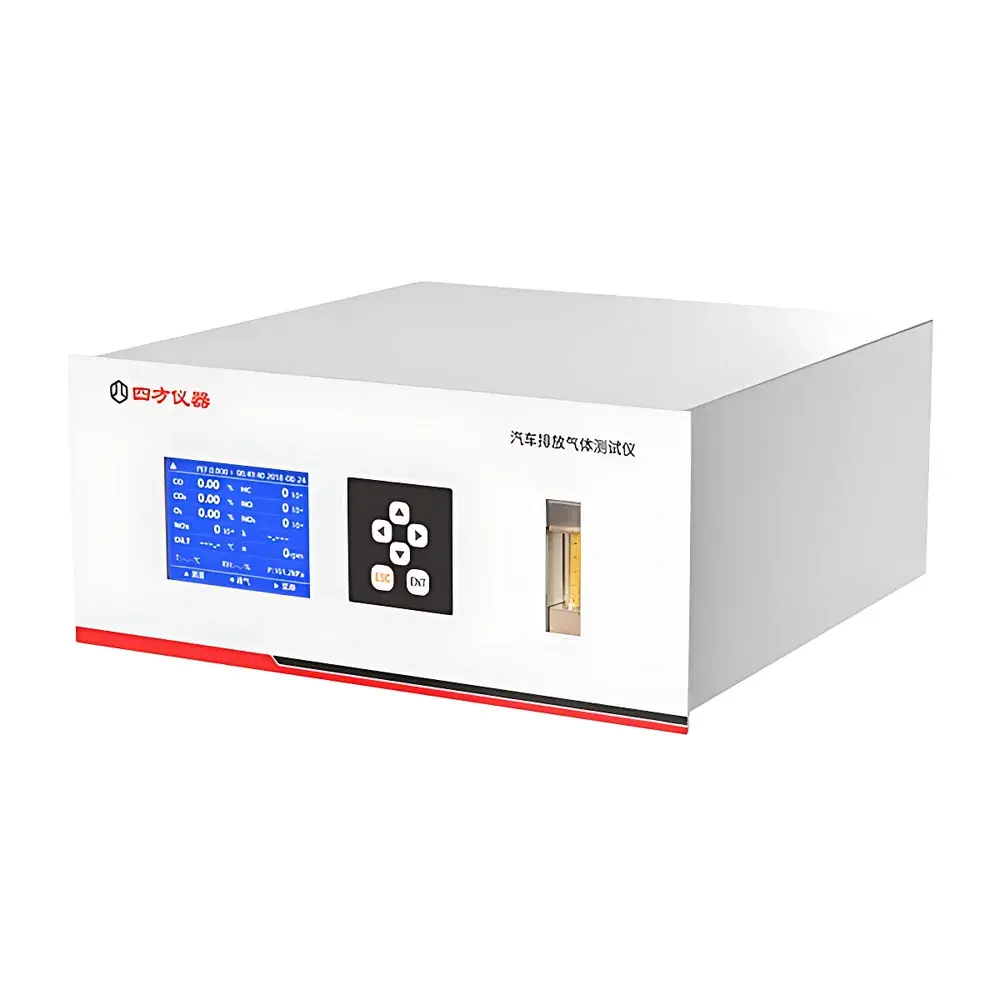
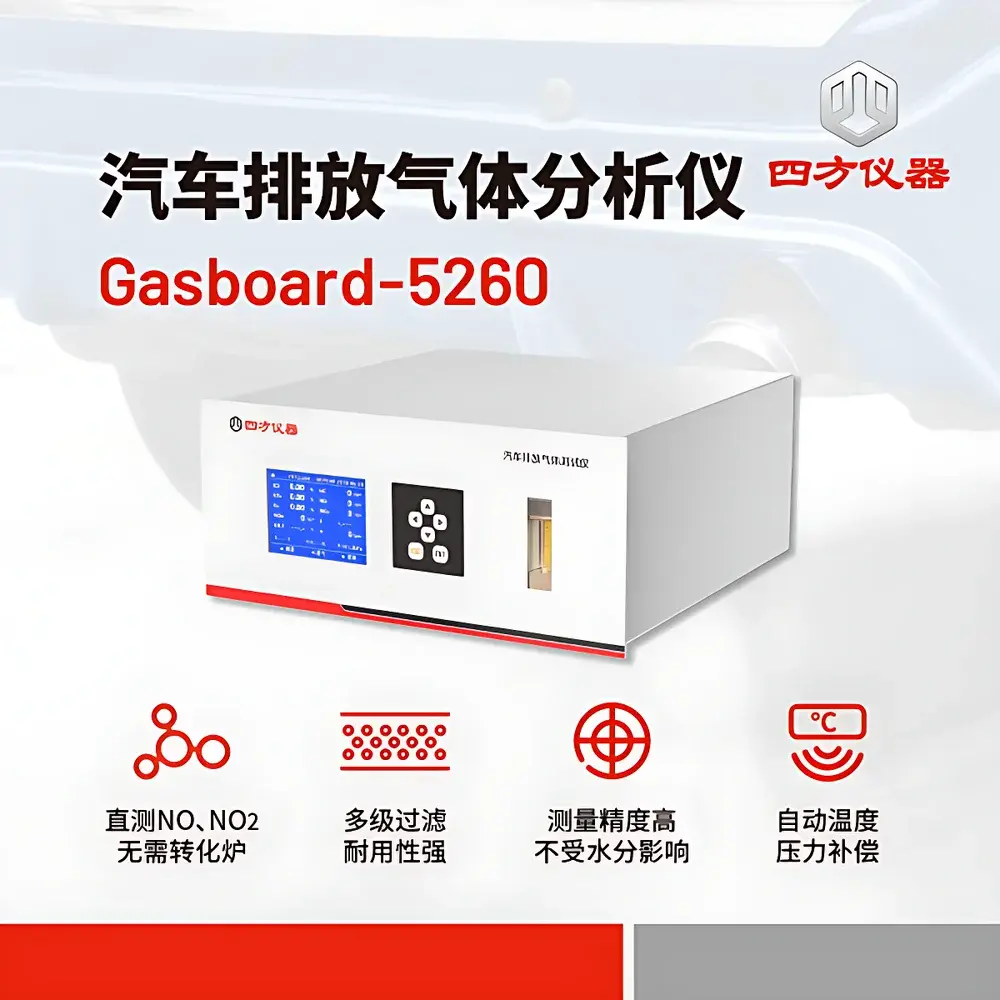
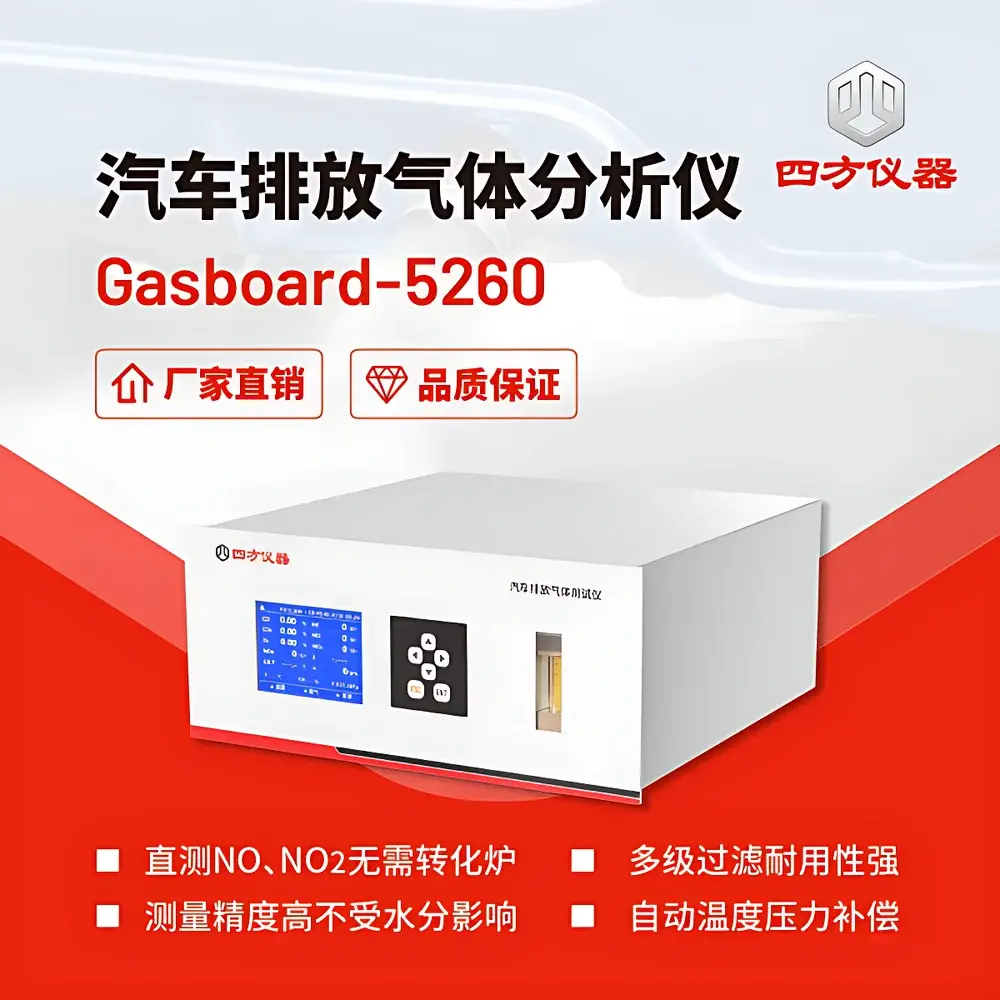
CUBIC INSTRUMENTS Gasboard-5260 Automotive Exhaust Gas Analyzer for Gasoline Vehicles
| Brand | CUBIC INSTRUMENTS |
|---|---|
| Origin | Hubei, China |
| Model | Gasboard-5260 |
| Instrument Type | Online Analyzer |
| Measurement Principles | Microflow Dual-Chamber NDIR (HC, CO, CO₂), Electrochemical (O₂), Microflow Infrared with Dual-Chamber Compensation (NO), Non-Dispersive Ultraviolet (NDUV) Absorption (NO₂) |
| Measured Gases | HC, CO, CO₂, O₂, NO, NO₂ |
| Accuracy | As per GB 18285–2018 & JJG 688–2017 Class 00 |
| Zero Drift | < ±2% FS/8h |
| Span Drift | < ±2% FS/8h |
| Repeatability | ≤ ±1% FS |
| Response Time (T90) | HC/CO/CO₂ ≤ 8 s |
| Warm-up Time | 30 min |
| Power Supply | 100–240 VAC, 150 W |
| Communication Interface | RS-232 / RS-485 |
Overview
The CUBIC INSTRUMENTS Gasboard-5260 is a certified online automotive exhaust gas analyzer engineered specifically for regulatory compliance testing of gasoline-powered vehicles. It implements a multi-physical principle architecture to simultaneously quantify six critical gaseous components—hydrocarbons (HC), carbon monoxide (CO), carbon dioxide (CO₂), oxygen (O₂), nitric oxide (NO), and nitrogen dioxide (NO₂)—in real time under dynamic exhaust conditions. Unlike conventional analyzers relying on catalytic NOx converters, the Gasboard-5260 directly measures NO and NO₂ using independent, interference-resistant optical methods: microflow dual-chamber non-dispersive infrared (NDIR) spectroscopy for NO, and non-dispersive ultraviolet (NDUV) absorption for NO₂. HC, CO, and CO₂ are quantified via high-stability NDIR detection with long-life optical cells, while O₂ concentration is determined by precision electrochemical sensing. All measurements undergo automatic temperature and pressure compensation, ensuring metrological integrity across ambient fluctuations. The system meets the stringent performance requirements of China’s national standard GB 18285–2018 and fulfills JJG 688–2017 Class 00 verification criteria for exhaust gas analyzers—making it suitable for statutory emission inspections, factory line audits, and R&D validation in OEM and Tier-1 environments.
Key Features
- Direct, simultaneous measurement of NO and NO₂ without NOx converter—eliminating conversion inefficiency, thermal drift, and maintenance dependency
- Patented microflow dual-chamber infrared sensor for NO (PCT/CN2018100767), incorporating temperature-compensated optical design and spectral filtering to suppress cross-sensitivity from H2O vapor and CO₂
- NDUV-based NO₂ detection with dedicated 350–450 nm bandpass optics—immune to ozone interference and requiring no chemical scrubbers or thermal conditioning
- Multi-gas NDIR platform with optimized optical path length and thermal stabilization for HC (C1–C5 equivalent), CO, and CO₂—achieving T90 ≤ 8 s and resolution of 1 ppm (NO/NO₂), 0.01% (CO₂)
- Electrochemical O₂ sensor with 0.1% vol accuracy and built-in air calibration routine—enabling precise air-fuel ratio (λ) calculation per ISO 8765
- Multi-stage particulate and moisture filtration (heated sample line optional) to extend system service life and reduce downtime in high-humidity or soot-laden exhaust streams
- Embedded linearization algorithms correcting for nonlinearity, baseline offset, and spectral overlap—validated against NIST-traceable gas standards
- RS-232/RS-485 serial interface compliant with SAE J1939 and MODBUS RTU protocols for seamless integration into inspection line control systems
Sample Compatibility & Compliance
The Gasboard-5260 is validated for use with raw, uncooled, and un-diluted exhaust gas from spark-ignition (SI) engines operating under idle, fast-idle, and steady-state conditions per GB 18285–2018 Annex A. It accommodates exhaust temperatures up to 200 °C at the probe inlet and supports sampling flow rates of 0.8–1.2 L/min. All gas sensors comply with ISO 15057–2 for automotive exhaust analyzers and meet the metrological class requirements of JJG 688–2017 for zero drift (< ±2% FS/8 h), span drift (< ±2% FS/8 h), and repeatability (≤ ±1% FS). The analyzer’s firmware implements audit-ready data logging with timestamped calibration events, operator ID tagging, and tamper-evident memory—supporting GLP-aligned record retention for third-party accreditation (e.g., CNAS, CMA) and regulatory review.
Software & Data Management
The embedded firmware provides real-time display of all six gas concentrations, calculated λ value, and diagnostic flags (e.g., low flow, sensor saturation, filter clogging). Raw analog and digital outputs are timestamped and stored internally (≥ 10,000 records) with configurable export via USB or serial link. Optional PC software (Gasboard Control Suite v3.x) enables remote configuration, trend analysis, statistical process control (SPC) charting, and automated report generation compliant with GB/T 19001–2016 documentation requirements. All calibration and maintenance logs adhere to ALCOA+ principles (Attributable, Legible, Contemporaneous, Original, Accurate, Complete, Consistent, Enduring, Available), supporting FDA 21 CFR Part 11 readiness when deployed in GMP-aligned vehicle certification labs.
Applications
- Statutory emissions testing at MVA-designated inspection stations and environmental protection bureaus
- In-line exhaust diagnostics during engine calibration, durability testing, and OBD-II development
- Aftermarket repair shop verification of three-way catalyst (TWC) efficiency and EGR valve function
- Research applications in combustion optimization, alternative fuel evaluation (e.g., ethanol blends, CNG), and aftertreatment system modeling
- Third-party conformity assessment for type approval under China’s CN10 and CN11 emission regulations
FAQ
Does the Gasboard-5260 require periodic NOx converter replacement?
No. Its dual-optical architecture eliminates the need for catalytic NOx converters entirely.
Is the analyzer compatible with existing inspection line PLCs?
Yes—it supports MODBUS RTU and SAE J1939 over RS-485, enabling direct integration with common industrial controllers.
How is moisture interference mitigated during HC measurement?
The NDIR optical cell employs spectral deconvolution and integrated dew-point monitoring to correct for H2O absorption bands in the 3.3–3.5 µm region.
Can the unit be calibrated using certified reference gases?
Yes—zero and span calibration follows ISO 15057–1 procedures using NIST-traceable gas mixtures (e.g., NO in N2, CO in air) with documented uncertainty budgets.
What is the recommended maintenance interval for the internal filters?
Under typical urban inspection duty cycles, the multi-stage particulate/moisture filter set requires replacement every 6 months or 5,000 tests—whichever occurs first.
Related Products







